You can use a portable power station in cold weather only within that model’s documented conditions. Check discharging, charging and storage separately. A unit that can supply power below freezing may still be unable to accept a recharge there. The relevant temperature can be the battery pack’s temperature, which isn’t necessarily the outside-air reading.
For a winter camping trip, decide where the station will operate, when it can recharge and what you’ll do if either becomes unavailable. The seven checks below turn those questions into a record you can keep with the manuals. They don’t assume that every lithium battery has the same limits or that a temperature warning will always clear after a fixed wait.
1. Portable power station in cold weather: temperature limits
Find the current manual for the model and generation printed on the station. Record separate temperature limits for discharging, charging and storage, plus placement and moisture restrictions. If an extra battery or charger is part of the setup, check its requirements too. One component’s range doesn’t establish permission for the complete system.
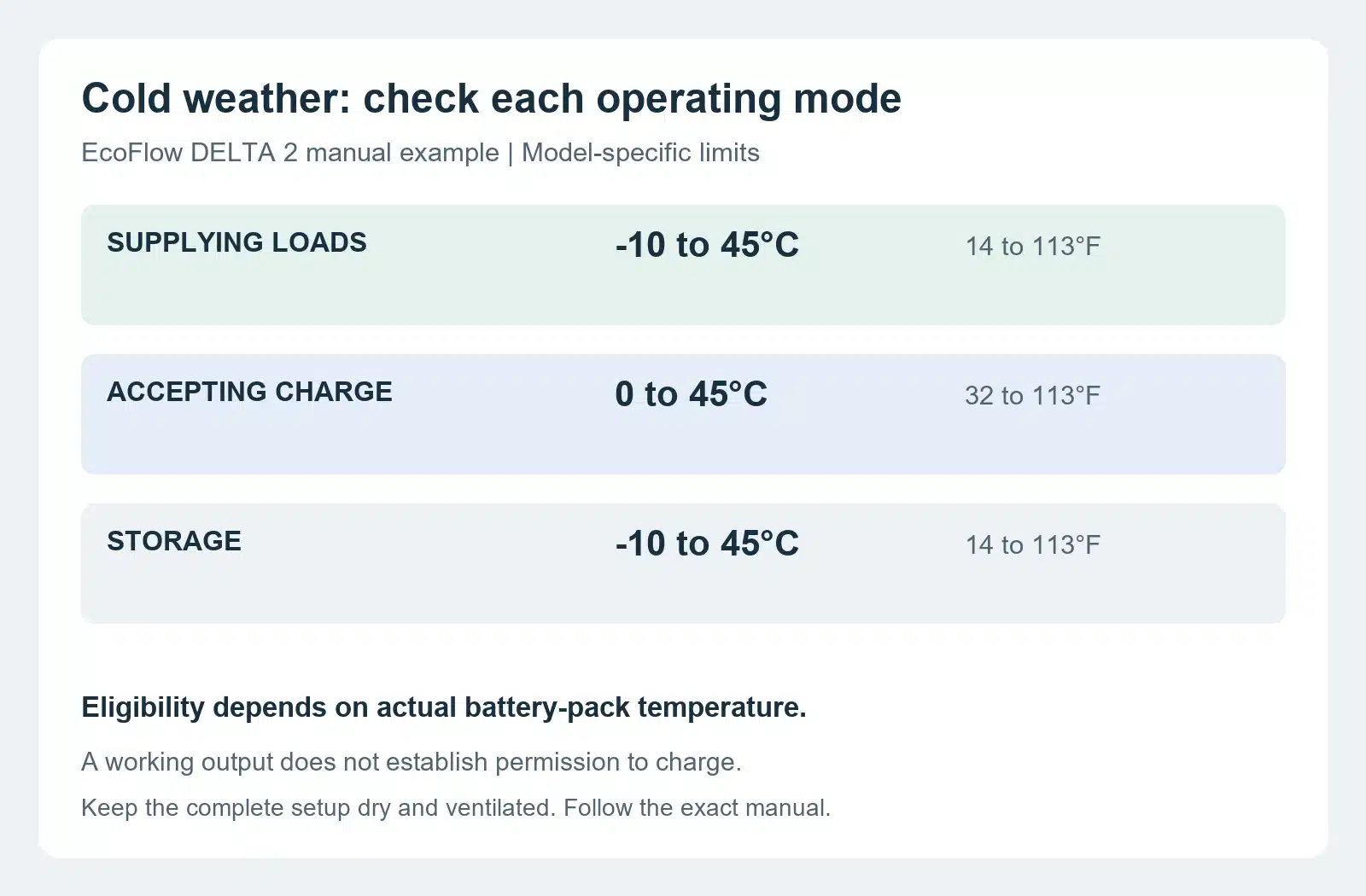
The EcoFlow DELTA 2 user manual gives this concrete example:
| DELTA 2 mode | Documented temperature range | What the entry establishes |
|---|---|---|
| Discharging | −10°C to 45°C / 14°F to 113°F | The specified window for supplying loads |
| Charging | 0°C to 45°C / 32°F to 113°F | A different window for accepting charge |
| Storage | −10°C to 45°C / 14°F to 113°F | Storage conditions, with separate care instructions |
The manual also says that charging and discharging depend on the actual battery-pack temperature. These limits apply to DELTA 2. They aren’t a shortcut for another EcoFlow model, a Jackery or an Anker, even if both products use LFP cells.
When planning a portable power station in cold weather, copy the source and model next to each number. If the manual gives an ambiguous “operating temperature,” ask support which modes it covers before depending on it. Battery chemistry, advertised capacity and a rugged-looking case cannot supply the missing answer.
2. Check battery temperature after an overnight cold soak
A station left in a vehicle overnight may be colder than the sheltered place where you put it in the morning. Conversely, its battery may remain warmer than the air for a while after leaving indoors. An outdoor forecast is useful for planning, but it cannot certify the battery’s present charging condition.
Use the temperature information and warning interpretation that the product actually provides. Don’t open the enclosure to place a probe on the cells. Keep the time, previous location and displayed warning with your observations. If the product doesn’t show a usable pack-temperature reading, follow its manual or support procedure instead of inferring one from a surface thermometer.
For a portable power station in cold weather, the mode distinction can change your morning plan. Consider a hypothetical DELTA 2 pack at −5°C. That temperature falls inside its stated discharge window and outside its charge window. The comparison illustrates why the modes differ; it doesn’t guarantee output under a particular load or authorize charging because the unit still turns on.
For a portable power station in cold weather, check the connected devices too. A laptop, display, fridge controller or charger can have its own environmental limits. The station’s eligibility doesn’t establish the appliance’s eligibility.
3. Charging a portable power station in cold weather
If the battery is outside the permitted charging window or the unit reports a low-temperature restriction, stop the unsupported charging attempt. A different source doesn’t make the cold battery eligible: AC, vehicle and solar inputs must still follow the station’s charging conditions.
Move the equipment to a suitable dry environment within its requirements and follow the manufacturer’s recovery instructions. Allow its temperature to equalize without putting it against a heater, fire, hot-air outlet or heating pad. DELTA 2’s safety instructions prohibit use near heat sources and require keeping its fan unblocked.
There is no universal 30-minute or one-hour wait that proves a cold-soaked battery is ready. Its starting condition, size and surroundings differ. Moisture is another concern when cold equipment enters a warm space. Don’t restart wet equipment merely because the casing feels warmer; follow the model’s guidance and contact support if moisture may have entered.
Choose a portable power station in cold weather with documented features you can use. Low-temperature charging protection and automatic battery heating are different features. Don’t assume a station heats itself because it has a temperature-warning icon. If heating is supported, check how it activates, which power source it requires and how its energy demand affects your plan.
4. Plan dry placement without blocking cooling
A winter shelter must satisfy both environmental and ventilation requirements. Snow, meltwater and damp connectors remain problems even when the air is below freezing. Keep the station and connections in a location permitted by their own ratings, away from water and where cables won’t create a trip hazard.
The DELTA 2 manual requires dry, ventilated storage, prohibits rain or humid use and says not to block the fan during operation. Wrapping an operating station in blankets or sealing it inside a plastic bag can conflict with those requirements. Use only a supported operating cover or enclosure, with its required clearance and access.
For a portable power station in cold weather, an insulated transport bag isn’t automatically an operating enclosure. Check whether accessories are approved while charging or supplying loads, and whether the ports and air paths remain accessible. The portable power station rain-protection guide covers the separate shelter and component-rating questions.
Secure the equipment during travel using the station and vehicle instructions. A parked car doesn’t maintain a guaranteed temperature all day or night. If its conditions can’t remain suitable, plan another location before the trip rather than relying on the protection circuit to manage every excursion.
5. Recharging a portable power station in cold weather
Record when a supported charging source will be available and when the battery can actually accept it. A drive that ends before the pack reaches permitted conditions may replace less energy than expected. Check the complete vehicle connection and outlet behavior using the SUV driving-charge guide.
Solar requires two separate checks: the battery’s charging eligibility and the array’s electrical compatibility. Cold panel conditions can affect open-circuit voltage, while available daylight, shade and snow affect the charging opportunity. Our solar panels in series vs parallel guide explains the array-rating check before choosing a configuration.
Don’t assume that a sunny but freezing morning will recharge a portable power station in cold weather. Record the displayed input, battery state, conditions and any warning. A panel’s rated watts don’t establish net stored watt-hours during that window.
For arithmetic only, replacing 300Wh at a sustained net 100W requires three hours. At a net 50W it requires six hours. These are assumed inputs, not a winter test or a forecast for a named station. Tapering, loads used during charging and periods with no accepted input can lengthen the opportunity needed.
6. Budget winter loads and a practical fallback
Start with the devices you intend to run and their supported connections. Measure or document the energy they need over the relevant period. Avoid applying a universal “30% winter capacity loss” to every station: the result depends on equipment, temperature, output path, load and battery condition.
Heating can dominate a small battery budget. A hypothetical 1,000W resistive heater used for one hour consumes 1,000Wh at the appliance, before power-path losses or reserve. A high inverter watt rating doesn’t mean the battery can sustain that load throughout the night.
A diesel heater has separate electrical startup, running and shutdown stages, as well as fuel and installation requirements. Use the diesel-heater power guide for that equipment-specific task. This winter checklist doesn’t establish a safe heater installation or sleeping arrangement.
Plan a portable power station in cold weather around the next dependable recharge, including a missed charging window. Identify recreational loads you can reduce and the point when the trip plan needs to change. For the lighting part of that budget, use the camping lights connection and energy worksheet. Carry lighting and communication alternatives with their own temperature requirements. A battery station should not be the only basis for keeping people warm in severe conditions.
7. Record the portable power station in cold weather plan
Keep this worksheet with the exact manuals and approved cables. An unknown entry is a reason to resolve the plan before relying on it.
| Planning question | Record before departure |
|---|---|
| Which station, extra battery and charger? | Exact models, manual source and supported arrangement |
| Can it discharge, charge and be stored here? | Three limits, how temperature is assessed and placement rules |
| Where will it stay overnight? | Dry location within limits; ventilation and cable access |
| How will charging become available? | Supported source, eligible battery conditions and charging window |
| What energy is needed until then? | Device-specific demand, output compatibility and reserve |
| What if input or output remains unavailable? | Alternate equipment, reduced loads or revised trip plan |
| What needs manufacturer support? | Warning, model, prior exposure, source and load details |
After the trip, compare observations with your planned windows. Record missed charging time or output loss without relabeling it as measured permanent degradation. A warning that persists under documented conditions needs model-specific support rather than a borrowed reset or forced discharge.
The useful result is a permitted operating plan for your portable power station in cold weather, with a fallback you can carry out. The portable power station guide collection connects this winter check with capacity selection, runtime and the relevant troubleshooting owners.