Choose a power station for camping lights by matching the lights’ electrical inputs and the energy they need over your evening schedule. Check USB, 12V DC or AC compatibility before comparing battery sizes. Small LED loads may need relatively little energy, but an output’s automatic shutoff can still interrupt them.
If lighting is your only electrical task, compare a station with rechargeable lanterns or a compatible power bank too. A large inverter rating doesn’t make one option more useful for a few small lights. The seven checks below help you choose a complete connection, budget brightness-hours and keep an independent light available.
1. Power station for camping lights: list the lighting tasks
List separate lighting tasks: preparing dinner, lighting the table, moving around the campsite and reading inside a tent. Give each one a lamp, brightness setting and intended hours. One bright floodlight pointed across camp and a low lamp beside your book solve different tasks.
Lumens describe light output; watts describe electrical power. A lamp’s advertised maximum lumens don’t establish the power used at every setting. Check whether the manufacturer gives wattage for each brightness level. If it doesn’t, measure the supported connection under your intended setting rather than treating the brightest rating as a measured average.
Plan a power station for camping lights around the actual schedule. Lights that are off while you’re sleeping don’t need an all-night runtime allocation. If you need a marker light or path light later, give it its own low-setting row instead of extending every lamp’s hours.
Keep a headlamp or independent lantern for finding the main power controls and moving away from the station. A built-in station light can be useful near the unit, but it doesn’t automatically illuminate a table or tent some distance away.
2. Match the power station for camping lights to its inputs
Read each lamp’s input label and instructions. Distinguish a continuously powered lamp from a rechargeable lantern that operates on its own battery. The connection and energy boundary differ.
| Lighting arrangement | Check before connecting |
|---|---|
| USB-powered light | Required voltage, connector, cable and any shared port limit |
| Rechargeable USB lantern | Supported charger/input and energy needed for the planned top-up |
| 12V DC lamp | Permitted voltage/current, polarity and the documented adapter |
| AC light or its original power supply | Regional voltage/frequency, output limits and cord/environment requirements |
A USB-C socket doesn’t supply every DC voltage by itself, and a physically matching barrel connector doesn’t establish polarity or compatibility. Use the lamp and station makers’ supported cables and adapters. Don’t improvise a USB-to-12V lead or modify pins to make an unsupported lamp work.
When several lights share one output, check the combined demand and the permitted connection arrangement. A chainable lamp has its own maximum chain count. Don’t assume a splitter makes that limit disappear.
3. Use brightness-specific figures from a named lamp
The Goal Zero Light-A-Life 350 product specifications provide a concrete example. The page lists a 12V, 6mm barrel input, 0.4A and 4.5W maximum. It gives 4.5W/350 lumens at high brightness and 1W/100 lumens at low brightness, with up to eight lights chainable.
Goal Zero describes powering this lamp from a Yeti station or a 12V car port using the included adapter. That statement doesn’t approve every third-party station’s barrel output. Check the complete connection for the equipment you actually own.
When choosing a power station for camping lights, use the brightness ratings to plan when each setting will run. Lower brightness may fit reading or a table after dinner, while the high setting may be useful for a shorter task. Decide whether the actual illumination suits the job before selecting hours.
The input-current and wattage labels are manufacturer ratings, with their own stated precision. The example below uses the published brightness wattages. It does not derive a new measured power figure from a rounded current label, copy the manufacturer’s runtime table or report a test by Wild Smart Gear.
4. Power station for camping lights: calculate evening energy
For a steady assumed power setting, energy in Wh equals power in W multiplied by hours. Add the rows for every lamp and brightness period. Count a setting change as a separate period so the same hours aren’t counted twice.
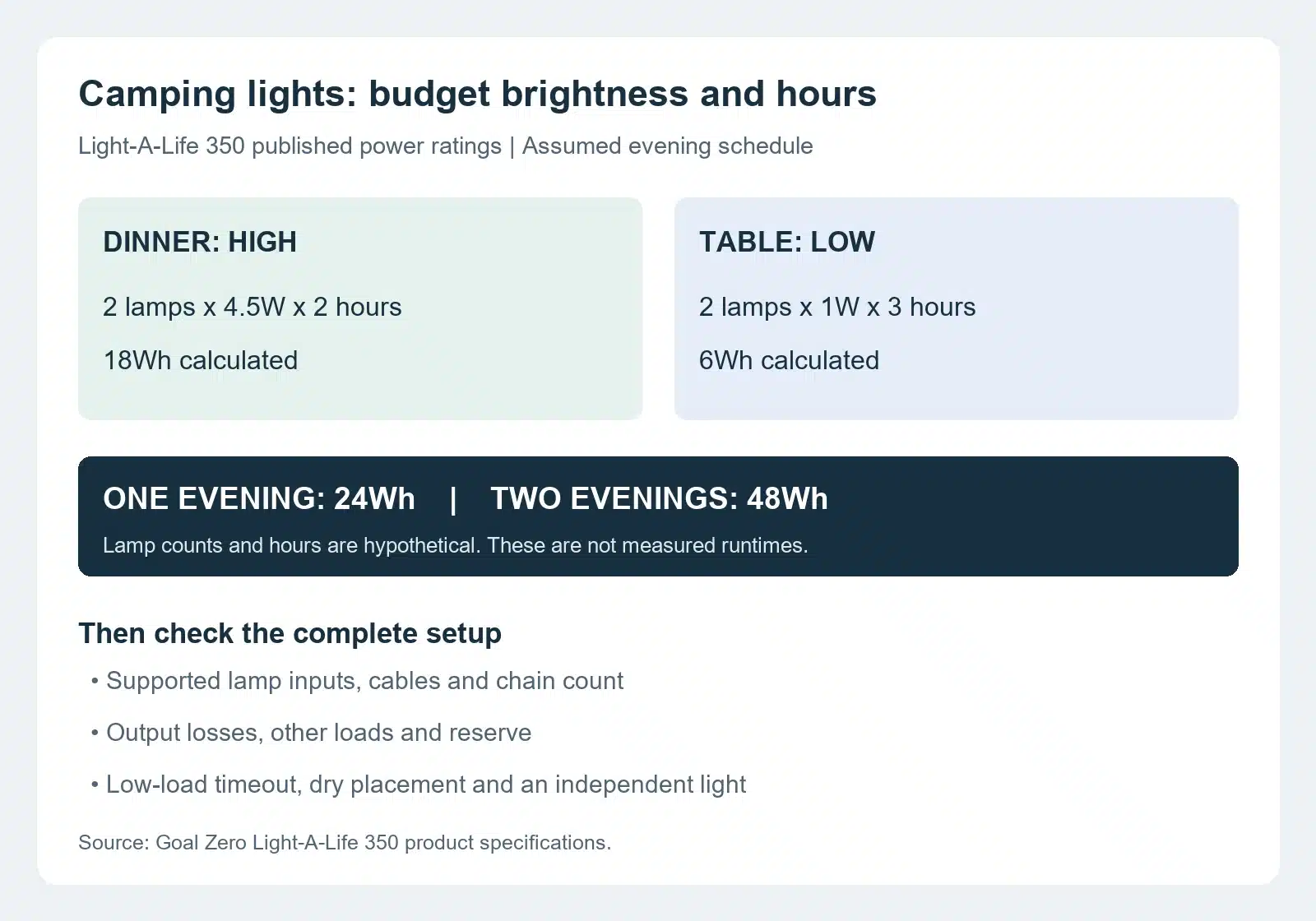
Here is a hypothetical schedule using two Light-A-Life 350 lamps and their published brightness wattages:
| Period | Lamp count | Power per lamp | Hours | Calculated energy |
|---|---|---|---|---|
| Dinner preparation at high brightness | 2 | 4.5W | 2 | 18Wh |
| Table lighting at low brightness | 2 | 1W | 3 | 6Wh |
| One evening total | 5 | 24Wh | ||
| Two identical evenings | 48Wh |
The calculation is 2 × 4.5 × 2 = 18Wh, then 2 × 1 × 3 = 6Wh. These are assumed lamp counts and durations using rating-based power inputs. They are not observed camping consumption or guaranteed stored energy requirements.
Add recharge energy for independent lanterns separately. If a hypothetical USB meter recorded 8Wh entering a lantern during a top-up, two identical top-ups would add 16Wh at that USB measurement boundary. Don’t also add the lantern’s full battery label unless you’re budgeting a different event; that would count the same replenishment twice.
Keep the boundary clear when sizing a power station for camping lights. Energy at the lamp or USB input and nominal station batteryWh aren’t the same measurement. Actual output losses and operating overhead need their own evidence or an explicitly assumed allowance.
5. Check delivered energy and small-load output behavior
If you have a representative delivered-energy measurement for the same output and lighting arrangement, compare that with the schedule and reserve directly. If you only have nominal capacity, show the usable-energy assumption instead of presenting it as a measured efficiency.
For illustration, 48Wh of lighting demand divided by an assumed 0.80 delivered fraction and another 0.80 allowance for retaining a 20% reserve gives 75Wh nominal: 48 ÷ (0.80 × 0.80). Neither fraction is a verified property of a named station. Other loads and a missed recharge change the budget.
AC overhead can matter beside a very small lamp load. If an arrangement hypothetically added 5W of inverter overhead for five hours, that would add 25Wh before other losses. This is a calculation input, not a claim that your station draws 5W while idle. The AC and DC power-path guide explains how to compare consistent measurement boundaries.
Check the output’s low-load or timeout settings in the exact manual. The DELTA 2 user manual describes an AC timeout after an idle period. Its documented setting and output behavior should not be transferred to another model or to every USB/DC port.
Before relying on a power station for camping lights, run the intended supported setup through a representative evening, including dimmed periods. If it starts normally and later turns off, use the low-load shutdown guide to identify the output and timing. Don’t add a wasteful artificial load merely to defeat an unsupported shutdown behavior.
6. Plan placement, weather and recharge
Keep the station and each connection within their environmental requirements. A light marketed for outdoor camping does not establish that the station, its AC supply or every cable join can be exposed to rain. Position the supply in a permitted dry, ventilated place and route cables clear of walking paths.
Hang or place lamps using their instructions without making electrical cables carry unsupported mechanical loads. Preserve access to the switches. Don’t string a cable through a closing vehicle door, across a stove or where a connector will sit in water.
A power station for camping lights also needs a recharge opportunity that fits the trip. Count daytime access to a supported source and the energy needed before the next evening. The 12V outlet in a parked vehicle may switch off or use the starting battery; its behavior belongs to the vehicle manual.
For winter camping, use the cold-weather power-station checklist before planning a recharge. An output that works in cold conditions doesn’t establish permission to charge there. The lights and any independent batteries also need suitable temperature conditions.
7. Record the power station for camping lights plan
Keep the lighting schedule and connection details together. This worksheet makes it easier to compare a compact station, a supported power bank and independently rechargeable lanterns without assuming every option powers the same lamps.
| Decision | Your record |
|---|---|
| Lighting tasks | Which area, lamp and brightness setting |
| Connections | Input requirement and supported cable/adapter |
| Lighting energy | Lamp count×settingW×hours, or representative measuredWh |
| Lantern top-ups | Separate recharge events and measurement boundary |
| Battery allowance | Delivered-energy basis, other loads and reserve |
| Small-load behavior | Output, supported timeout setting and evening check |
| Placement and backup | Dry supply location, cable route and independent light |
Choose the smallest practical arrangement that meets the actual connection, energy and use requirements. If the power station for camping lights will also supply a movie, use the projector movie-session power worksheet to check that separate connection and energy budget. If you’re also adding a fridge, fan or computer, put those loads into the complete car camping power setup rather than calling their energy part of the lighting budget.
A suitable power station for camping lights gives you the intended illumination through the planned evening and a usable backup when the main connection is unavailable. The portable power station guide collection links the separate capacity, device and charging decisions for the rest of your setup.