Measure 12V fridge power consumption by recording the energy used over a representative 24 hours. With a supported cumulative-energy meter, subtract the starting Wh reading from the ending reading. Keep the fridge setting, power connection and operating conditions with that result. A momentary watt reading cannot capture a compressor that cycles through the day.
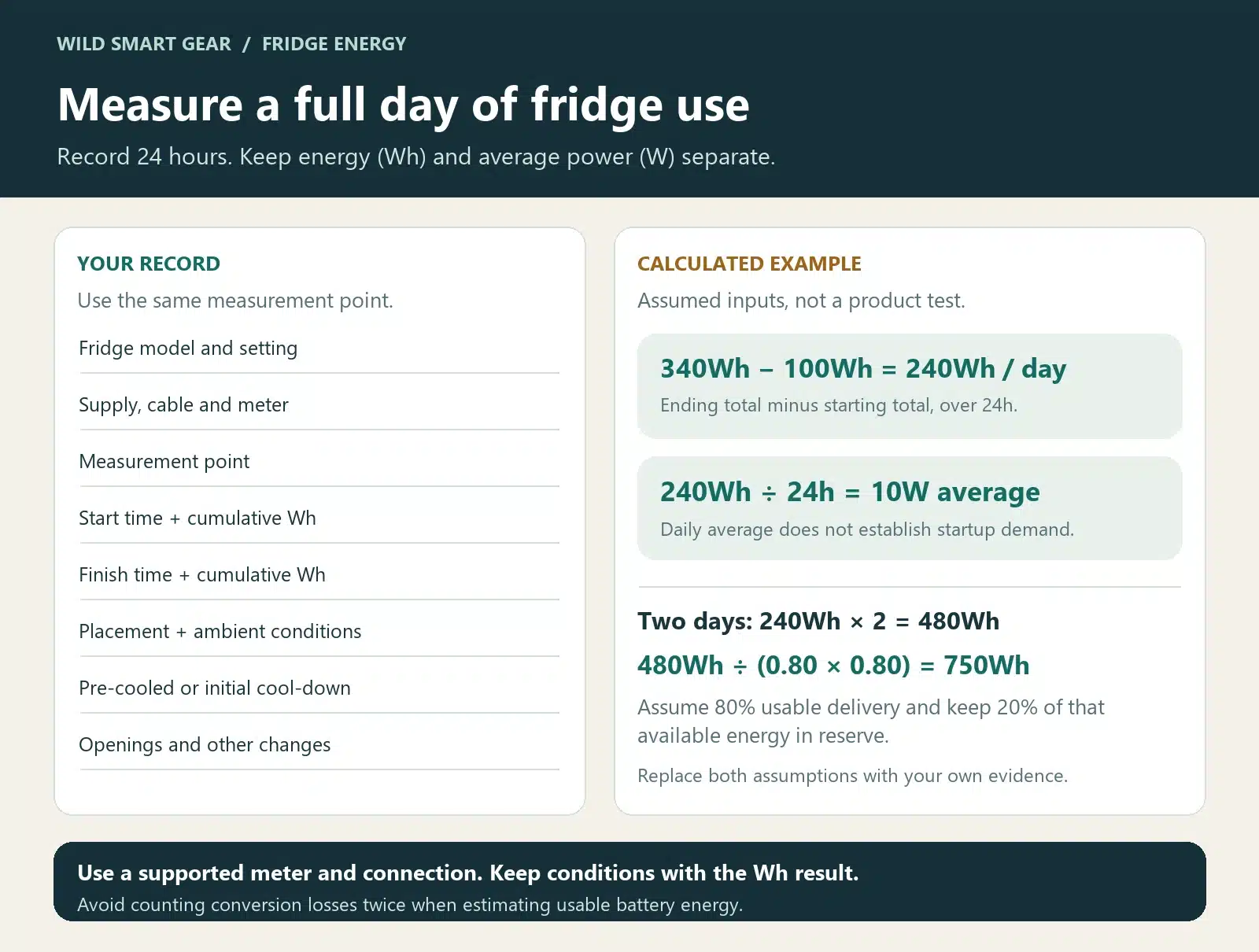
For example, an assumed meter reading rising from 100Wh to 340Wh in 24 hours means 240Wh used at that measurement point, averaging 10W across the day. Those numbers illustrate the calculation; they are not a Wild Smart Gear fridge test or a consumption claim for your model.
1. Separate running watts from daily energy
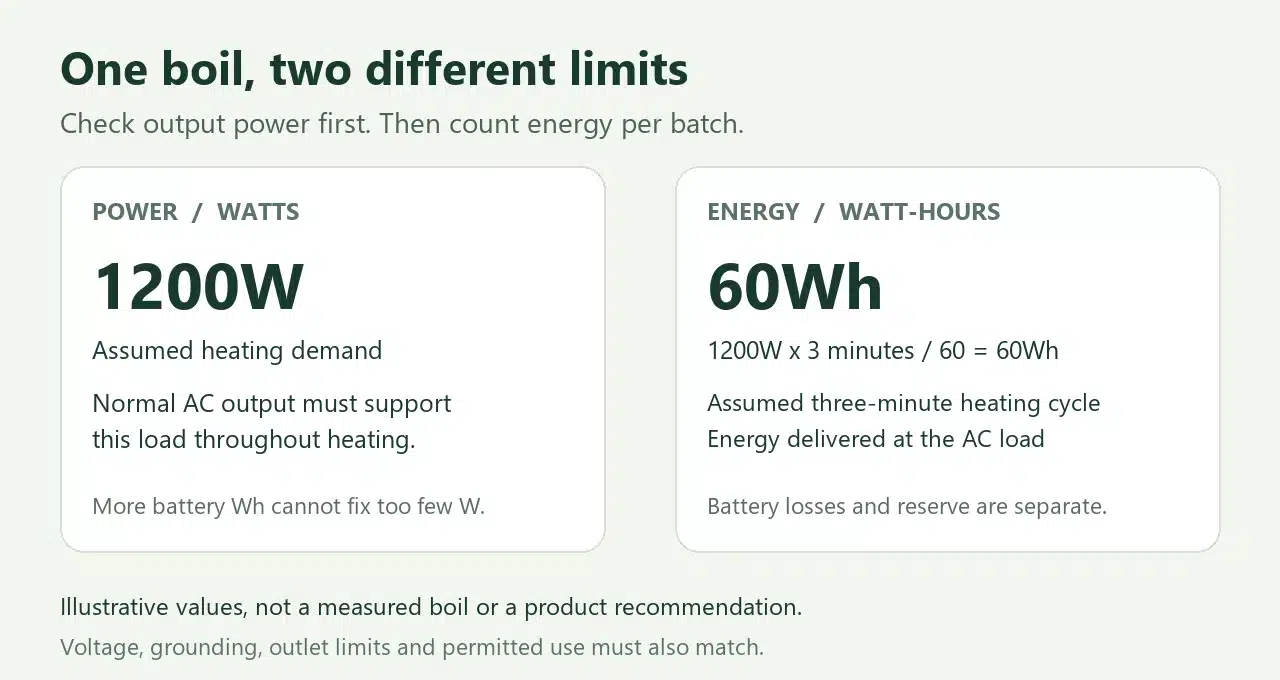
Watts describe power at a moment. Watt-hours describe accumulated energy. Amps describe current; amp-hours accumulate current over time. When comparing a fridge label with a battery budget, identify which quantity the manufacturer actually provides.
An input-current rating helps check the supply and connection. A documented energy figure over a stated period can help estimate demand under those stated conditions. They answer different questions.
Engel’s MT45 product specifications identify model MT45F-U1-P and list variable 12V DC draw from 0.54 to 2.35A. That specification does not establish how long the compressor runs, so multiplying either endpoint by 24 hours would not give a measured daily result.
Do not use a single universal figure for 12V fridge power consumption. Size, temperature setting, ambient conditions, contents, lid openings and ventilation can change demand. National Luna’s explanation of compressor cycling shows why a full-day energy record is more useful than a snapshot. Its example concerns its own described test arrangement; those results do not establish your fridge’s consumption.
2. Choose a supported meter and measurement point
Write down where the meter sits before recording 12V fridge power consumption. A reading at the fridge’s DC input covers a different energy path from a reading at an AC outlet powering the fridge’s adapter.
| Measurement | What the reading covers | What it leaves out |
|---|---|---|
| Inline DC meter before the fridge | Energy crossing that DC connection | Losses upstream of the meter |
| Plug-in AC meter before the fridge adapter | AC energy entering the adapter and fridge arrangement | Power-station losses before its AC outlet |
| Power-station battery percentage change | An indication of change in the station’s reported charge | A precise delivered-energy measurement |
Use a meter rated for the actual voltage, current, connectors and environment. Its cumulative Wh function must capture changing loads; a display showing only instantaneous W cannot supply the full-day total by itself. Follow the meter, fridge and supply instructions. If a supported arrangement is unavailable, retain a manufacturer-based estimate and label it as such.
To isolate 12V fridge power consumption, keep other equipment outside the measured branch. A meter recording the fridge plus a light gives their combined demand. It cannot separate the fridge’s share afterwards without another valid measurement.
An AC-outlet reading already includes the downstream adapter’s losses. Battery sizing may still need to account for losses inside the station, but applying another adapter-efficiency deduction would count the same loss twice. Always keep the measurement point with the number.
3. Reproduce the trip conditions within the manuals’ limits
Decide whether you want normal operation after pre-cooling or the energy needed to cool a warm fridge and contents initially. Record that choice. If your trip includes both, keep a separate initial cool-down record and a normal-day record rather than silently treating them as identical.
Use the setting and contents that represent the planned use. Do not change the treatment of temperature-sensitive contents to reduce the number. Follow the applicable storage guidance and the fridge’s instructions.
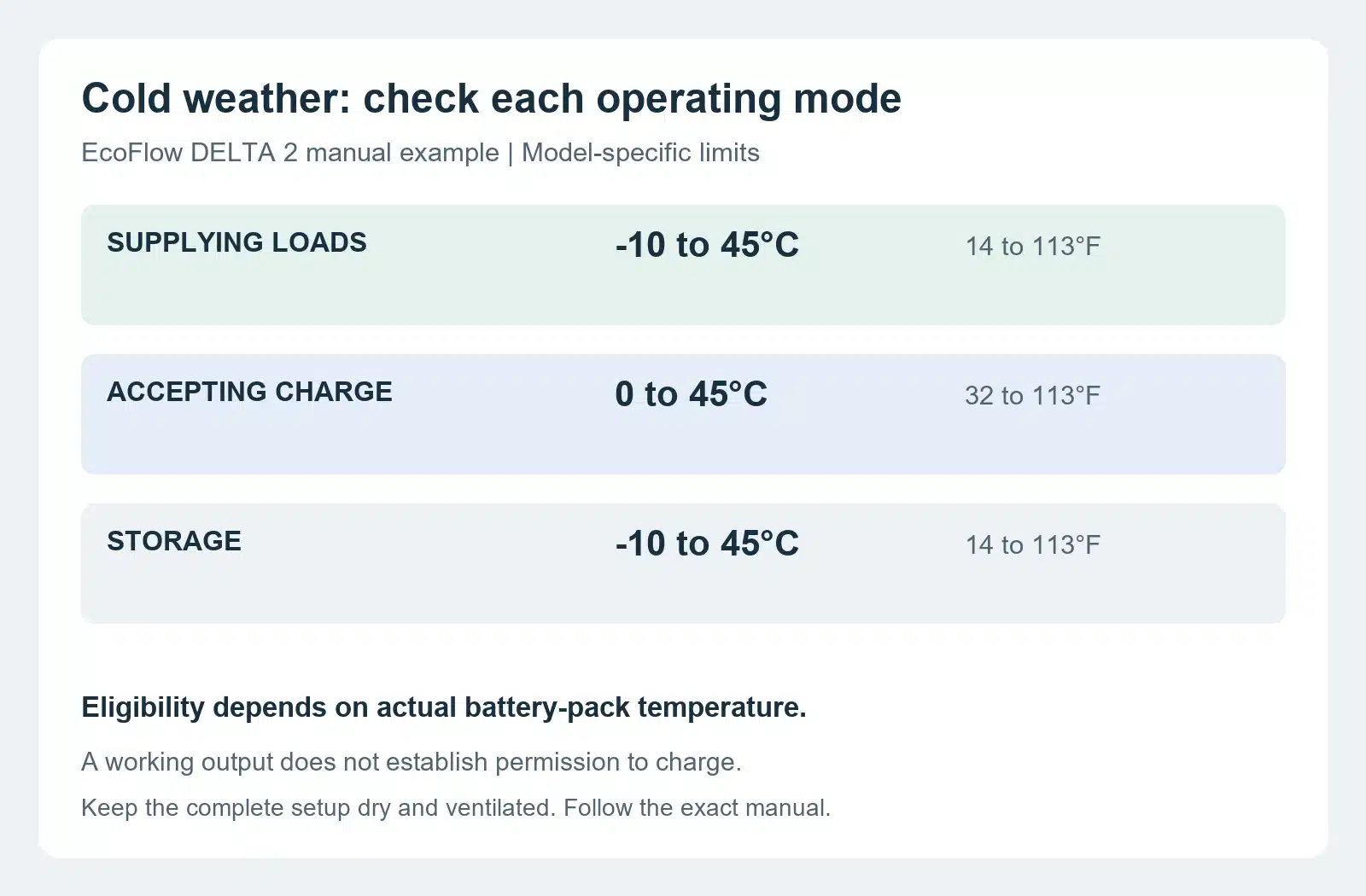
Placement matters when measuring 12V fridge power consumption. Record shade or direct sun, ventilation, ambient conditions and any moves during the day. Avoid testing outside the equipment’s permitted environment.
The separate Engel MT35F-U1D-P / MT45F-U1D-P owner’s guide tells owners of those models to avoid direct sunlight and heat sources and keep at least 6 inches from solid walls for ventilation. Use your exact model’s requirement. That distance is not a universal clearance for camping fridges or power stations.
4. Record 12V fridge power consumption over 24 hours
Record the starting cumulative Wh, then the finishing total using the same meter and connection. Choose a start time that lets you cover the following day and night. Reset the meter only as its instructions permit, or leave its accumulated total intact and subtract the starting reading.
| Field | Your record |
|---|---|
| Exact fridge model and temperature setting | |
| Supply, cable and supported meter | |
| Measurement point and other loads included | |
| Start time and cumulative Wh | |
| Finish time and cumulative Wh | |
| Placement, ambient conditions and ventilation | |
| Pre-cooled or initial cool-down; contents | |
| Lid openings, moves, interruptions and other changes |
Check that cooling continued throughout the observation. Note any warning, unplugged connection, exhausted supply or output shutdown. A low total after several hours without cooling is not evidence of an efficient fridge.
Intermediate readings can help locate when demand changed, provided the meter keeps the complete total. Keep them with their times instead of averaging a handful of display readings and calling that a measured day.
5. Calculate 12V fridge power consumption in Wh per day
Subtract the beginning cumulative energy from the final total:
Energy used = final Wh − starting Wh.
For the assumed 24-hour example, 340Wh − 100Wh = 240Wh. The daily average power is 240Wh ÷ 24h = 10W. The 10W figure includes the cycling over that day; it does not establish instantaneous running current or starting demand. Check those electrical requirements separately.
If a meter reports kWh, multiply by 1,000 to express the difference in Wh. An assumed difference of 0.240kWh is 240Wh. Preserve the meter’s useful precision instead of adding unsupported decimal places.
For a shorter interval, dividing Wh by hours gives that interval’s average power. Multiplying by 24 produces an extrapolation, not a measured full-day total. An overnight record can miss warm daytime conditions and initial cool-down. Keep it labeled with its actual duration.
6. Validate your 12V fridge power consumption record
Before taking one day’s 12V fridge power consumption into a trip budget, check what happened during the record.
| Observation | How to use the result |
|---|---|
| Complete 24 hours, normal cooling, representative conditions | Use as an observed input for those conditions |
| Meter reset or lost its total midway | Treat the cumulative record as incomplete; repeat |
| Cooling stopped because an output turned off | Resolve the interruption and repeat a normal-operation record |
| Another appliance shared the measured connection | Label combined demand or isolate the fridge for a new record |
| Mild indoor day; next trip will be substantially warmer | Keep the observation, but obtain a more relevant record or retain explicit uncertainty |
| Different setting or contents on a second day | Record the change before comparing totals |
Compare repeated days with their conditions attached. A lower reading after moving into shade may be useful, but changing the setting and contents at the same time prevents you from attributing the difference to shade alone. Averages across several recorded days also need those conditions; they cannot guarantee the next trip’s weather.
7. Carry the measured input into the right decision
Keep the final record together: model, connection, boundary, duration, Wh, conditions and interruptions. That is the usable output of a 12V fridge power consumption check.
In the assumed 240Wh-per-day example, two similar days require 480Wh at the recorded measurement point. The station must also support the fridge’s voltage, current, connector and output behavior. Capacity alone cannot establish compatibility.
Use that daily figure in the 12V fridge runtime calculation, replacing example consumption with your own relevant evidence. For the diagram’s capacity illustration, 480Wh ÷ (0.80 × 0.80) = 750Wh assumes 80% of nominal energy reaches the load and 20% of that available energy remains in reserve. Neither percentage is a product measurement or a universal allowance.
Once you have recorded 12V fridge power consumption, add phones, lights and other equipment through the SUV camping capacity budget. When choosing equipment, follow the power-station checklist for a 12V fridge. If you have narrowed the purchase to Anker, use your measured 12V fridge power consumption in the current Anker Gen 2 fridge comparison. The complete car camping power setup guide connects those decisions with storage, placement and recharge planning.