A lithium-battery power station over 160Wh cannot travel in ordinary US passenger baggage under FAA guidance. For a smaller power station on a plane, check the battery’s rated watt-hours, the airline’s classification of the product and its current restrictions before packing. A 100Wh battery allowance does not guarantee acceptance of every device, and some airlines prohibit power banks above 100Wh even when larger spare batteries have a separate approval route.
If the unit is damaged, swollen, overheating or subject to a battery recall, resolve that with the manufacturer and airline before travel. FAA guidance prohibits damaged or recalled batteries likely to generate dangerous heat.
The rules here concern US passenger baggage. Your operating airline and the countries on your itinerary may impose tighter limits. Check every flight segment, including the return journey.
1. Check the Wh rating before taking a power station on a plane
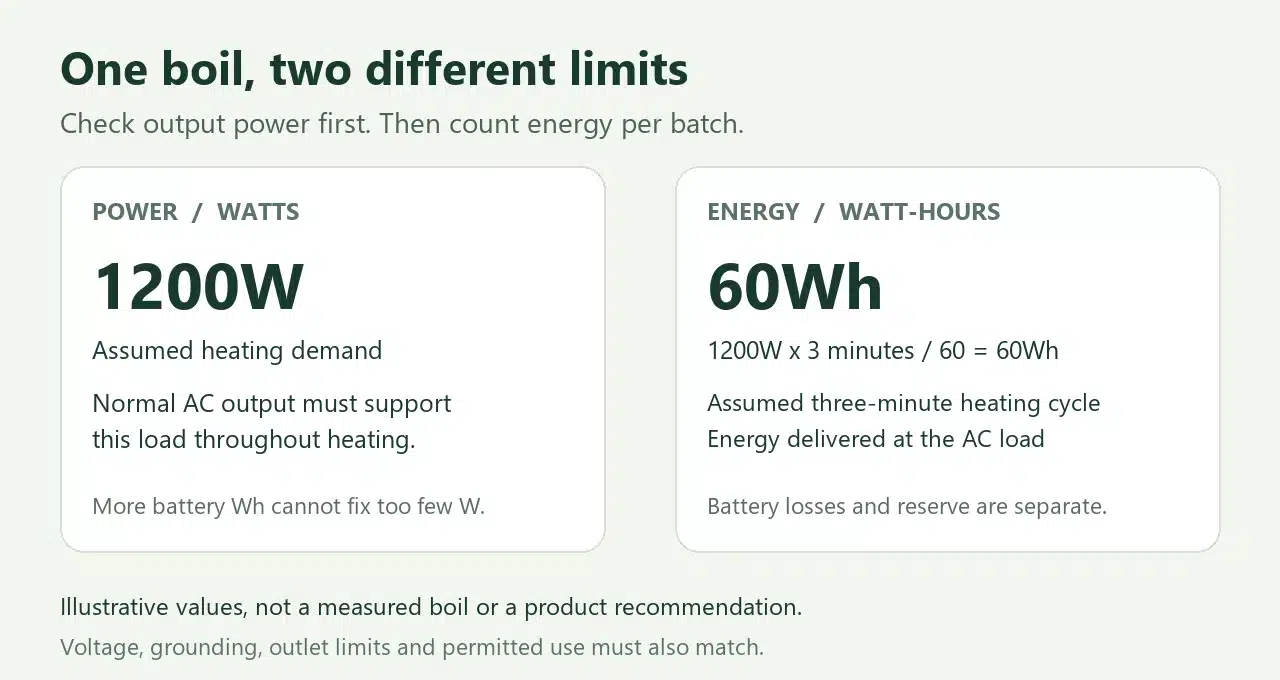
Find the energy capacity on the battery label or in the exact model’s manual. Look for “Wh” or “watt-hours.” The advertised AC output, such as 300W or 1,000W, describes a power capability and cannot determine whether the battery meets an airline energy limit.
A hypothetical station labeled 300W output and 256Wh capacity exceeds 160Wh despite its modest output. A hypothetical 90Wh portable charger is below the FAA’s ordinary 100Wh lithium-ion threshold, although the carrier still needs to accept its category and packing arrangement. These examples are calculations and label interpretations, not product approvals.
The watts and watt-hours guide explains the two ratings if your product description mixes them. For air travel, start with rated battery energy. The percentage remaining on the display does not change the manufacturer’s Wh rating: discharging a 500Wh station to 10% does not turn it into a 50Wh battery for the baggage rule.
Convert mAh only with the correct battery voltage
The FAA’s passenger battery guidance gives this calculation:
Wh = battery voltage × amp-hours
For milliamp-hours, divide by 1,000 first:
Wh = battery voltage × mAh ÷ 1,000
The FAA’s example is 12V × 8Ah = 96Wh. A separate hypothetical label showing 27,000mAh at 3.7V calculates to 99.9Wh. Multiplying that same mAh number by a USB output’s 5V would describe the wrong voltage basis.
Use the voltage associated with the manufacturer’s battery-capacity rating. A station may have several output voltages, none of which is the value needed for this conversion. If the label supplies mAh without the relevant voltage, ask the manufacturer for the rated Wh and supporting document. Keep that document with the label photo.
Do not round a capacity down to fit a limit or put a new capacity label on the enclosure. If the battery label and manual disagree, resolve the discrepancy before asking the airline to assess it.
2. Apply the FAA passenger-baggage limits
The FAA’s US baggage chart distinguishes spare batteries, power banks, installed consumer-device batteries and special mobility equipment. For ordinary rechargeable lithium batteries, the starting points are:
| Rated battery energy | FAA passenger baseline | What you need to establish |
|---|---|---|
| 100Wh or less | Within the ordinary lithium-ion size allowance | The product category, airline acceptance, quantity and packing rules |
| More than 100Wh, up to 160Wh | Airline approval is required; up to two larger spare batteries may be allowed | Whether the airline offers approval for this particular battery or portable charger |
| More than 160Wh | Ineligible for ordinary passenger baggage | Arrange a different power source for the destination |
The FAA chart’s lithium battery powered generator entry specifically describes stand-alone generators, backup generators and units used in solar power systems that exceed 160Wh as forbidden in both cabin and checked baggage. An extra checked-bag payment does not change that restriction.
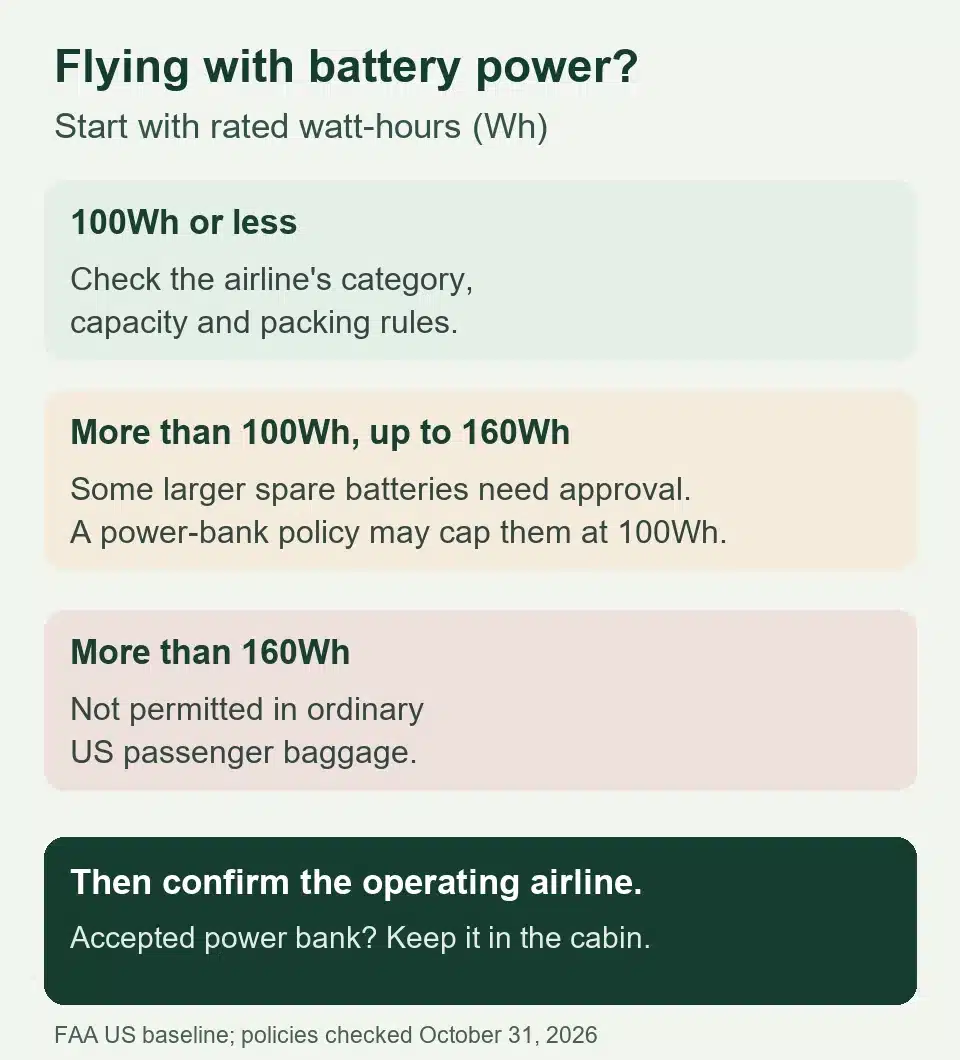
The middle row needs care. The FAA lithium-battery guidance describes carrier approval for larger spare lithium-ion batteries and warns that airlines may set stricter quantity and Wh limits for power banks. A general 160Wh statement therefore cannot promise that an airline will take your 150Wh portable power source.
Limits apply to the battery’s rating. Calling the equipment a solar generator, laptop battery or camping accessory does not resolve its category. A rechargeable lithium chemistry such as LiFePO4 is not an exemption from the lithium-battery rules.
Mobility aids have separate provisions in the FAA chart. Those exceptions do not give an ordinary camping station a higher limit. If your trip involves medical equipment, obtain the equipment-specific arrangements through the airline and device provider rather than applying a camping article’s table.
3. Check how the operating airline treats your power station
A battery built into a portable charger can still be treated as a power bank. The FAA expressly includes external battery chargers and portable rechargers in its spare-battery guidance. You cannot assume a station qualifies for checked baggage simply because its battery is inside an enclosure with sockets and a handle.
The rules for a laptop or camera with an installed battery are a different case. The FAA portable electronic device guidance permits some eligible devices in checked baggage when completely powered off and protected against damage and accidental activation. Its spare-battery rule still requires cabin carriage. Ask the carrier how it classifies the actual station, especially when its policy does not name that product.
Delta shows why the airline check changes the answer
On the Delta battery restrictions page, checked October 31, 2026, power banks are limited to two per passenger, each no more than 100Wh, with no exceptions. The page also describes larger lithium batteries elsewhere. The power-bank restriction is the relevant provision if Delta classifies your unit as a power bank.
For those power banks, Delta also prohibits overhead-bin storage and recharging the power bank aboard the aircraft. It prohibits using one to recharge another electronic device during taxi, takeoff and landing. Those are separate questions from whether the battery fits the energy limit.
This means a hypothetical 150Wh power bank cannot be packed for Delta on the strength of the FAA’s larger spare-battery allowance. Even a permitted 99Wh unit needs the airline’s cabin storage and use rules followed.
Check the airline operating the aircraft. If you booked through another carrier or have a connection, obtain the applicable policy for each operating carrier. An acceptance message from the first airline does not establish acceptance on the next flight.
4. Get an answer for the exact model and itinerary
Before departure, collect five items so an airline can assess the product without guessing:
- The exact model name, battery chemistry and rated Wh, supported by a clear label photo and the matching manual or specification sheet.
- The operating carrier, flight segments and countries involved, including the return route.
- The carrier’s classification of the unit, plus its capacity and quantity rules for that category.
- Any approval the carrier requires and actually offers, with its stated conditions recorded.
- The permitted baggage location, cabin storage and onboard charging or use restrictions.
Ask a specific question: “I have this model with this battery rating. Do you accept it as passenger baggage on these flights, and under which category and packing conditions?” Attach the documentation when the carrier’s contact process permits it.
For a battery above 100Wh and no greater than 160Wh, ask whether the carrier’s approval route covers your product. If its power-bank policy caps that category at 100Wh without exceptions, requesting ordinary spare-battery approval does not resolve the conflict.
Save the applicable policy and acceptance details where you can reach them without internet access. Recheck before travel because airline policies change. Documentation helps staff identify the unit; it does not override a restriction or ensure acceptance when the product or itinerary differs from what was assessed.
If capacity cannot be verified or the airline leaves the classification unresolved, arrange destination power before traveling. The cost of a rental or local purchase is easier to evaluate in advance than at a departure gate.
5. Pack an accepted unit for cabin carriage
For an accepted lithium power bank or portable charger, cabin carriage is required. The TSA power-bank entry also says carry-on yes and checked baggage no. Screening guidance supports that baggage distinction; it does not replace the airline’s capacity and category decision.
Protect the unit from crushing and keep battery contacts or terminals from touching metal. FAA guidance lists original packaging, insulated terminals and individual protective cases or pouches as possible methods. Choose a method suitable for your unit and its instructions; loose keys, tools or spare cells should not contact exposed terminals.
Turn the unit off and prevent accidental activation. Keep the identifying label readable and the supporting documents accessible. An accepted battery still has to fit the airline’s cabin baggage size and weight limits, so confirm the packed dimensions instead of relying on the station’s bare weight.
Remove power banks if your carry-on is gate-checked
If staff send your carry-on to the hold at the gate or beside the aircraft, remove all spare lithium batteries and power banks before handing it over. The FAA requires them to stay with the passenger in the cabin. Pack them where you can retrieve them quickly without emptying an entire bag.
Follow the carrier’s storage instructions once aboard. For example, Delta’s policy requires accessible cabin storage and prohibits an overhead bin for power banks. Do not recharge a power bank where the airline prohibits it, and follow any restrictions on using it to charge other devices.
If a battery becomes hot, expands, smokes or burns during the flight, notify the crew immediately. FAA guidance says crews are trained to respond to lithium-battery fires. Do not hide an overheating unit in your bag or move it to an inaccessible compartment.
When the station cannot fly, plan power at the destination
For a station above 160Wh, shift the plan to what you can obtain after landing. Options include a local rental, equipment supplied with a camper or campsite, or a local purchase with suitable return and storage arrangements. Confirm availability, battery capacity, outputs and charging access before booking around it.
A smaller accepted portable charger may be enough for a phone or a supported laptop connection. It may leave too little energy for the equipment that motivated the trip. Use the power station buying guide to compare the actual load and output requirements before choosing a smaller source merely to meet a baggage threshold.
For camping after a flight, the car camping power setup guide helps organize the destination load list and recharge opportunities. Verify the rental vehicle, campsite outlet or other planned charging route supports the actual equipment.
Shipping a station is a separate dangerous-goods task. A unit prohibited in passenger baggage is not automatically eligible for an ordinary parcel or air-cargo service. Ask the manufacturer and a carrier that handles the relevant lithium-battery shipment about acceptance, documentation and packaging; arrange the service before dispatching anything.
Before leaving home, you should have either an accepted unit with a documented cabin packing plan or a confirmed power arrangement after arrival. Keep the exact battery rating and operating-airline policy together so the decision remains tied to the equipment and flights you will actually use.