
When comparing solar panels in series vs parallel for a portable power station, start with its input limits. Series connections add panel voltage; parallel connections add current. Choose a complete arrangement that the equipment manufacturers support, with voltage, current, connectors and protection within their requirements. Neither layout is automatically better or compatible.
Use the five checks below before adding a second panel. The arithmetic illustrates electrical quantities; it is not a wiring recipe or a test of a named panel. A plug that fits and an array below the station’s wattage cap are not enough to establish compatibility.
1. Read the station and every panel label
Write down the exact model and generation. Find the station’s solar input voltage window, maximum permitted voltage, input-current limit, wattage limit and supported cable arrangement. Separate limits for different ports if the product has more than one solar input.
For a concrete manufacturer reference, the EcoFlow DELTA 2 user manual specifies solar charging at 11–60V, 15A maximum and 500W maximum. Its solar section warns to keep panel output voltage within 60V to avoid product damage and to follow the supplied instructions when using EcoFlow panels. These are DELTA 2 limits, not a general specification for other EcoFlow models or brands.
On each panel, collect the following values and their stated test conditions:
| Panel value | What it describes | Why you need it |
|---|---|---|
| Voc | Open-circuit voltage | Check the array’s maximum voltage, including specified temperature effects |
| Vmp | Voltage at the maximum-power point | Compare the intended operating point with the input window |
| Isc | Short-circuit current | Provide source-current information for equipment and protection checks |
| Imp | Current at the maximum-power point | Compare expected operating current and cable requirements |
| Temperature coefficients and tolerances | How specified quantities change | Evaluate the intended environment with the manufacturer’s method |
Voc and Isc describe different electrical conditions. Multiplying them does not give the panel’s usable maximum-power output. Vmp × Imp describes the stated operating power at the specified conditions.
Keep these values together when evaluating solar panels in series vs parallel. A nominal “12V panel” label cannot replace its datasheet. Likewise, a battery’s nominal voltage is not the portable station’s PV input specification.
2. Solar panels in series vs parallel: voltage and current
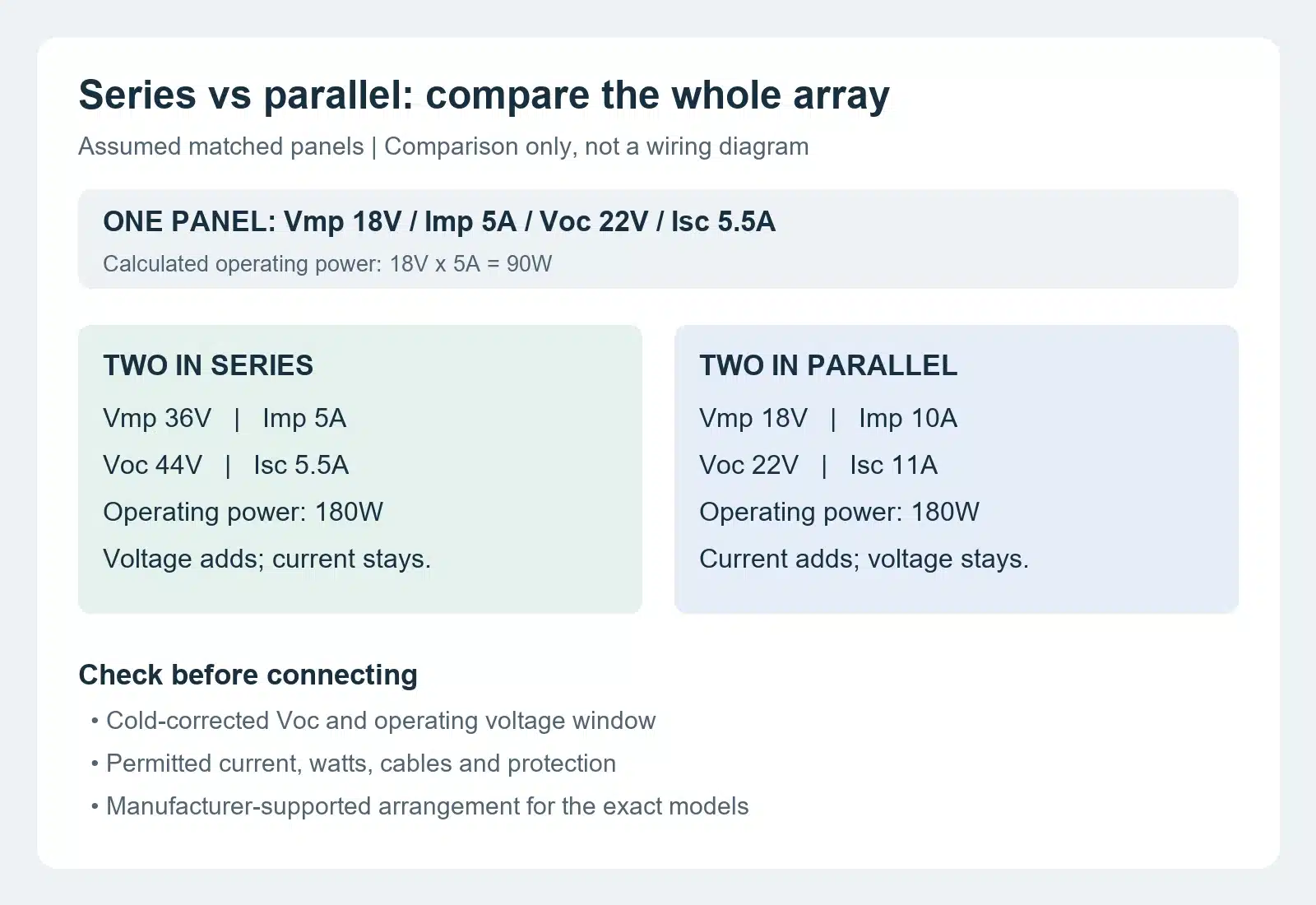
For matched panels under the same stated conditions, series adds voltage while current stays at the string’s operating current. Parallel adds current while voltage stays at the shared operating voltage. RICH SOLAR’s explanation of the configurations illustrates that distinction, including combined series-parallel arrangements.
Here is an assumed two-panel comparison. Each panel has Vmp 18V, Imp 5A, Voc 22V and Isc 5.5A. The operating point represents 18 × 5 = 90W per panel.
| Assumed arrangement | Vmp | Imp | Voc at the stated reference | Isc | Calculated operating power |
|---|---|---|---|---|---|
| One panel | 18V | 5A | 22V | 5.5A | 90W |
| Two matched panels in series | 36V | 5A | 44V | 5.5A | 180W |
| Two matched panels in parallel | 18V | 10A | 22V | 11A | 180W |
The comparison of solar panels in series vs parallel does not create extra rated energy: both two-panel examples have the same calculated 180W operating point. Their voltage and current differ, which may make only one arrangement appropriate for a particular input.
The table does not prove that either array will deliver 180W in actual sunlight, or that either is approved for DELTA 2. It does not include environmental changes, tolerances or accessory requirements. Use the equipment’s documented configuration rather than transferring this hypothetical pair to your station.
Can you mix solar panels in series vs parallel?
The matched-panel table isn’t a shortcut for mixing models. For example, a 90W panel and a 120W panel cannot be treated as two copies of the assumed panel just because their connectors fit. Compare every voltage and current value, then look for explicit support for the proposed combination. Don’t average their ratings to fill a missing specification.
For solar panels in series vs parallel with mismatched modules, the actual operating point depends on the combined electrical characteristics and conditions. A sum of advertised watts describes neither that operating point nor accessory compatibility. If the manuals don’t address the combination, ask the manufacturer with both datasheets attached. Keep the reply with the worksheet; a recommendation for another panel generation may not apply.
3. Check cold voltage, the operating window and shade
Series wiring can put an array near its voltage ceiling. Cold cells can raise open-circuit voltage further. Use the panel maker’s temperature correction, the expected minimum temperature and specified tolerances before accepting a series count.
For arithmetic only, assume a panel’s Voc is 22V at a 25°C cell reference and its Voc coefficient is −0.30% per °C. At an assumed −10°C cell temperature, the change from the reference is −35°C. The estimated voltage increase is (−0.30%) × (−35) = 10.5%. One panel becomes 22 × 1.105 = 24.31V; a pair in series becomes 48.62V.
These are assumed specifications. This example does not establish a safe minimum ambient temperature or sufficient voltage margin for an actual panel. The coefficient belongs to Voc; do not substitute a maximum-power temperature coefficient.
If a configuration exceeds the documented maximum, stop that design. An input-wattage cap does not make excessive voltage acceptable. Our guide to excessive solar input voltage explains the next checks when an existing arrangement is already over the limit.
The lower end of the input window matters too. Parallel wiring does not increase voltage. If the supported panel arrangement cannot start or sustain input, use the low solar input voltage guide rather than adding panels without checking their full series voltage.
Shade changes the operating conditions for solar panels in series vs parallel. Parallel branches may be affected differently from a series string, but bypass-diode design, shading pattern and the controller’s tracking behavior also matter. Do not promise a fixed shade advantage or daily charging yield from the connection type alone. Compare supported layouts in the conditions you actually have.
4. Check the complete cable and protection arrangement
A supported choice between solar panels in series vs parallel includes every connector, branch adapter and cable. The station’s supplied input lead may support one configuration but not every extra-panel arrangement someone can physically connect to it.
Parallel branches increase combined current in the shared cable. Higher-current arrangements need compatible conductors, connectors and protection. Series arrangements need components rated for the complete voltage, including the relevant cold condition. Length, routing, environment and manufacturer instructions also affect cable selection. For a separately purchased premade extension, use the solar extension cable selection worksheet to check the complete route and stated voltage-drop assumptions.
Use documented compatible assemblies and preserve their polarity. Similar connector housings do not prove that different brands or contact families are approved to mate. Do not change pins, improvise branches or use an AC extension lead as a PV cable.
Consult the solar fuse and breaker compatibility guide when the proposed arrangement requires protection design. A portable station’s built-in controller does not certify custom external wiring. Have a qualified installer resolve conductor protection or assembly work outside your competence.
Follow the equipment’s shutdown and isolation sequence before changing a layout. PV modules can generate voltage in light; do not separate PV connectors while carrying load or deliberately short a panel to collect a current figure for this worksheet.
5. Solar panels in series vs parallel decision worksheet
Use this worksheet to preserve the basis for your solar panels in series vs parallel choice. Mark an unknown value as unknown instead of inferring it from panel watts.
| Decision field | Your record |
|---|---|
| Exact station model and solar port | |
| Input window, maximum voltage, current and watts | |
| Panel models; Voc, Vmp, Isc, Imp and test conditions | |
| Proposed series count and parallel branch count | |
| Calculated array values, temperature correction and tolerances | |
| Approved cable, connectors, branches and protection | |
| Manufacturer-supported arrangement or written clarification | |
| Planned placement, shade and available charging window |
Reject an arrangement that exceeds a permitted limit. Hold the decision if a necessary rating or supported connection is missing. If all checks align, follow the model’s installation and commissioning instructions and retain the record with the manuals.
Keep compatibility and charging performance separate
Once a supported layout is operating, record the station’s displayed input, battery charge level, panel placement, shade and time alongside the configuration. Those observations help explain the result without changing the compatibility calculation. A single midday watt reading cannot establish daily stored energy or show that an unsafe voltage arrangement is acceptable.
When comparing solar panels in series vs parallel across two supported layouts, use similar weather, placement and battery conditions and note anything that changed. Follow the prescribed shutdown sequence between configurations. If charging is unexpectedly weak, keep the configuration record and the symptom together for troubleshooting. Don’t repeatedly change adapters or add panels until the input rises: that loses the comparison and can introduce a new unsupported arrangement.
The useful outcome of evaluating solar panels in series vs parallel is a documented arrangement for your particular equipment. After that, the solar charging guide collection connects configuration with panel output, recharge planning and troubleshooting. Daily stored Wh remains a separate observation; the array’s rated W and its wiring topology cannot guarantee how much energy reaches the battery during your trip.