Yes, a portable power station can run an electric kettle if its normal AC output supports the kettle’s voltage and sustained power draw, and both manufacturers permit the connection and location. When choosing a power station for an electric kettle, check the continuous output in watts first, then budget the watt-hours used by each boil. A large battery doesn’t make an undersized inverter compatible.
For camping, the useful question is whether your setup can finish the boil and still leave enough energy for the rest of the trip. Start with the labels on your kettle and power station. Once those match, a short energy measurement will tell you much more than a battery-percentage guess.
Choose a power station for an electric kettle
An electric kettle draws substantial power while it heats. Its water capacity, such as 0.9 liters, doesn’t tell you the electrical demand. Find the voltage, frequency and power rating on the kettle or base, then check the manual for that exact version.
As a documented example, Fellow’s Stagg EKG product specifications list a North American Type-B plug, 110-120V, 1000-1200W and 50-60Hz, with a 0.9-liter capacity. The linked safety manual identifies the US and Canadian Stagg EKG Pro and Pro Studio Edition models with the same electrical ratings. Allow for the upper stated power requirement when selecting output.
These specifications illustrate sizing. They don’t establish that this kettle is suitable for outdoor camping: Fellow’s manual says not to use it outdoors, requires a properly grounded outlet and prohibits adapters. For any kettle, check those conditions alongside the watts. Ask the manufacturers to confirm the complete power connection if its suitability is unclear.
A hypothetical power station rated for 1000W continuous AC output would therefore fall short of a 1200W kettle requirement. Even a 2000Wh battery wouldn’t remove that output limit. A station with sufficient continuous output gets past this first check; its remaining energy becomes the next question.
Read the limits for the AC outlet you intend to use and for all AC outlets together. Four sockets don’t necessarily provide four separate inverter power budgets. A fridge, charger or other appliance running at the same time shares whatever total limit the manufacturer specifies.
For example, a 1200W kettle, a 60W running appliance and a 30W charger total 1290W. That fits below a hypothetical 1800W combined continuous rating. It doesn’t establish complete compatibility: the other appliance’s startup demand, individual outlet limits and the station’s operating conditions still matter.
Use the following table to screen an arrangement before connecting it. It assumes matching voltage and frequency, normal AC operation and no other loads.
| Hypothetical continuous AC output | Kettle requirement | First decision |
|---|---|---|
| 300W | 1200W | Insufficient output; more battery capacity won’t fix it |
| 1000W | 1200W | Insufficient output in normal operation |
| 1500W | 1200W | Power rating fits; check the exact outlet and operating limits |
| 1800W | 1500W | Power rating fits; account for any simultaneous loads |
These rows illustrate the comparison. They aren’t recommendations or measured results for named products. If the W and Wh labels are still confusing, the guide to power ratings and stored energy explains how to read them.
A surge or boost number needs a separate check
A kettle’s heating demand continues until the water reaches its target temperature. A momentary surge rating, intended for a brief load, doesn’t establish that the inverter can supply the heating element for several minutes.
Special appliance or boost modes also need their own documentation. Their advertised wattage can come with restrictions on supported loads and operating conditions. A kettle with electronic temperature controls may have requirements beyond those of its heating element. Don’t assume that every electric kettle behaves the same way in a special mode.
If your purchase depends on such a mode, look for explicit guidance for the exact station and appliance. Confirm the permitted load, output behavior and any restrictions on concurrent charging. A general product-family claim isn’t enough to validate your particular combination.
For a straightforward setup, choose a kettle whose requirements fit the station’s normal continuous output. If that would mean buying a much larger station solely for hot water, compare the cost and weight of changing the kettle instead.
An overseas kettle introduces another issue. A 220-240V model isn’t a match for a 120V outlet simply because a travel adapter lets its plug fit. A plug adapter doesn’t convert voltage, and the kettle may prohibit adapters entirely. Check the complete electrical specification before buying either item, especially when the same product name is sold in several markets.
Calculate energy per boil, rather than hours of kettle runtime
Once the output is compatible, estimate the energy for the amount of water you actually heat. For a roughly constant heating draw:
Energy at the AC load in Wh = average heating power in W × heating time in minutes ÷ 60.
Consider a hypothetical kettle averaging 1200W for three minutes:
1200 × 3 ÷ 60 = 60Wh at the AC load.
A battery holding more than 60Wh could contain enough energy for this assumed task and still have an inverter that cannot supply 1200W. Both limits have to fit.
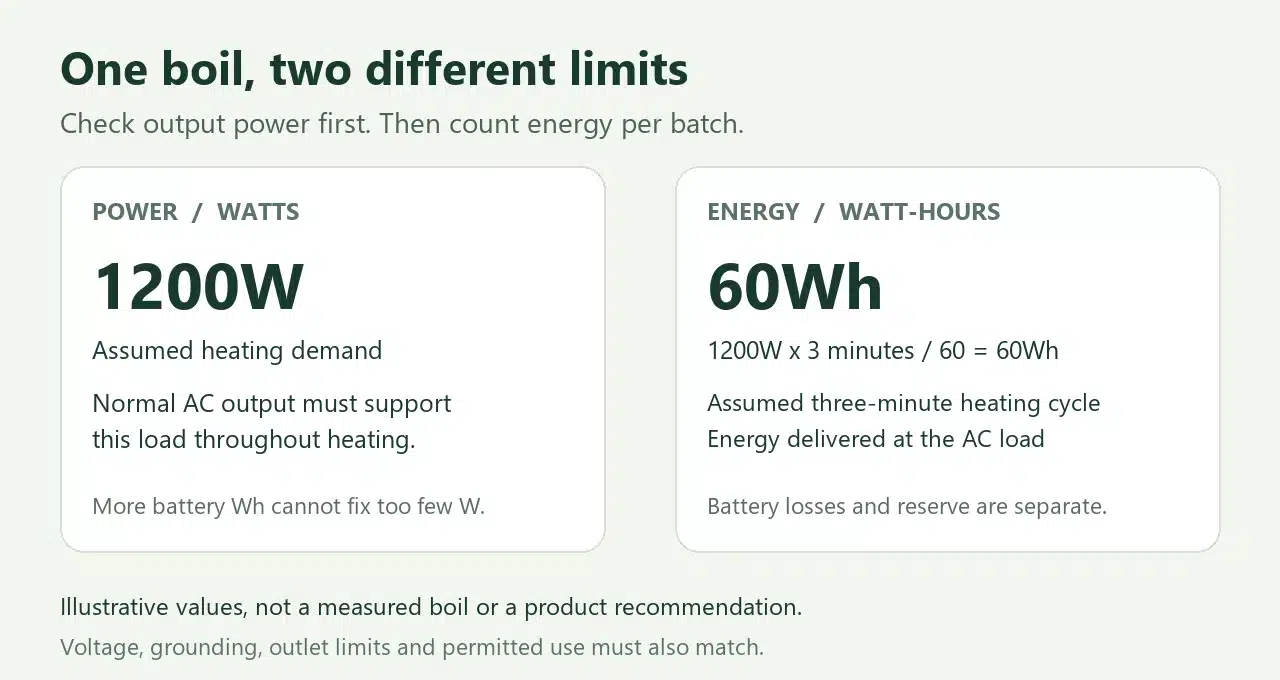
The three-minute heating time is an assumed input. It isn’t a prediction for the Fellow kettle or for a particular amount of water. Water volume, starting temperature, target temperature, kettle design and conditions change the result. Measure your intended batch to replace the assumption.
If the kettle adjusts its power or cycles while heating, multiplying its maximum nameplate rating by the full elapsed time may overstate energy. An appropriate plug-in energy meter can record the cumulative Wh directly. For a kettle with a hold mode, decide whether you’re measuring heating alone or heating plus the time it stays warm.
Keep the measurement point clear. A meter between the AC outlet and kettle measures energy delivered to the kettle. It doesn’t include the battery energy lost inside the power station. Conversely, a measured amount of usable AC energy from the station already reflects those upstream losses; applying another efficiency discount would count them twice.
A lower-wattage kettle can solve the output problem
A lower-power kettle may fit a station that cannot support a kitchen kettle. It will generally take longer to heat a comparable batch, and the energy saving isn’t automatic.
Compare these two assumed heating cycles:
| Hypothetical heating draw | Assumed heating time | Calculated AC energy |
|---|---|---|
| 1200W | 3 minutes | 60Wh |
| 600W | 6 minutes | 60Wh |
The lower-power example halves the required heating output but uses the same calculated energy. Real kettles won’t necessarily produce exactly these times or matching totals. Heat lost during the longer boil, different water volumes and different controls can change the comparison.
The reason to buy a lower-wattage kettle is therefore clear when your existing station has limited continuous output. Whether it also saves battery energy needs a measurement with the same starting water temperature, volume and target temperature.
Changing water volume can be useful too. Heat the amount you’ll use, within the kettle’s documented minimum and maximum fill levels. Filling a large kettle for one cup adds work you didn’t need the battery to do. Heating below the minimum line, however, isn’t an acceptable way to reduce consumption.
A 12V kettle needs a different compatibility check. Read its input current and connector requirements against the station’s DC port limits. A car-style socket isn’t evidence that the port can support any appliance with a matching plug. Use the documented supply route rather than an improvised cable or adapter.
Put repeated boils into the trip energy budget
The kettle shares the battery with your other camping equipment. Budget the number of batches before the next dependable recharge, including evening drinks or hot water for meals if you’ll use them.
Suppose a hypothetical 500Wh station delivers 80% of its nominal capacity through the intended AC arrangement. That gives 400Wh of usable AC energy. The 80% figure is an illustration, not a verified conversion efficiency or output capacity for a product.
Now allocate that energy:
| Energy allocation | Hypothetical amount |
|---|---|
| Usable AC energy from the station | 400Wh |
| Energy allocated to other loads on the same AC basis | −200Wh |
| Energy held in reserve | −80Wh |
| Energy available for the kettle | 120Wh |
At an assumed 60Wh per batch, the remaining allocation supports two batches. A third would use energy already reserved for another purpose. If measurements show that each batch needs 75Wh, the same 120Wh allocation covers only one complete batch.
The example keeps every allocation on the same usable-AC-energy basis. If your trip mixes DC, USB and AC loads, account for each route’s energy demand and losses consistently. Don’t subtract raw USB-device Wh from an AC-only delivered-capacity test and treat the result as a validated mixed-output budget.
Keep-warm operation is another load. If you leave a kettle maintaining temperature, measure that period and include it. Once hot water is no longer needed, turn off the hold function and any unused AC output according to the manuals. A suitable insulated flask can reduce repeated heating, but you’ll still need to measure the batches you actually boil.
For the rest of the trip, use the car camping power setup guide to connect your load plan with charging opportunities. Count a recharge only when the supported source and enough charging time will be available.
Measure one representative batch before departure
A useful kettle measurement is small and repeatable. Use a plug-in energy meter rated for the voltage, current and appliance load. Follow its instructions as well as the kettle and station manuals. If adding a meter isn’t a supported arrangement, obtain appropriate product guidance rather than improvising the connection.
- Record the exact kettle and station models, along with their relevant electrical ratings.
- Choose a water volume within the kettle’s fill limits. Record the starting temperature if you can measure it safely.
- Use the intended target temperature and normal supported AC mode. Begin with sufficient charge and conditions within the station’s limits.
- Start the meter’s energy record and heat the batch while attending it. Record elapsed time, cumulative Wh and any warning or interrupted heating.
- Repeat with a comparable batch if you need to understand variation. Measure hold time separately when you’ll use that feature at camp.
Save the result in a simple worksheet:
| Item | Your record |
|---|---|
| Kettle model, voltage and rated watts | |
| Station model, normal AC limit and operating mode | |
| Water volume and starting temperature | |
| Target temperature | |
| Time to finish heating | |
| AC energy per batch in Wh | |
| Hold time and additional Wh, if used | |
| Other loads active during the measurement | |
| Planned batches before recharge |
This record answers both practical questions: did the supported arrangement finish heating, and how much energy did the task require? Battery percentage alone is less useful for a small batch because the display may round, update slowly or vary with operating state.
Don’t extrapolate one successful boil into a guarantee at every charge level or temperature. Check any manufacturer restrictions that affect output, and leave a usable fallback if hot water is essential to your trip.
Keep hot water and the power station physically separate
Place the kettle on a stable surface suitable for hot appliances, and position the power station so steam, splashes or a tipped kettle cannot reach it. Keep the station’s ventilation clear and follow its own environmental limits.
Fellow’s Stagg EKG Pro and Studio Edition safety manual prohibits outdoor use and requires a properly grounded outlet without an adapter. A dry camping table therefore doesn’t make that appliance suitable for outdoor use. Choose an appliance and location permitted by the relevant manuals.
Grounding requirements also need to match the portable source. A three-pronged socket by itself doesn’t confirm that the station provides the arrangement the kettle requires. Obtain model-specific manufacturer guidance; don’t modify plugs or add a homemade grounding or bonding connection to force compatibility.
Use your kettle’s instructions to confirm fill limits, permitted surfaces and handling. Keep its lid in place as directed, avoid its hot surfaces and attend it during heating or hold operation.
Arrange the cord so it can’t pull the kettle off the surface, and keep the plug and base dry. Don’t boil while the vehicle is moving or place the kettle where bedding, a crowded cargo area or unstable furniture prevents proper use. If your campsite can’t provide a suitable location for both appliances, change the arrangement before heating.
If the AC output trips, stop the attempt and check the error, kettle requirement and simultaneous load. Repeatedly restarting the same incompatible kettle isn’t a solution. Follow the station’s specific instructions; the guide to power station overload errors explains what to record before troubleshooting.
Before departure, you should have three concrete entries: a compatible normal AC output, measured or clearly estimated Wh per batch, and enough allocated energy for the planned number of batches. If the output falls short, change the kettle or power source. If energy falls short, reduce the planned heating, arrange dependable recharging or choose another suitable hot-water setup.