Can a Portable Power Station Run a Refrigerator? 9 Smart Facts for Safe Sizing

can a portable power station run a refrigerator step 1

can a portable power station run a refrigerator step 2

can a portable power station run a refrigerator step 3

Can a portable power station run a refrigerator? Yes, it can, but only when the power station is sized correctly for startup surge, usable battery capacity, inverter output, and realistic runtime. That short answer is what most buyers want, but it is not enough by itself. The reason people get this wrong is simple: a refrigerator is not a steady, predictable load. It cycles on and off, the compressor pulls extra power when it starts, and real kitchen conditions are very different from ideal lab examples.

If you are shopping for blackout backup, apartment emergency power, RV use, storm prep, or a quieter alternative to a gas generator, then can a portable power station run a refrigerator is one of the most important questions you can ask. A refrigerator is one of the few appliances people genuinely care about during an outage. Food safety matters. Medicine storage matters. Daily comfort matters. And once the power goes out, people quickly discover that running a fridge is very different from charging a phone or powering a lamp.

That is why the right answer to can a portable power station run a refrigerator depends on more than one number on a product page. It depends on how much power the fridge uses while running, how much power it needs during startup surge, how much usable battery capacity the station can actually deliver after inverter losses, and how long you need the fridge to stay cold before utility power returns or another charging source becomes available.

Many buyers make the mistake of looking only at watt-hours. Others focus only on the inverter watt rating. Both are incomplete. If you want a setup that actually works when the lights go out, you need to look at the full picture and size the system honestly rather than optimistically.

Portable backup power context for estimating refrigerator runtime

Can a Portable Power Station Run a Refrigerator? The Direct Answer

Yes, can a portable power station run a refrigerator is a valid question, and for many people the answer is absolutely yes. A properly chosen portable power station can keep a refrigerator running through a short outage, overnight interruption, campsite situation, RV stop, or emergency event. The problem is that not every power station can do it, and not every refrigerator behaves the same way.

A compact mini fridge may be easy to support. A modern efficient top-freezer model may be manageable with the right battery. A large French-door refrigerator with an ice maker and extra electronics may be much harder. That is why the answer to can a portable power station run a refrigerator is always tied to your exact appliance and your real backup goal.

Why a refrigerator is harder to run than many buyers expect

At first glance, a refrigerator does not sound that demanding. Many units only use roughly 100 to 250 watts while the compressor is actively running. That makes people assume a modest power station should handle the job easily. The trap is startup surge. When the compressor kicks on, power demand can spike sharply for a short moment. If the station’s inverter cannot handle that brief surge, the refrigerator may fail to start at all.

This is the central misunderstanding behind can a portable power station run a refrigerator. Buyers see a low average running watt number and assume success. But startup behavior is what often decides whether the setup works in real life. A power station may have enough battery capacity for a few hours of fridge runtime and still fail instantly because the inverter cannot absorb the compressor start.

That is why entry-level battery stations are sometimes disappointing for appliance backup. They may be marketed heavily for emergency use, but emergency use means very different things depending on whether you want to charge USB devices or keep a refrigeration cycle going safely.

The 4 numbers that matter most before you buy

If you want a real answer to can a portable power station run a refrigerator, focus on these four numbers:

  • The refrigerator’s running wattage
  • The refrigerator’s startup surge or compressor surge
  • The power station’s continuous inverter rating and surge tolerance
  • The usable battery capacity after normal AC conversion losses

Most purchase mistakes happen because one of these numbers gets ignored. Looking only at battery capacity can make a weak inverter seem more capable than it really is. Looking only at inverter output can make a tiny battery seem more useful than it will be in an actual outage.

When people ask can a portable power station run a refrigerator, what they really need is not a generic yes or no. They need a sizing framework that combines these four numbers honestly.

What usable battery capacity really means

One reason this topic creates so much confusion is that a battery’s headline watt-hour rating is not the same thing as the energy your refrigerator actually receives. When you run an AC appliance from a portable power station, the stored battery energy goes through an inverter. That conversion is not perfect. Some energy is lost in the process. Battery management systems, temperature, and load behavior also affect what is truly available.

So if a power station is advertised as 1024Wh, you should not assume your refrigerator gets the full 1024Wh. In practice, usable AC output is lower. This matters because buyers planning tightly around a theoretical maximum often end up disappointed when the real runtime is shorter than expected.

That is why can a portable power station run a refrigerator is partly a battery question, but it is also an efficiency question. A setup that looks good in a sales chart may feel weak once real conversion loss and compressor behavior are involved.

A practical sizing rule that reduces regret

If your main use case is blackout backup, the safest buying strategy is not to shop at the exact limit. A power station that only barely qualifies on paper usually creates stress in real life. A little extra inverter headroom and a little extra battery capacity make the system much more forgiving.

For many households, the 1000Wh class is where refrigerator backup starts becoming realistic for certain efficient units, especially when the goal is short-term protection. But if your question is can a portable power station run a refrigerator overnight with less stress, many buyers are happier once they move into the 1500Wh to 2000Wh range and pair that battery size with a stronger inverter.

That does not mean everyone needs a giant system. It means safer sizing usually beats optimistic sizing. If food safety or medication storage matters, underbuying is rarely the smart decision.

Emergency power and battery backup context for refrigerator sizing

How long will a portable power station run a refrigerator?

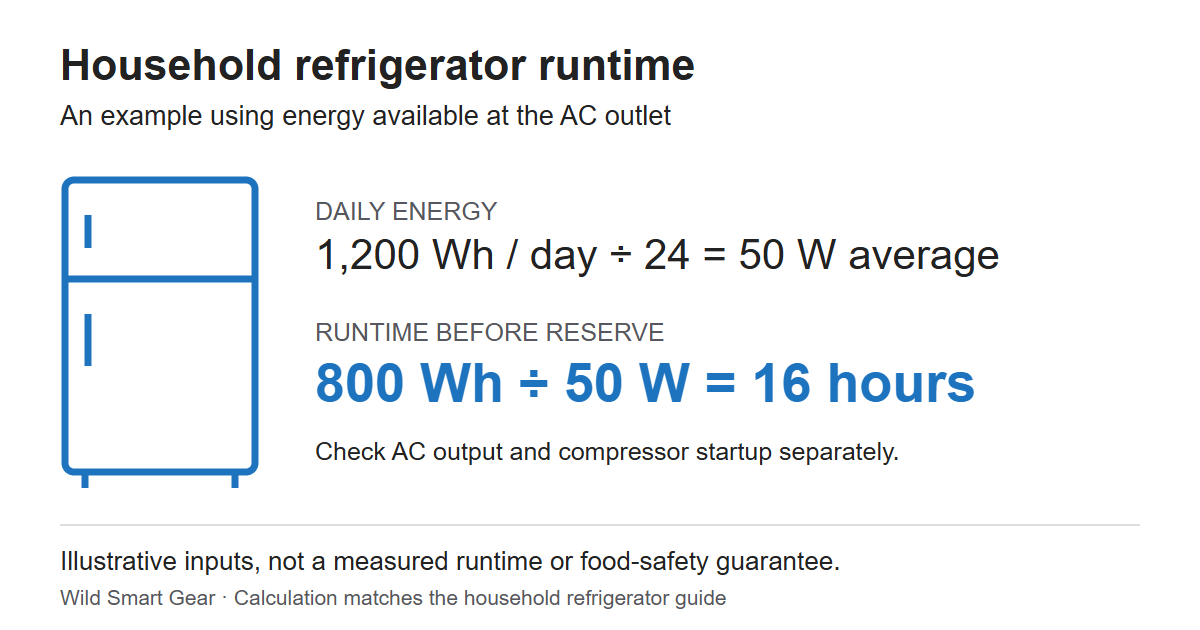
This is the next question people ask after can a portable power station run a refrigerator, and the honest answer is that runtime varies a lot. Refrigerators cycle. They do not draw the same power constantly. In a cool room, with the door mostly shut and the contents already cold, the compressor may run less often. In a warm kitchen, during summer, or with constant door openings, the refrigerator may work much harder and drain the battery faster.

That is why you should think in terms of practical ranges rather than one fixed runtime promise. Marketing often presents clean examples because clean examples sell products. Real life is messier. A station that might support one household’s refrigerator for much of the night may only provide a shorter bridge in another home.

Related Guides

The best mindset is to treat the battery as a buffer. It buys time. It protects food through shorter outages. It helps preserve normal life until the grid returns or another charging source is available. It is not automatically a whole-house substitute.

What changes runtime in the real world

  • Kitchen temperature and ambient heat
  • How often the refrigerator door is opened
  • How full the refrigerator is
  • Whether the fridge is already cold when the outage starts
  • Whether you are powering other devices from the same station
  • The efficiency of the refrigerator model itself

Each of these factors changes the practical answer to can a portable power station run a refrigerator for your situation. That is why copying someone else’s runtime example from a forum can be misleading.

Can a portable power station run a refrigerator and freezer together?

Sometimes, but that becomes a much more demanding project. Running one refrigerator is already a serious appliance backup task. Running a refrigerator and a separate freezer together usually calls for more battery capacity, more inverter headroom, more careful load planning, and much tighter expectations about runtime.

If your goal expands that far, can a portable power station run a refrigerator becomes part of a larger home backup strategy rather than a simple one-appliance question. At that point, you may be comparing larger modular battery systems, solar recharge plans, or even hybrid approaches involving generators.

Common mistakes that make buyers think battery backup is worse than it is

The first mistake is buying for watt-hours only. The second is ignoring compressor surge. The third is assuming every refrigerator is basically the same. The fourth is forgetting that once people have a portable power station, they start plugging in extra things like routers, phone chargers, fans, and lights. Those loads eat into the battery too.

Another common mistake is testing under ideal conditions and assuming the result always holds. A quick living-room demo does not guarantee strong performance in a hot kitchen during a storm outage.

When people later complain that their setup underperformed, the issue is often not that portable power stations are useless. It is that the system was chosen too close to the edge.

When a portable power station is a smart solution

A portable power station is a smart solution when you value quiet operation, indoor safety, low maintenance, and fast setup. It is especially appealing for apartment dwellers who cannot run a gas generator, for suburban households dealing with short outages, and for RV owners who want one battery system that serves multiple roles.

In those situations, can a portable power station run a refrigerator is not just a technical question. It is also a lifestyle question. Battery backup is quieter, cleaner, and easier to store than fuel-based alternatives. For many people, that convenience is exactly why the product category exists.

When you may need a larger backup plan

If you expect multi-day outages, want to power multiple kitchen appliances, need to support a second freezer, or live somewhere with repeated storm-related blackouts, a small or mid-sized portable power station may not be enough. You may need a larger battery ecosystem, solar charging support, or a generator backup layer.

This does not mean a portable power station is a bad purchase. It means can a portable power station run a refrigerator is the right starting question, but it may lead to a broader discussion about your whole outage strategy.

What type of battery chemistry is better?

Many modern buyers prefer LiFePO4-based units for appliance backup because they tend to offer strong cycle life, good safety characteristics, and solid long-term value. That makes sense if the station will be used repeatedly for testing, camping, RV travel, or frequent outage preparation. While chemistry alone does not answer can a portable power station run a refrigerator, it does affect how comfortable you may feel relying on the unit long term.

Can solar help keep the refrigerator running longer?

Yes, but only if the solar side is realistic. Solar can extend battery usefulness during a prolonged outage, but solar charging is slower and more condition-dependent than many people expect. If you plan to rely on solar for emergency refrigeration support, make sure you also understand issues like panel matching, charging thresholds, cable loss, and weather limitations.

That is exactly why we linked our other guide on power station not charging from solar. A solar plan that fails in practice is not much of a backup plan.

Helpful external resources

For official energy guidance, the U.S. Department of Energy refrigerator guide is useful for understanding appliance efficiency. For power outage food safety timing, the FoodSafety.gov outage chart is worth reading before an emergency happens.

These are helpful because the question can a portable power station run a refrigerator is not just about watts and batteries. It is also about what you are trying to protect and for how long.

A practical buying checklist

  • Check the refrigerator’s running wattage and compressor behavior
  • Look for enough inverter headroom, not just battery size
  • Do not assume the full rated watt-hours are usable on AC
  • Plan for real household conditions, not perfect test conditions
  • Decide whether you only need a short outage bridge or overnight support
  • Consider whether solar or another recharge option is part of the plan
  • Leave margin instead of buying right at the theoretical minimum

FAQ

Will a 500W power station run a refrigerator?

Sometimes a very small or unusually efficient refrigerator, but many full-size household models will fail on startup surge even if the running wattage looks low enough.

How many watt-hours do I need to run a fridge overnight?

There is no universal number because fridge duty cycles vary, but overnight confidence usually requires more than the smallest entry-level units.

Is it safer to oversize the inverter?

Yes, within reason. Extra inverter headroom reduces the chance that startup surge will shut the system down.

Can a portable power station run a refrigerator every day?

Technically it can in some setups, but for most buyers the realistic use case is emergency backup, RV use, or intermittent off-grid support rather than replacing normal household electricity.

How to avoid disappointment after you buy

The best way to avoid disappointment is to test your setup before an emergency. Plug the refrigerator into the station under normal home conditions. Watch whether startup surge causes a shutdown. Track how the battery behaves across several compressor cycles. If you plan to use solar recharge, test that too. The goal is to discover limitations early, not when the power is already out and your groceries are warming up.

That testing mindset gives you a much more useful answer to can a portable power station run a refrigerator than any product page ever will.

Bottom line

Can a portable power station run a refrigerator? Yes, but the right answer depends on inverter headroom, startup surge, usable battery capacity, and realistic outage goals. If you size the system honestly, leave margin, and understand that runtime varies with real conditions, a portable power station can be one of the most practical and quiet emergency upgrades you can make. If you buy at the limit and trust marketing examples too literally, you are much more likely to be disappointed when you need the system most.