
Yes, a portable power station can run a household refrigerator if its AC output supports the appliance’s voltage, continuous load and starting demand. Battery capacity then determines how long it can supply a compatible refrigerator. Check both questions before choosing a station: enough stored energy cannot compensate for an output that fails when the compressor starts.
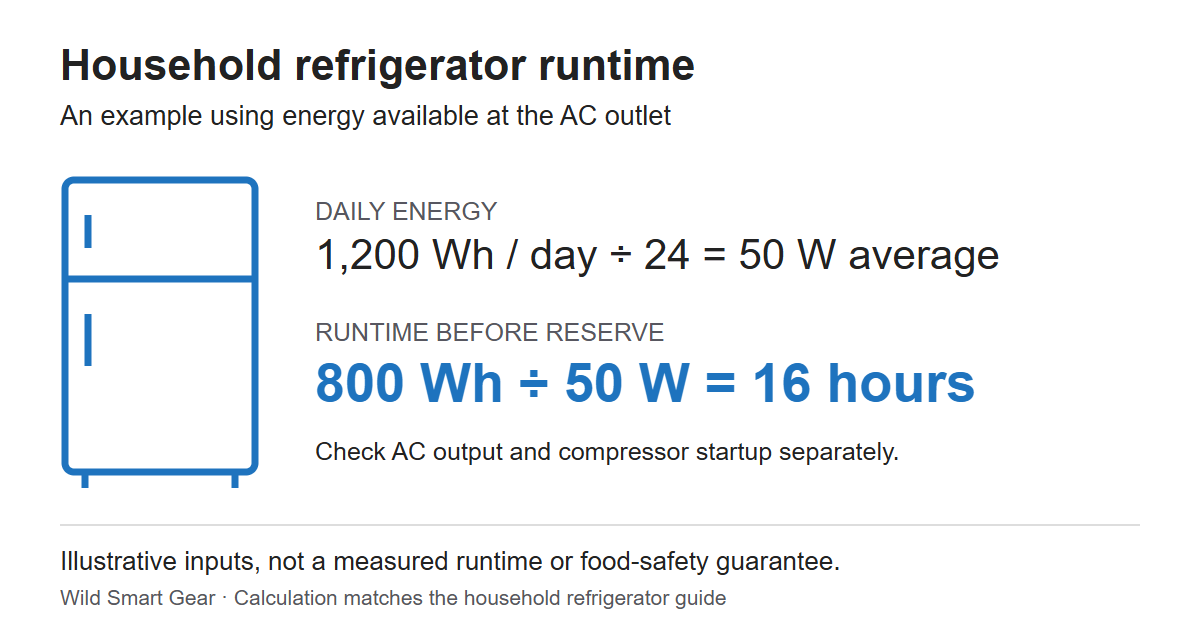
For a hypothetical runtime example, a refrigerator using 1.2kWh over 24 hours averages 50W. A station with 800Wh available to that appliance would provide about 16 hours at the same average consumption, before a separate reserve. These are calculation inputs, not measurements by Wild Smart Gear or a guarantee for your refrigerator.
Editorial correction: earlier versions included unsupported testing, experience or performance claims. This research guide replaces those claims with compatibility checks, documented food-safety guidance and labeled calculations.
Check output compatibility before estimating hours
Read the refrigerator’s rating label and manual, then compare its requirements with the station’s normal AC output specifications. Include the regional voltage and frequency. A US-market appliance and another region’s station cannot be assumed compatible because both have an AC socket.
Check the station’s continuous output rating and its documented starting-load capability. A compressor can need more power while starting than after it is running. Find appliance-specific startup information where available; a station’s short-term surge number alone may not establish that it can start your refrigerator.
If the specifications leave that question unresolved, ask the appliance and station manufacturers about the exact combination. Validate a supported arrangement under representative conditions before making it your outage plan. A successful brief run does not demonstrate a full night of stable operation or every later compressor start.
Also check any boost mode separately. A mode that changes the output voltage to accommodate some loads cannot automatically be treated as extra normal output capacity for a compressor appliance. Use it only where the instructions support the intended appliance.
Get an energy figure that covers compressor cycling
A refrigerator’s nameplate watts help identify electrical requirements. Daily energy answers the runtime question. The compressor cycles, so multiplying its running watts by 24 hours can overstate consumption, while ignoring defrost and other loads can understate it.
An appropriately rated plug-in energy meter can record AC energy over a representative period. Follow its instructions and the appliance’s connection requirements. Include enough time to capture cycling and normal use, and note room temperature, door openings and whether the appliance was already cold.
An annual energy label is a standardized comparison figure. You can divide its annual kWh by 365 to get an approximate daily value, but your outage conditions may differ. The ENERGY STAR refrigerator page is a useful source for energy-efficiency information; use the label and documentation for your exact appliance when doing the budget.
Convert units before calculating. One kWh equals 1,000Wh. In the earlier example, 1.2kWh per day becomes 1,200Wh per day, and 1,200 ÷ 24 gives 50W average. That average includes the off periods represented by the daily measurement; it is not the compressor’s continuous running wattage.
Estimate runtime from energy delivered to the appliance
Use this formula when your daily refrigerator energy is known:
Runtime in hours = available AC energy in Wh ÷ daily refrigerator energy in Wh × 24.
For a hypothetical 800Wh AC budget, different daily-use assumptions give:
| Assumed refrigerator use | Average load | Calculated hours |
|---|---|---|
| 800Wh per day | About 33W | 24 hours |
| 1,200Wh per day | 50W | 16 hours |
| 1,600Wh per day | About 67W | 12 hours |
These rows demonstrate sensitivity to consumption. They are not categories of refrigerator, typical-use ranges or station test results. None proves startup compatibility.
If you start with nominal battery capacity, document the usable-energy assumption for the AC route. For example, a hypothetical 1,000Wh nominal battery with an assumed 80% available at AC gives 800Wh. Setting aside 100Wh of that delivered energy leaves a 700Wh refrigerator budget, or 14 hours at the example 50W average.
The 80% factor and reserve are assumptions, not specifications or universal recommendations. If you already have a relevant measured AC energy figure, do not apply the same inverter loss again. Temperature, battery state and the station’s own consumption can change the result; keep the measurement boundary clear.
Include the rest of the outage load
Lights, network equipment and phone charging draw from the same battery. Suppose the refrigerator uses the hypothetical 1,200Wh per day and other supported loads consume another 200Wh. The daily budget becomes 1,400Wh. An 800Wh delivered-energy budget would cover about 13.7 hours at that combined daily average, before reserve.
Check simultaneous watts as well as daily energy. An extra appliance can exceed the station’s output limit during a compressor start even when its daily energy is small. Use the household load-planning guide to decide what shares the supply.
For recharge, count energy actually restored through a supported connection. Solar input varies with weather, placement and available daylight, and the station may limit charging while supplying AC. A recharge plan should cover a missed window as well as an average day.
Set up the supported connection
- Use the station and appliance according to their instructions, with the station’s ventilation clear.
- Check the refrigerator’s extension-cord requirements before adding a lead. Confirm the cord’s ratings and follow its use instructions.
- Keep electrical connections dry and protect leads from pinching or damage.
- Check output timers, automatic shutdown and how AC output behaves after charging input is removed.
- Use the station’s intended appliance outlet. Do not connect its output to a household wall receptacle; a fixed-circuit backup installation requires appropriate equipment and qualified installation.
Monitor food temperature if power is interrupted
Battery runtime is not a food-safety measurement. Keep an appliance thermometer in the refrigerator and follow FoodSafety.gov’s power-outage guidance if cooling is interrupted.
That guidance says an unopened refrigerator keeps food safe for up to four hours during a power outage. It advises discarding refrigerated perishables such as meat, poultry, fish, eggs and leftovers after four hours without power. Its detailed chart gives food-specific decisions for exposure to 40°F (4°C) or above for more than two hours. Use the guidance for the food and conditions involved, rather than assuming a partly charged station makes food safe.
If you need freezer guidance, FoodSafety.gov states that a full freezer holds a safe temperature for approximately 48 hours, or 24 hours if half full, with the door kept closed. Those are unpowered food-storage conditions, not power-station runtime claims.
Household refrigerator or 12V camping cooler?
This page covers household refrigerators powered through a compatible AC connection. A 12V camping compressor cooler has different input connections and operating conditions. Use the 12V camping fridge selection guide for that equipment.
For a more detailed capacity example, see 1,000Wh station and refrigerator runtime. A separate chest freezer backup guide covers freezer planning.