Yes, a portable power station can run an air fryer when its normal AC output meets the appliance’s electrical requirements and it has enough usable energy to finish the whole meal. Choosing a power station for an air fryer means checking both: can it supply the heating load, and can it cover preheating, every basket and any extra cooking time?
When assessing a power station for an air fryer, start with the equipment you own. A station that lights up the fryer’s display may still shut down when heating begins. A compatible station may finish the first basket and run short during the second. The five checks below separate those problems so you can choose a workable dinner plan before an outage.
This is a guide based on manufacturer documentation and transparent calculations. Wild Smart Gear has not tested the product pairing or measured the meal examples below. The times, delivery allowances and capacity comparisons are planning assumptions, not cooking instructions or promised performance.
1. Choose a power station for an air fryer from its exact label
Find the fryer’s model number, voltage, frequency and rated electrical power. Then compare them with the station’s normal continuous AC output, the intended socket’s limits and the limits shared by other connected devices. Check both manuals’ connection requirements before trying the combination.
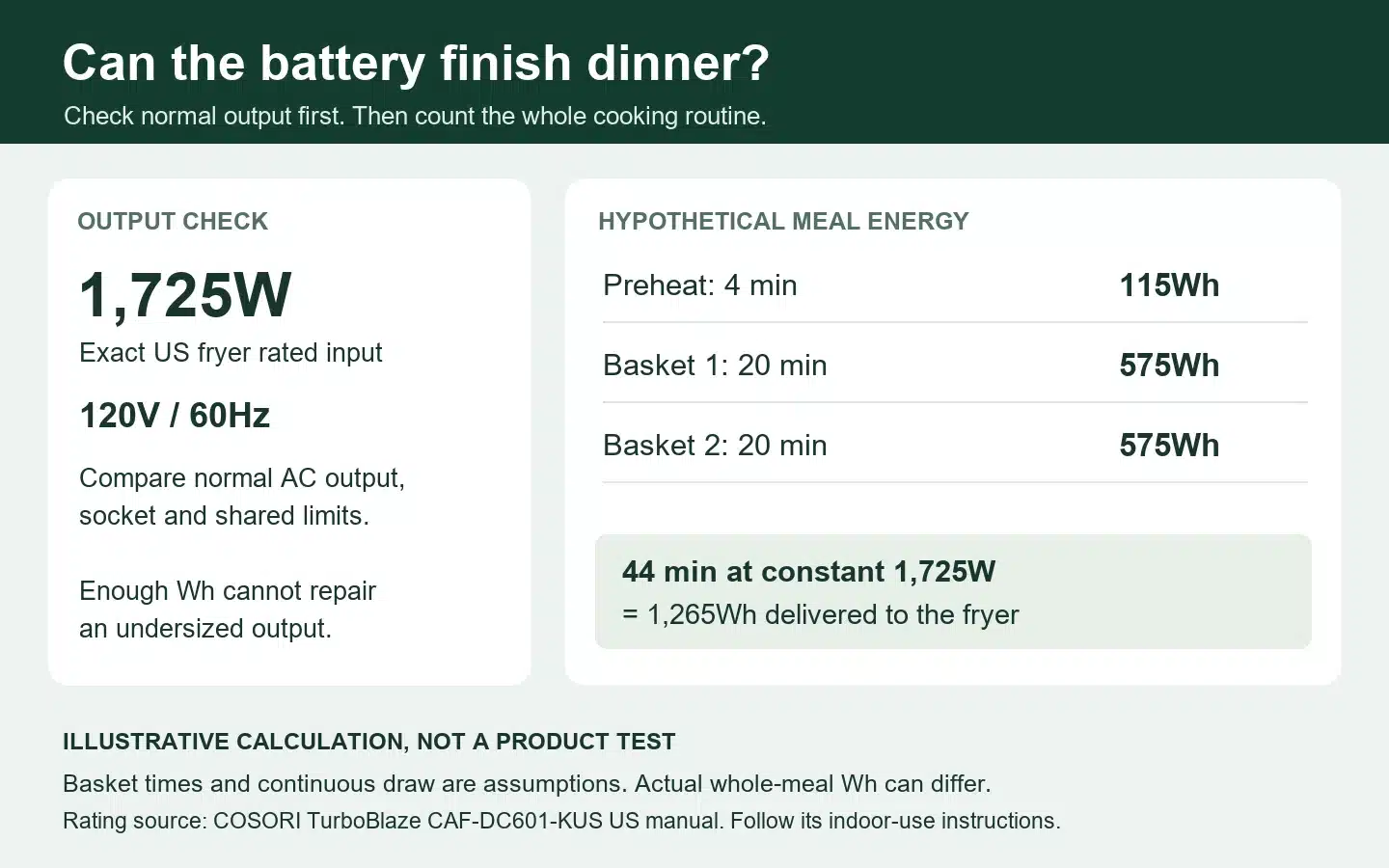
For a concrete reference, the COSORI TurboBlaze US user manual lists model CAF-DC601-KUS at 1,725W and AC 120V, 60Hz. Those figures apply to that version. Basket capacity, brand name and a similar-looking plug cannot establish the rating of another fryer, including a model sold in a different country.
If a proposed power station for an air fryer is rated for 1,000W of normal AC output, it fails the rated-power comparison with this 1,725W appliance. Buying more battery watt-hours with the same output limit would not fix that mismatch. The fryer needs sufficient electrical supply whenever it calls for heat.
Check the operating mode and everything running together
The Anker C1000 Gen 2 A1763 US guide lists 2,000W rated AC output and a separate 1,800W maximum for bypass operation. It also describes restrictions on SurgePad. These specifications illustrate why the normal battery-powered rating and the arrangement used while connected to mains need separate checks.
The 1,725W fryer sits below those two headline limits by 275W and 75W respectively. That arithmetic alone does not verify the product pair: socket, current, connection and operating conditions still apply. Adding a hypothetical 100W AC load produces 1,825W, which exceeds the stated bypass maximum even though it remains below 2,000W. Other output groups may impose additional restrictions.
Assess a power station for an air fryer in normal supported operation. A surge or boost figure has its own duration, voltage behavior and permitted loads; it is not a universal replacement for the continuous rating. If your plan depends on such a mode, obtain confirmation for the exact fryer and station before relying on it.
A lower temperature is not a verified lower-wattage setting
Turning the temperature down does not establish a new maximum electrical input. A temperature-controlled appliance may change when or how long it heats. The TurboBlaze manual lists cooking temperatures, times and fan speeds, but it provides no instantaneous wattage table for each temperature.
Keep the appliance’s rated requirement in the output comparison unless its manufacturer supplies a supported alternative. Do not assign a universal startup multiplier to every air fryer either. Resolve uncertain behavior through the exact documentation and an ordinary supported trial. Use the portable power station buying guide for the wider purchase decision once the fryer’s requirements are clear.
2. Budget the whole meal on a power station for an air fryer
Write the meal as a sequence: preheat if required, first basket, second basket if needed, and any finishing or keep-warm time. Count the routine you will actually use. “Twenty minutes of cooking” is incomplete if there are two batches and a preheat before them.
The TurboBlaze manual recommends preheating before adding food unless the appliance is already hot. For its listed 345–450°F range, the preheat table gives four minutes. Follow the instructions for your own model and recipe. Skipping a required stage to make a battery calculation fit can change the cooking result.
For an initial planning scenario, assume the rated input remains constant throughout the selected period:
Load energy in Wh = rated watts × total minutes ÷ 60.
The following example uses the documented 1,725W rating, a four-minute preheat, and hypothetical twenty-minute cooking periods. The cooking times are arithmetic inputs, not a recipe, measured duty cycle or recommendation for a particular food.
| Meal stage | Assumed time | Energy at a constant 1,725W |
|---|---|---|
| Preheat | 4 minutes | 115Wh |
| First basket | 20 minutes | 575Wh |
| Second basket | 20 minutes | 575Wh |
| One basket plus preheat | 24 minutes total | 690Wh |
| Two baskets plus preheat | 44 minutes total | 1,265Wh |
Heating control can make actual accumulated energy differ from this continuous-load scenario. Extra cooking or warming can increase the total period. Treat the table as a clearly defined planning case, not a guaranteed upper bound or an actual result for the COSORI appliance.
Measure a power station for an air fryer through a full meal
A suitable energy meter can record accumulated Wh across the whole routine where both equipment manufacturers and the meter instructions permit that connection. Check its voltage, current and load rating before use. A meter reading of 0.4kWh means 400Wh at the point where that energy was recorded.
Keep a meal record when evaluating a power station for an air fryer: include the fryer model, food amount, starting condition, selected program, preheat, basket count and total elapsed time. Include additional stages you normally use. Measuring only a low-power moment between heating periods misses the rest of the program.
The Department of Energy’s standby-power measurement guidance explains measuring energy over an interval and dividing by elapsed time when power fluctuates. That source describes standby measurement; it does not supply air-fryer consumption figures or certify this practical cooking worksheet.
Load-side Wh describes energy delivered to the appliance. It does not automatically include the station’s conversion losses or its own operation. Keep that boundary labeled, and use the runtime formula and measurement boundaries if you need to translate between nominal battery capacity and delivered energy.
3. Set the dinner budget for a power station for an air fryer
A power station for an air fryer needs a cooking allowance after other commitments are accounted for. If the same battery must keep your communications and refrigerator running, reserve their energy before deciding how many baskets dinner can use.
When sizing a power station for an air fryer without suitable discharge measurements, show your delivery and reserve assumptions explicitly. Suppose a fully charged battery delivers 80% of its nominal capacity to the chosen load boundary, and you leave 20% of that assumed usable energy untouched as a reserve:
Cooking allowance = nominal Wh × 0.80 delivery × 0.80 after reserve.
These percentages are hypothetical. They are not measured efficiency, a recommended universal reserve or a conversion from the station’s displayed battery percentage. With this convention, the allowance is 64% of nominal capacity before deducting other equipment.
| Nominal capacity | Hypothetical allowance | Comparison with the assumed meal |
|---|---|---|
| 500Wh | 320Wh | Below the 690Wh one-basket scenario |
| 1,024Wh | About 655Wh | Slightly below the 690Wh one-basket scenario |
| 2,048Wh | About 1,311Wh | Above the 1,265Wh two-basket scenario by about 46Wh |
The last row has little room for extra cooking in this example. It does not promise two meals, establish an appliance pairing, or leave a separate budget for other devices. Under the same assumptions, the 690Wh meal calls for about 1,079Wh nominal capacity; the 1,265Wh meal calls for about 1,977Wh. Both still need a compatible output.
If you already have a relevant delivered-energy measurement, start with that figure and check what losses, cutoff and reserve it includes. Applying the same allowance again would deduct energy twice. A half-charged starting battery also requires a different estimate from a full-charge scenario.
Protect the rest of the outage budget
Suppose you have a hypothetical 800Wh of delivered energy remaining and allocate 200Wh to the household network plus 100Wh to selected lighting. That leaves 500Wh before any further contingency allowance. The 690Wh one-basket planning case does not fit, even though the station may supply the fryer’s watts.
Enter the whole routine in the household load-planning worksheet. Scheduling a kettle and fryer at different times can reduce their simultaneous power requirement. It does not remove either appliance’s energy consumption from the ledger.
Change the constraint that actually fails
| Failed check | Useful change | Tradeoff to check |
|---|---|---|
| Normal output cannot meet fryer requirements | Use a documented lower-input appliance or an adequate supported station | A smaller appliance may need more batches |
| Enough watts, too little meal energy | Reduce the complete cooking task, use dependable mains power, or choose a suitable meal needing no electric cooking | Food quantity and required cooking stages still matter |
| Other appliances cause the combined load to exceed a limit | Schedule optional loads separately | Total meal Wh remains in the budget |
| Next recharge is uncertain | Fund dinner from energy already available | Planned solar yield cannot be spent before it arrives |
For an occasional outage, a suitable meal that needs no electric cooking may preserve the most battery energy for essential services. If you need hot food, compare complete, permitted routines rather than appliance wattage alone. The kettle boiling-energy guide and microwave electrical-input guide explain those alternatives; neither is automatically compatible or lower in energy for your meal.
4. Provide a permitted cooking location
A power station for an air fryer must be used in a location permitted by both manufacturers. The TurboBlaze US manual says do not use outdoors and do not leave the air fryer unattended while in use. A portable battery therefore does not turn that appliance into approved outdoor camping equipment.
For this exact fryer, the setup instructions require a stable, level, heat-resistant surface, five inches of clearance behind and above, and enough front room to remove the basket. Keep it away from flammable materials and areas that steam can damage. These distances are model-specific; use your own manual for another appliance.
Position the power station for an air fryer separately from the appliance’s hot exhaust, steam and possible spills, while maintaining the station’s documented cooling clearance. Do not put the battery against the air outlet, cover its vents or use an enclosed box to shield it during operation.
Plan the cord route before starting. Keep it away from hot surfaces and prevent it from hanging where someone can pull it or trip. The COSORI manual specifies conditions for any extension cord, including a marked electrical rating at least as great as the fryer’s rating. A power strip or cord fitting physically does not verify the complete arrangement. Follow the stricter requirements across the connected equipment.
If the available location or connection cannot meet both manuals, choose another supported cooking arrangement. Do not alter plugs, improvise voltage adapters or add a neutral-ground connection from a general internet tip. Resolve unclear requirements with the manufacturers before using the equipment together.
5. Verify the routine and identify why it stops
After the documentation checks, verify a power station for an air fryer with the intended, supported routine while dependable power and a fallback meal are available. A brief demonstration that the screen turns on is insufficient. Observe heating, every basket and the normal end of the program.
Record starting and ending battery state, operating mode, other connected equipment, meal stages, elapsed time and accumulated Wh where measurement is permitted. Note any output error or unusual behavior. Use the complete result to revise the meal allowance; do not extrapolate a few minutes into a guaranteed number of dinners.
| What happens | What to check next |
|---|---|
| Display works, station stops as heating starts | Fryer rated input, normal output, socket/shared limits, operating mode and exact error |
| First basket completes, second cannot finish | Starting energy, all stages, other loads and configured discharge cutoff |
| Fryer stops with an overheat indication | Its own clearance, loading and overheat instructions; do not treat it as an inverter reset problem |
| Temperature warning appears on the station | Stop affected use and follow that station’s temperature and cooling instructions |
| Correctly supported setup repeats the fault | Stop relying on the combination and contact support with the recorded model, mode, load and code |
For A1763 specifically, the manual identifies E0036 as AC output exceeding about 2,000W and instructs the user to bring the connected load under 2,000W before pressing the AC output button again. That is an exact-model instruction, not a universal reset for every station. Check the cause before reconnecting; use the overload checks before resetting to organize the information.
The TurboBlaze has separate overheat protection and requires complete cooling before use again. Its manual also directs users to stop and unplug for dark smoke, and to contact support if the cause was not burnt food. Follow those appliance instructions instead of repeatedly restarting an interrupted meal.
A completed timer does not verify that the food is properly cooked. Follow the appliance guidance and the recipe’s doneness checks; a power interruption can invalidate the planned cooking sequence. If your power station for an air fryer cannot finish the routine reliably, change the meal or power arrangement before relying on it during the next outage.