A portable power station can run a microwave if its normal AC output supports the microwave’s electrical input, startup demand and required connection. When choosing a power station for a microwave, check the appliance’s input rating first. The cooking wattage on the front and a lower cooking setting don’t establish how much power the outlet must supply. Once compatibility is confirmed, budget watt-hours for each heating session.
Check both manuals before connecting anything. A matching plug and sufficient watts don’t establish that the grounding arrangement, location or operating mode is permitted. If the connection requirements are unclear, get model-specific guidance before trying the combination.
Choose a power station for a microwave using electrical input
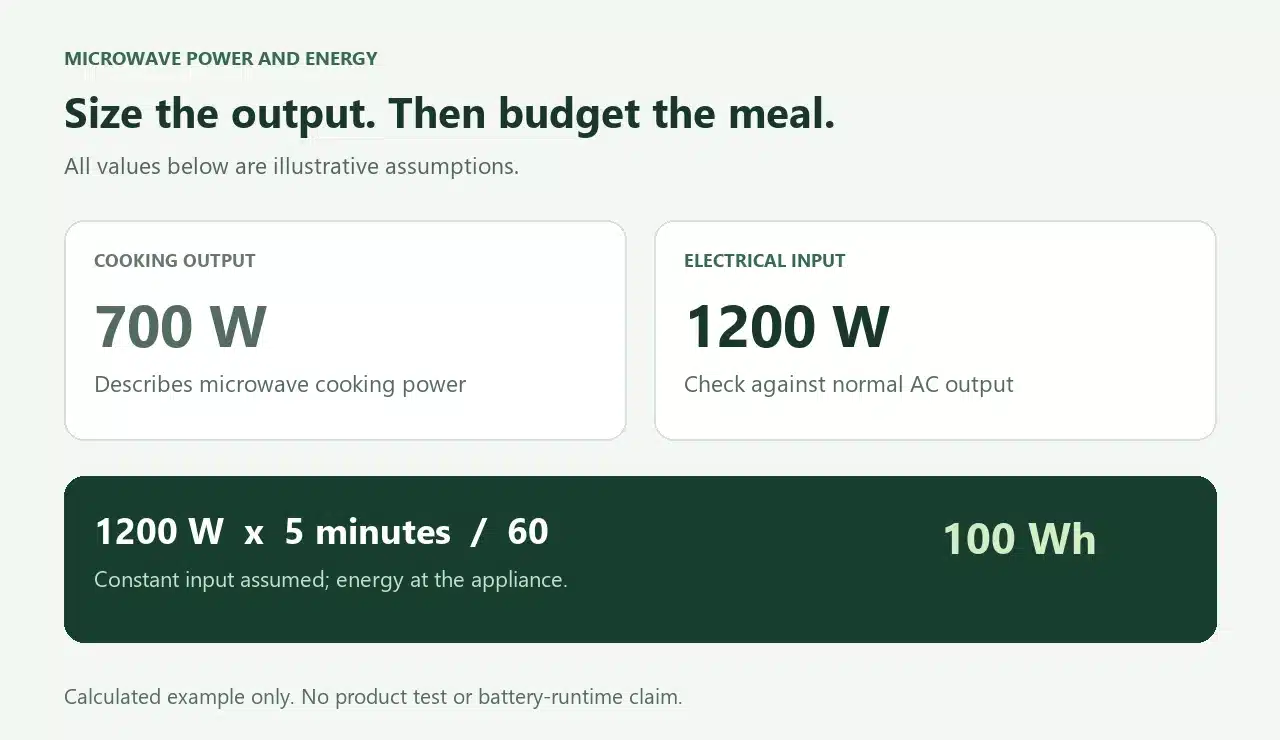
A microwave’s cooking output describes the microwave energy it produces for heating. Its electrical input supplies that process and the appliance’s other components. Those are different quantities, even when both are expressed in watts.
Find the rating label, often on the back or inside the door opening, and look for input power, power consumption or rated input. Match it to the exact model’s manual. Keep the supply voltage and frequency beside the number, especially if you’re comparing US equipment with a model sold in another market.
| Information you find | What it answers | What to do with it |
|---|---|---|
| Cooking output, such as an advertised 700W | How the appliance’s cooking power is described | Use it for cooking instructions; keep looking for electrical input |
| Rated input in W | The specified electrical power requirement | Compare it with the station’s normal output and outlet limits |
| Voltage and frequency | The required AC supply | Match the appliance and station documentation |
| Input current in A | A supply-current requirement | Check the outlet limit; ask for input watts if that’s unclear |
| Battery capacity in Wh | Nominal stored energy | Use it later for the meal budget |
The 700W entry is an illustrative cooking label, not a specification assigned to the GE model discussed below.
If the appliance lists only volts and amps, don’t silently treat their product as a measured watt reading. AC voltage multiplied by current gives volt-amperes; real watts also depend on power factor. Both the current limit and the watt limit can matter to the source. Manufacturer confirmation or a suitable measurement can resolve the missing information.
Our guide to power ratings and stored energy explains the W/Wh distinction if your station’s label mixes several numbers. For this decision, write down the microwave’s electrical input and the station’s normal AC output on separate lines.
Suppose a microwave requires 1200W of electrical input and the station has an 1800W continuous AC rating. On those hypothetical numbers, the microwave leaves 600W of arithmetic headroom before any other loads. That comparison is a starting point: you still need the permitted connection, per-outlet limits and startup behavior.
A real manufacturer example shows why output and capacity need separate checks. The US EcoFlow DELTA 3 specification table lists 1800W total AC output across six outlets and 1024Wh nominal capacity. The 1800W rating is shared across those AC outlets. It isn’t an 1800W allowance for every connected device, and the specification alone doesn’t certify a particular microwave pairing.
Add the electrical demand of equipment that will run at the same time. If a refrigerator or another intermittent appliance starts during cooking, its startup requirement also enters the comparison. Schedule high-demand tasks separately where interrupting the other equipment is acceptable. Keep essential loads on their documented continuity plan.
A power station for a microwave needs a normal output rating that covers the heating session. A short surge rating has a duration and operating conditions; it cannot cover several minutes of cooking above the continuous rating. Similarly, a boost mode may have its own appliance restrictions or alter the supplied voltage. Use normal operation as the basis of the comparison unless the manufacturer explicitly supports your appliance in that special mode.
When a microwave triggers a shutdown, record whether it happened at the first start, at a later heating pulse or after another appliance began running. That timing helps distinguish an unresolved startup requirement from combined-load demand. Follow the existing guide to power station overload errors for the fault and reset procedure. Repeatedly resetting the same incompatible combination won’t establish compatibility.
A lower cooking setting can still produce high-power pulses
Turning a microwave to 50% doesn’t necessarily make it a steady half-power electrical load. Some models control lower cooking settings by alternating heating periods with rest periods.
The GE JES1072 and RES1072 owner’s manual gives a specific example on page 8. It describes power level 7 as microwave energy supplied 70% of the time and power level 3 as energy supplied 30% of the time. It also explains that rest periods, when microwave energy cycles off, allow heat to spread through the food.
For that style of control, the station must support the appliance during its heating periods. A lower average energy use doesn’t establish that each pulse falls below the station’s output limit. Selecting a lower setting therefore cannot be assumed to rescue an otherwise unsupported combination.
Other microwave designs may regulate cooking power differently. Read the exact model’s description and check its electrical demand at the setting you intend to use. An “inverter microwave” label alone doesn’t provide a plug-side watt reading at every level.
There are two observations to keep:
- The highest supported operating demand, including starts and heating pulses, determines whether the source can run the appliance.
- The cumulative energy over the complete session determines how much of the meal budget it uses.
A station screen that updates slowly can miss a short event. Use its displayed watts as an observation, then resolve unexplained shutdowns with the equipment maker rather than assuming a low average proves adequate output.
Verify the permitted arrangement before relying on it
Start with the physical setup and connection requirements. The GE manual’s pages 3 and 5 specify a grounded outlet, clearance around the oven and no extension cord for that model family. Page 3 also prohibits outdoor storage and use near water. These requirements don’t automatically carry over to every microwave, but they show why a generic campsite extension-cord setup needs more than a wattage check.
For the GE example, the stated clearances are 3 inches on each side, 3 inches above and 1 inch behind. Keep the door’s front surface at least 3 inches back from the counter edge, as directed. A cabinet, cargo shelf or tight vehicle compartment must satisfy the appliance’s actual installation requirements; don’t infer approval from whether it fits.
A three-prong socket on a power station doesn’t, by itself, settle the microwave’s grounding requirement. Ask the manufacturers for the supported standalone arrangement when the manuals don’t make it clear. Leave changes to grounding or building wiring to qualified personnel.
Once the arrangement is confirmed, check a representative heating session before you depend on it during an outage or trip:
- Record both model numbers, the station’s operating mode and the microwave input specification.
- Check at a representative battery state and within both devices’ permitted temperature and location limits.
- Use food or another load permitted by the microwave instructions. Don’t run the oven empty for a power test.
- Observe the initial start, any later heating pulses and the complete session. Record faults or interruptions.
- Repeat the intended operating pattern if it includes several sessions, allowing the ventilation and cooling the manuals require.
If the microwave resets, the station trips or the connection remains uncertain, stop relying on that pairing. A successful short run is useful evidence for those conditions; it doesn’t establish performance at every battery state, temperature or shared load.
Calculate watt-hours for a heating session
For a constant electrical input, energy at the appliance is:
Energy in Wh = input watts × minutes ÷ 60
A hypothetical microwave drawing 1200W for five minutes uses 100Wh at the appliance. These figures are assumed inputs, not a GE specification or a Wild Smart Gear test result.
| Assumed constant electrical input | Heating duration | Energy at the appliance |
|---|---|---|
| 1200W | 2 minutes | 40Wh |
| 1200W | 5 minutes | 100Wh |
| 1200W | 10 minutes | 200Wh |
When sizing a power station for a microwave, check both limits: a smaller battery with adequate output may run a short session, while a larger battery with inadequate output may fail to start it. The session’s watt-hours and the appliance’s electrical input answer those separate questions.
For cycling operation, add the energy of each part instead of multiplying the highest reading by the whole clock time. Suppose a hypothetical four-minute session contains two minutes at 1200W and two minutes at 60W for the remaining appliance load:
1200 × 2 ÷ 60 + 60 × 2 ÷ 60 = 42Wh
That is an electrical trace example, not an observed GE cycle or a claim that this setting delivers the same cooking result as four minutes at full power. Food quantity, starting temperature, cooking instructions and any further heating determine the actual session.
Measure the whole meal and keep the energy boundary clear
Cumulative Wh over the complete heating task is more useful than a single watt snapshot. Include the extra heating you normally need, and record whether the oven’s fan or light continues afterward.
If the microwave instructions and connection arrangement permit a plug-in energy meter, choose one rated for the actual voltage, current and load. The GE example expressly prohibits an extension cord; don’t turn the measurement method into an unapproved connection. Where a suitable meter arrangement isn’t permitted, use available station records and manufacturer guidance, marking any remaining estimate clearly.
A meter between the station and appliance measures energy delivered to the appliance. The battery supplies additional energy for conversion and the station’s own operation. A station’s battery-side energy record, if provided, has a different boundary. Keep that distinction with the result.
For example, if you assume that 85% of battery energy reaches the AC appliance, a 100Wh session would require about 118Wh from the battery: 100 ÷ 0.85. The 85% is a hypothetical efficiency assumption, not a universal station value. Replace it with relevant evidence.
If your available-energy budget already uses measured usable AC watt-hours, subtract the appliance’s 100Wh directly. Applying the same conversion allowance again would count that loss twice. Also account for any time you leave the station’s AC output active between meals if the usable-energy figure doesn’t already include that operating pattern.
| Record | What to write down |
|---|---|
| Appliance | Exact model, input specification and cooking setting |
| Meal | Quantity, starting condition and complete heating duration |
| Electrical behavior | Initial start, heating pulses, highest observed demand and faults |
| Energy | Starting and ending cumulative Wh; measurement location |
| Station conditions | Model, mode, battery state, temperature and simultaneous loads |
| Result | Whether the intended session completed and any further heating needed |
Use this record for the meals you’ll actually prepare. A small reheating task doesn’t predict the energy for a different quantity or a much colder starting condition.
Reserve energy for the rest of the outage or trip
Suppose you have 800Wh of usable AC energy for a defined period. You set aside 200Wh as reserve and allocate 350Wh to other loads. That leaves 250Wh for the microwave:
800 − 200 − 350 = 250Wh
At the hypothetical 100Wh per session, two sessions use 200Wh and leave 50Wh of slack outside the reserve. A third would exceed the meal allocation. This example starts with usable AC energy, so it doesn’t apply another conversion percentage.
Those numbers are a budgeting example, not a promise about a nominal 1000Wh station. Actual usable energy depends on the model and operating conditions. Planned recharging only enlarges the budget when a supported source is available and the energy is actually replenished.
For a trip, put the meal allocation into your complete car camping power plan, alongside refrigeration, lighting and recharging. During an outage, the home backup load worksheet helps you decide which other loads need the remaining energy.
| What your checks show | Next decision |
|---|---|
| Input, startup and connection are supported; meals fit the budget | Keep the documented arrangement and session record |
| The source can’t support heating demand | Choose a microwave with verified lower electrical input, a suitable power source or another meal arrangement |
| Output is adequate but the planned sessions exceed available energy | Reduce microwave tasks, arrange supported replenishment or reserve more energy for meals |
| Grounding, location or operating mode is unresolved | Obtain model-specific guidance before use |
| A permitted combination still trips or resets | Record the conditions and use manufacturer support rather than repeated resets |
Before departure or an expected outage, keep the input specification, supported connection, completed-session observation and Wh-per-meal record together. Those four pieces let you decide whether the microwave fits your equipment and energy plan.