You don’t necessarily need a dual battery system to camp in an SUV or run a fridge. A fixed system makes sense when you want a permanent supply for parked accessories, have a supported way to recharge it, and can accommodate the installation. A suitably sized portable power station can supply those loads too. Start by recording the energy you need between dependable recharges, then decide whether a fixed installation solves a problem that removable equipment leaves unresolved.
Editorial correction: Earlier versions included unsupported Moab field measurements, universal wiring advice and safety guarantees. Those claims have been removed. Wild Smart Gear has not measured the equipment in the examples below; the numbers are hypothetical inputs for explaining the calculation.
Check 1: What needs power when the engine is off?
Write down the loads that must keep working while you’re parked. A fridge, lighting and device charging can draw from the same camping supply, but the vehicle’s starting battery has a separate job. Don’t treat its capacity label as a budget you can spend overnight while still expecting the engine to start.
An installed arrangement separates the auxiliary supply from the starting battery through an appropriate isolation and charging arrangement. The camping loads must actually connect to that auxiliary side. Adding a second battery while leaving the fridge on a starter-powered socket doesn’t move the load. Keeping batteries permanently connected also fails to provide the intended separation.
DrivingLine’s explanation of dual battery systems describes this distinction and includes portable supplies as an alternative. Its relay examples describe particular arrangements; their switching voltages aren’t settings for every SUV. For the charging and isolation paths, use our separate guide to how a dual battery system works.
Check the owner’s manual for your exact vehicle and model year. Identify whether the accessory outlet turns off with the ignition, stays live for a time, or draws from the starting battery while parked. Hybrid, electric and stop/start vehicles need their own supported arrangements. A socket that shuts off can interrupt an appliance even when there is energy elsewhere in the vehicle.
If your only loads are occasional phone charging and a small lamp, measure their requirement before deciding you need a dual battery system. A separate rechargeable light or compatible portable supply may meet the trip’s needs. The question is how to supply your parked loads, not how many batteries an overland vehicle should have.
Check 2: Can a removable supply cover the whole charging gap?
Calculate energy across the period between reliable recharge opportunities, including the daytime hours. Two nights away may involve more than 48 hours after leaving home. For a cycling fridge, use representative measured daily energy or suitable model-specific consumption data. Its rated input current doesn’t describe how long its compressor runs.
Consider this hypothetical 48-hour trip. All energy entries are assumed demand at the camping loads, with no recharge during that interval.
| Load | Assumed use | Energy over 48 hours |
|---|---|---|
| Fridge | 240Wh per 24 hours | 480Wh |
| Lighting | 5W for 4 hours on each of two evenings | 40Wh |
| Phone charging | 20Wh per day | 40Wh |
| Total | The three loads combined | 560Wh |
Suppose you choose a separate 100Wh reserve. The supply then needs to deliver 660Wh at those loads. If you assume that 85% of its nominal energy reaches them, the nominal capacity requirement is 660 ÷ 0.85, or about 777Wh. Both the reserve and usable-energy factor are planning assumptions, not measured efficiency or universal recommendations.
A hypothetical 1,000Wh portable station meeting that 85% assumption would provide about 850Wh at the loads. It clears this particular 660Wh requirement. You wouldn’t need a dual battery system on capacity grounds alone. You still need to confirm the actual station’s outputs, timers, permitted conditions and delivered energy.
Change the fridge assumption to 480Wh per day and the same trip needs 1,040Wh before reserve. With the same 100Wh reserve and 85% factor, nominal capacity becomes about 1,341Wh. That increase calls for more energy or dependable replenishment. To decide whether you now need a dual battery system, compare the portable and installed options that can meet the revised requirement.
Use the SUV camping power station size guide when choosing nominal capacity. If you’re considering a separate 100Ah battery, calculate its camping runtime using its specified nominal voltage and permitted usable energy. An amp-hour label alone doesn’t establish equivalence with a station measured in watt-hours.
Check 3: Will your charging plan replace what you use?
If you need a dual battery system for a longer trip, plan how to replenish it. The system stores energy; it doesn’t create it. An installed bank is useful when its supported recharge arrangement matches your travel pattern. A trip involving regular driving can suit vehicle charging. A stationary stay needs enough starting energy and another dependable recharge opportunity, or a shorter stay and lower demand.
Compare net energy reaching the battery with the energy consumed from that same battery. Keep those measurement boundaries consistent. Peak charger watts multiplied by the whole day won’t tell you what you replaced: charging limits, concurrent loads and tapering can change the result.
For a separate hypothetical example, assume your camping supply loses 300Wh from its battery over a day. A supported charger sustaining a net 150W into that battery for two hours would replace 300Wh. At a net 75W for the same driving period, it would replace 150Wh and leave a 150Wh shortfall. These figures illustrate the energy balance; they don’t describe a vehicle socket, charger or battery you’ve bought.
Some portable stations support dedicated vehicle chargers, so a fixed auxiliary bank doesn’t automatically charge faster than every portable option. Compare the specific supported arrangements before deciding that faster recharge means you need a dual battery system. Check input limits, vehicle compatibility and installation requirements before assigning a charging advantage to either route.
Solar can contribute while you’re parked, but panel rating isn’t guaranteed daily energy. Allow for the actual weather, shade, placement and input compatibility. Record what happens when the expected solar window is missed. Solar availability alone doesn’t mean you need a dual battery system: both fixed and portable supplies need compatible charging inputs and enough stored energy for the gap.
If you’re recharging a portable station, use the guide to supported charging while driving. An installed bank needs its own battery and charger documentation. Don’t substitute a generic relay voltage, a larger fuse or an improvised connection for that compatibility check.
Check 4: Does a fixed installation fit your SUV and routine?
If you need a dual battery system for equipment that stays in the vehicle, plan its distribution around the fixed fridge and lighting, with controls you can reach. That convenience comes with mounting, protection, cable routing, charger access and maintenance requirements.
REDARC’s comparison of portable and traditional systems identifies travel pattern, accessory demand and vehicle space as selection factors. It describes the convenience of removable equipment and the ability to customize a fixed arrangement. Its GoBlock discussion concerns REDARC products, so it doesn’t establish runtime or fit for another brand.
If your load and recharge checks suggest you need a dual battery system, measure the available space with your sleeping platform, cargo and connected plugs present. Check mounting positions and operating conditions against the battery and charger instructions. Engine-bay space alone doesn’t establish that a battery is approved for that location. Cabin installation also needs the manufacturer’s mounting and ventilation requirements.
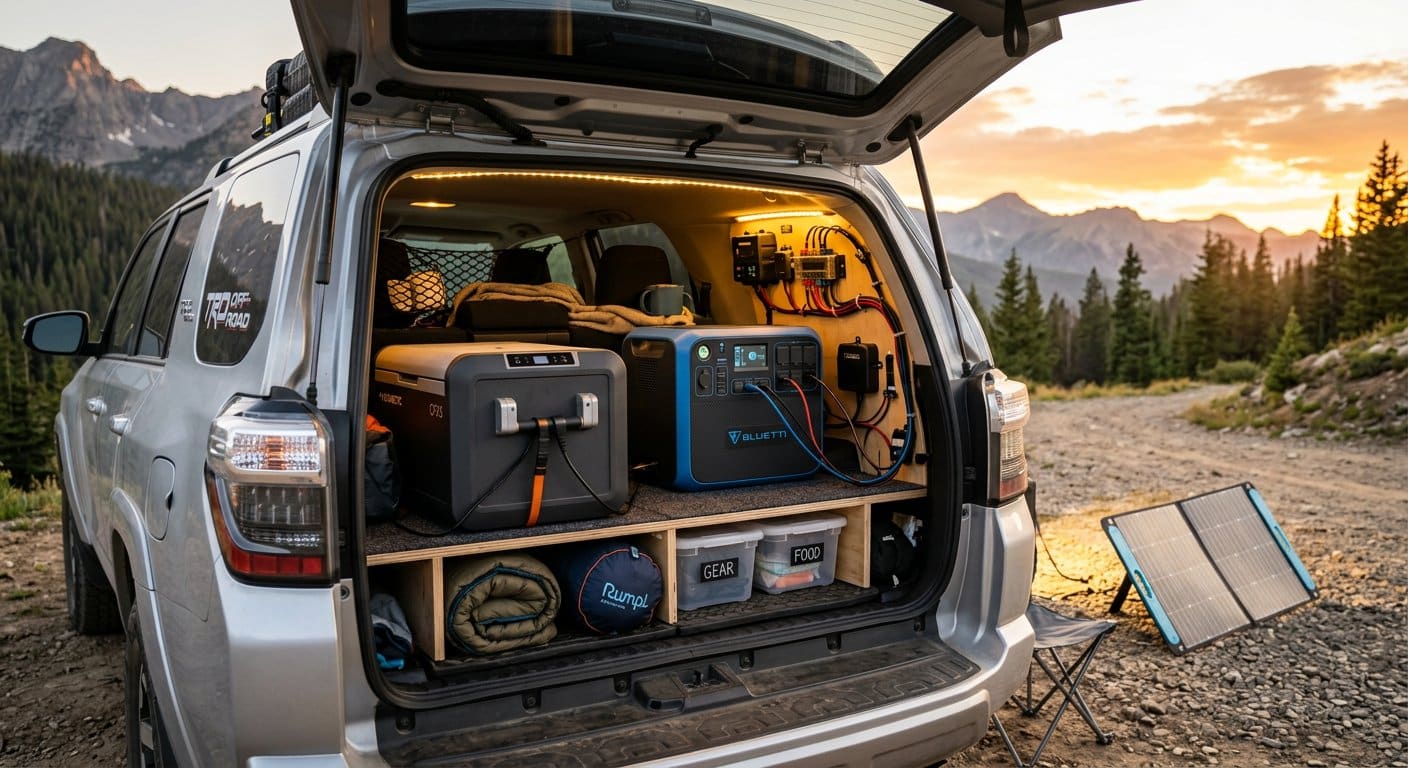
Price the complete installation. Include the battery, compatible charger, protection and distribution, mounting, cable routing, professional labor and access for service. Compare that total with portable equipment that can meet the same load and recharge requirement. A battery’s price per nominal Wh omits much of this decision.
For the tradeoffs across cost, removal, charging and usable energy, see portable power versus an installed auxiliary battery. This is particularly useful if you rent the vehicle, change vehicles often, or also want the supply available at home.
Check 5: What must still work if something fails?
Even if you need a dual battery system for camping loads, separating them doesn’t guarantee that the vehicle will start. A weak starting battery, vehicle electrical fault or unsupported installation can still cause a problem. Verify that the intended isolation works and arrange a suitable recovery plan for the route.
An auxiliary battery also isn’t automatically a jump starter. Some systems provide a documented combining or recovery function; others don’t. Use that function only within the vehicle, battery and system instructions. A portable power station with AC and USB outlets likewise has no implied engine-starting capability.
Inspect how you would switch off a faulty supply, reach the protection devices and keep essential loads supported. Don’t bypass a battery protection warning to finish the night. Damaged, swollen, leaking or unusually hot equipment needs the manufacturer’s stop-use guidance and appropriate assistance.
For medical equipment, use its current manufacturer-supported power arrangement and the treatment-continuity plan agreed with your clinician or equipment provider. A general camping energy example cannot establish medical backup suitability. Keep optional loads from consuming the reserve assigned to that plan.
If you need a dual battery system, have it commissioned using the documentation for the exact components and vehicle. REDARC recommends a suitably qualified auto electrician or installer for its products. OutdoorX4’s system explanation also shows why isolation, mounting and circuit protection belong in the complete arrangement. Its parallel-battery examples aren’t a wiring design for an arbitrary lithium installation.
When you need a dual battery system and when portable power fits
| Your situation | Next decision |
|---|---|
| Modest parked loads, dependable charging and a portable supply that meets the requirement | Keep the removable arrangement and validate it before travel |
| Fixed accessories, repeated use, supported recharge and an approved installation location | Assess whether you need a dual battery system against a complete installation quote |
| Several stationary days with an unresolved daily energy deficit | Solve the recharge or demand problem before choosing more storage |
| An existing system has started losing energy or refusing charge | Diagnose the current fault before buying another battery |
If you already have a bank and it isn’t replenishing during a drive, trace the auxiliary charging fault. If the problem is energy disappearing overnight, identify which camping battery is draining. Those are repair tasks, separate from deciding whether to install a system.
Do renters need a dual battery system?
Suppose you hire an SUV, already own a portable station and expect to recharge at a powered stop between camping stays. First confirm that the station supports the fridge and supplies the measured energy for the longest gap. If it does, you don’t need a dual battery system simply because the fridge runs overnight. Secure the portable equipment and its cables using an arrangement permitted for the vehicle. Check that the refrigerator connection remains reliable with the cargo packed and that the supply can be recharged before the next gap.
When might fixed accessories mean you need a dual battery system?
Now suppose the vehicle regularly carries a fixed fridge and lighting, and you want accessible distribution without unloading a station. You may need a dual battery system to meet that installation preference, provided a supported portable arrangement doesn’t offer the access you require. Give the installer your measured daily demand, usual driving window and available mounting space. Ask for a complete proposal identifying compatible components, connected loads, isolation, service access and the conditions under which charging stops. Compare that proposal with your actual routine before approving the installation.
Do you need a dual battery system for a stationary trip?
For several days in one place, list the energy needed if the expected solar contribution doesn’t arrive. A fixed battery and a portable station both have a finite reserve. You don’t establish that you need a dual battery system by identifying a shortfall in one undersized station; an installed bank must also cover the same interval. Decide whether a larger supported supply, lower demand, a dependable charging stop or a shorter stay resolves it. If none does, revise the trip’s power plan before leaving.
Record the parked load budget, dependable recharge interval, supported outputs, physical installation limits and failure plan. Keep the chosen equipment running through a representative parked interval close to home, using the intended outputs and packed arrangement. Record interruptions and remaining energy, then check the planned recharge opportunity. That trial tests the assumptions behind whether you need a dual battery system. Return to the complete car camping power setup guide to make the overall choice with those observations in hand.