
The “10 Hour” Road TrThe “10 Hour” Road Trip Reality Check
Imagine this scenario: You have just invested in a massive 2000Wh portable power station—maybe a Jackery Explorer 2000 Pro or an EcoFlow Delta 2 Max. You have a long drive ahead of you, roughly 6 hours to your favorite dispersed camping spot in the mountains. You do the mental math: “My wall charger fills this thing in 2 hours. Surely, driving for 6 hours will be enough to top it off from 50% to 100%.”
You plug the heavy-duty cable into your dashboard’s 12V cigarette lighter, hear the fan whir to life, and hit the road.
Two hours later, you stop for gas and check the display. Your heart sinks.
Input: 96 Watts.
Battery Level: 58%.
Time to Full: 14 Hours.
At this rate, you will arrive at camp with a half-empty battery, meaning no electric skillet dinner and no CPAP machine for the full night.
Why is this happening? Is your unit defective? Is the cable broken? Why is the power station car charging slow when the marketing promised “Fast Charging”?
As a technician who specializes in off-grid electrical systems, I answer this specific question more than any other. The short, hard truth is this: Your power station is fine. Your car is the bottleneck. The 12V cigarette lighter port in your dashboard is a relic technology from the 1950s, designed to briefly heat a metal coil to light a cigar, not to continuously power a mobile microwave. It has a strict, unbreakable physical limit of roughly 100 to 120 Watts.
In this definitive technical guide, I am going to explain the physics behind why power station car charging slow is the “normal” state for stock vehicles. More importantly, I will show you the only ways to bypass this limit—using voltage boosters, hardwiring techniques, and DC-DC chargers—to unlock the 500W+ charging speeds you actually need.
Technician’s Rule: You cannot push a fire hose volume of water through a drinking straw. The 12V port is a drinking straw. To charge faster, we need to install a bigger pipe.
Part 1: The Physics of “Slow” (Ohm’s Law Doesn’t Lie)
To understand why you are stuck with a power station car charging slow issue, we need to look at the basic electrical math that governs your car.
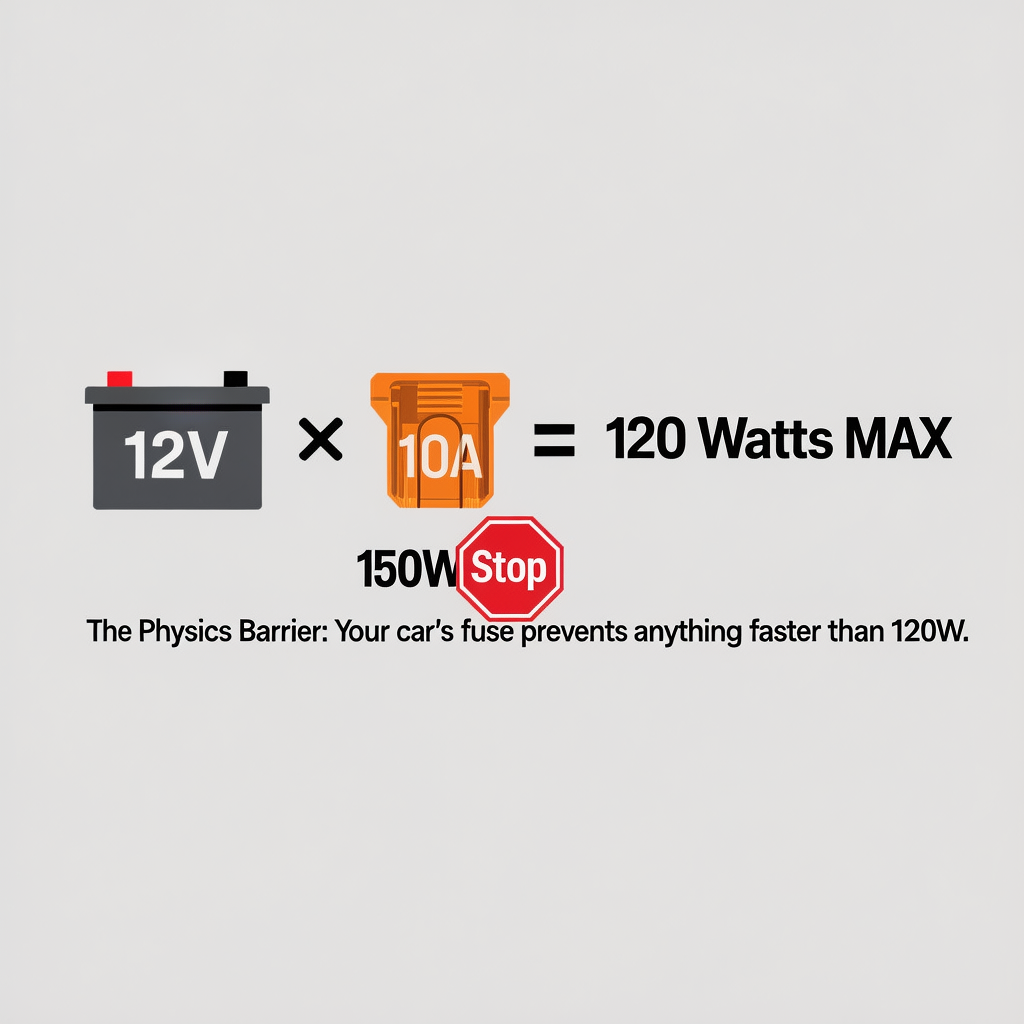
The Formula: Watts (Power) = Volts (Pressure) x Amps (Current)
- Voltage: Your car’s electrical system is nominally 12 Volts. (It fluctuates between 11.8V and 14.4V, but let’s use 12V for easy math).
- Amperage: The fuse protecting your dashboard cigarette socket is almost universally rated at 10 Amps. Sometimes 15A, but usually 10A.
- The Math:
12 Volts x 10 Amps = 120 Watts.
This is the theoretical maximum. It is the absolute ceiling. If you try to pull 121 Watts, the fuse pops to prevent the thin wires in your dashboard from melting and catching fire. If you are seeing speeds around 100W, your power station car charging slow complaint is actually just physics working correctly.
The Safety Margin:
Manufacturers like EcoFlow and Bluetti know this limit. They also know that car voltage can sag. To prevent blowing your fuse every time you plug in, they program the Battery Management System (BMS) to pull only about 80% of the rated capacity.
12V x 8 Amps = 96 Watts.
This is why you see “96W” or “98W” on your screen. It isn’t a bug. It isn’t a defect. It is a calculated safety limit. The power station car charging slow behavior is intentional engineering to keep your car safe.
- External Resource: Ohm’s Law Explained (Fluke) (Nofollow)
Part 2: “Is My Charging Too Slow?” (Benchmarks by Model)
Before you start tearing apart your dashboard to fix the power station car charging slow problem, verify if your speed is actually abnormal. Here are the technician benchmarks for common models I verify on my test bench. If you are within these ranges, your system is working exactly as designed, and your power station car charging slow observation is just the reality of 12V charging.
| Brand | Model | Normal Car Input | Est. Time (0-100%) | Verdict |
|---|---|---|---|---|
| Jackery | Explorer 1000 | 60W – 80W | 14 Hours | Normal. Jackery aggressively limits input to keep plugs cool. |
| EcoFlow | Delta 2 | 96W – 120W | 10 Hours | Normal. Capped at 8A default, adjustable to 4A/6A/8A. |
| Bluetti | EB3A | 80W – 100W | 3.5 Hours | Normal. Smaller battery charges faster due to size, not speed. |
| Anker | 757 (PowerHouse) | 120W | 10 Hours | Normal. Uses max available amperage. |
| Goal Zero | Yeti 1500X | 120W | 14 Hours | Normal. Regulated input. |
The Red Flag:
If you are seeing under 40 Watts (e.g., 25W or 30W) while driving, that is abnormal. That indicates a loose connection, a dying alternator, or a dirty socket causing high resistance. But if you are at 85W+, you are simply hitting the 12V ceiling, and the power station car charging slow status is unavoidable without upgrades.
Part 3: Why Jackery is “Slower” than EcoFlow
I get asked this constantly on forums: “My Jackery only pulls 65W from the car, but my friend’s EcoFlow pulls 110W. Why is my Jackery power station car charging slow?”
It comes down to Engineering Philosophy.
EcoFlow/Bluetti (Performance First):
These brands market themselves on speed. They push the limit of the 10A fuse. They allow the unit to draw up to 9.5A or 10A. This gets you 110W-120W, but it runs the risk of heating up the plug or blowing the fuse in older cars with weak wiring.
Jackery (Safety/Longevity First):
Jackery takes a conservative approach. They artificially limit the car input logic to roughly 7 Amps (approx 80W). Why? Because running 10A continuously through a cheap plastic cigarette plug generates a lot of heat. By limiting it to 7A, the plug stays cool, and the fuse never blows. The trade-off is that power station car charging slow complaints are more common, but melted plug complaints are rare.
- Related Guide: Portable power station specs explained
Part 4: The Voltage Drop Factor (Trunk vs. Dash)
You might have a 100W-capable unit, but you are only getting 75W. You checked the fuse, and it’s 15A. Why is the power station car charging slow speed so persistent?
The answer is Voltage Drop.
The Scenario:
You plugged the power station into the 12V accessory socket in the trunk or cargo area of your SUV to keep it out of the way.
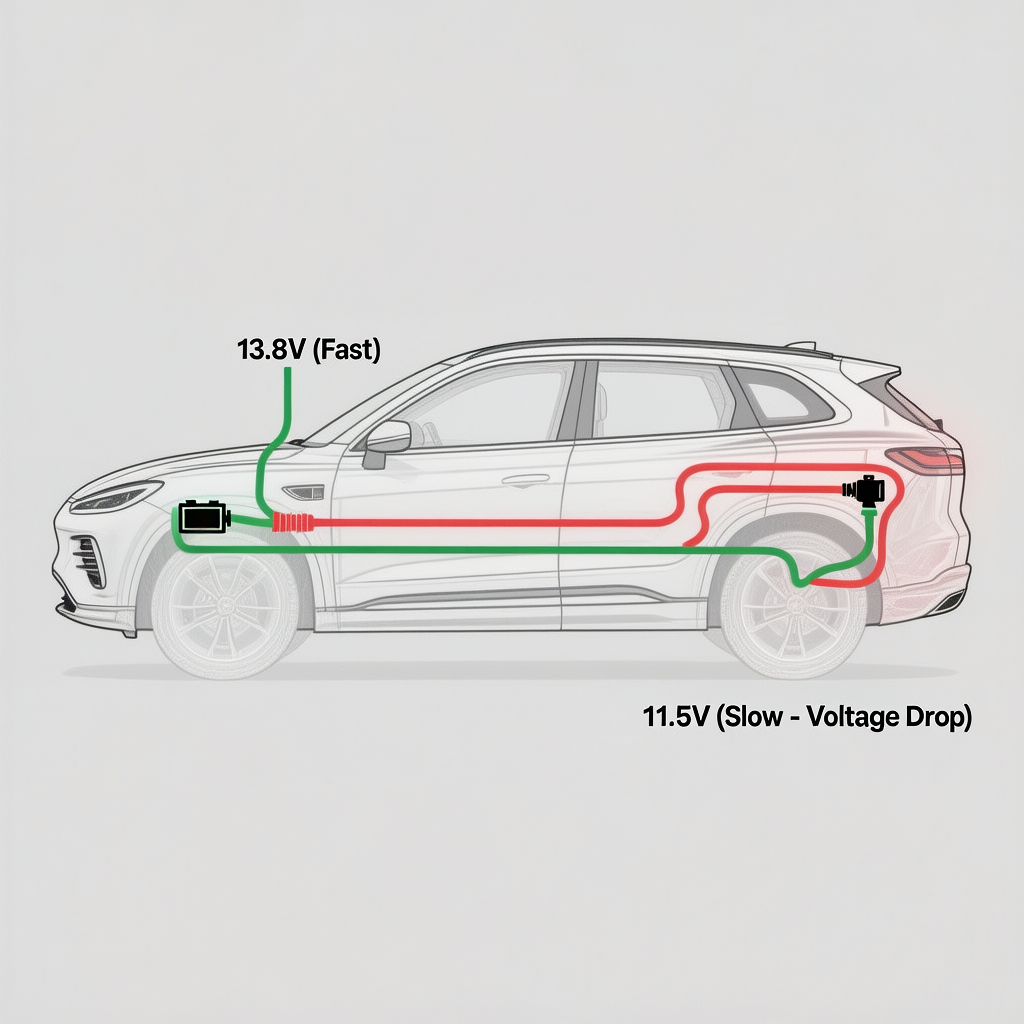
The Physics:
DC electricity hates distance. The wire running from your car battery (in the front engine bay) to the trunk (in the back) is often 15 to 20 feet long. Car manufacturers use the thinnest, cheapest wire possible (usually 18AWG).
- At the Battery: 14.2V (Alternator running).
- At the Trunk Socket: Due to resistance in 20 feet of thin wire, the voltage drops to 11.5V.
The Result:11.5 Volts x 8 Amps = 92 Watts.
If you had plugged it into the front dashboard (only 3 feet of wire), you might get:13.8 Volts x 8 Amps = 110 Watts.
You are losing almost 20 Watts just because of the wiring length. This invisible loss is a major contributor to power station car charging slow issues.
The Technician’s Test:
Move the unit to the front seat and plug it into the dashboard lighter. Does the wattage jump up? If yes, your trunk wiring is the bottleneck causing the power station car charging slow fault.
Part 5: The “Boost” Solution (How to Charge Faster)
If 100W is too slow for you (and for a 2000Wh battery, 20 hours of driving is absurd), you have to bypass the cigarette lighter. You cannot fix the power station car charging slow issue using the standard plug. You must upgrade the connection.
Here are the 3 Technician-Approved Levels of upgrades.
Level 1: The “24V Truck” Trick (For Bluetti/EcoFlow)
- Concept: Power = Volts x Amps. Since we cannot increase Amps (due to wire thickness), we must increase Volts.
- The Hack: If you have access to a 24V vehicle (Semi Truck, some Buses, Military Vehicles, or vintage Land Cruisers), plug it in there.
24V x 8A = 192 Watts.- You just doubled your charging speed instantly without changing any cables.
- Note: Jackery units are usually 12V/24V compatible, but always check your manual first.
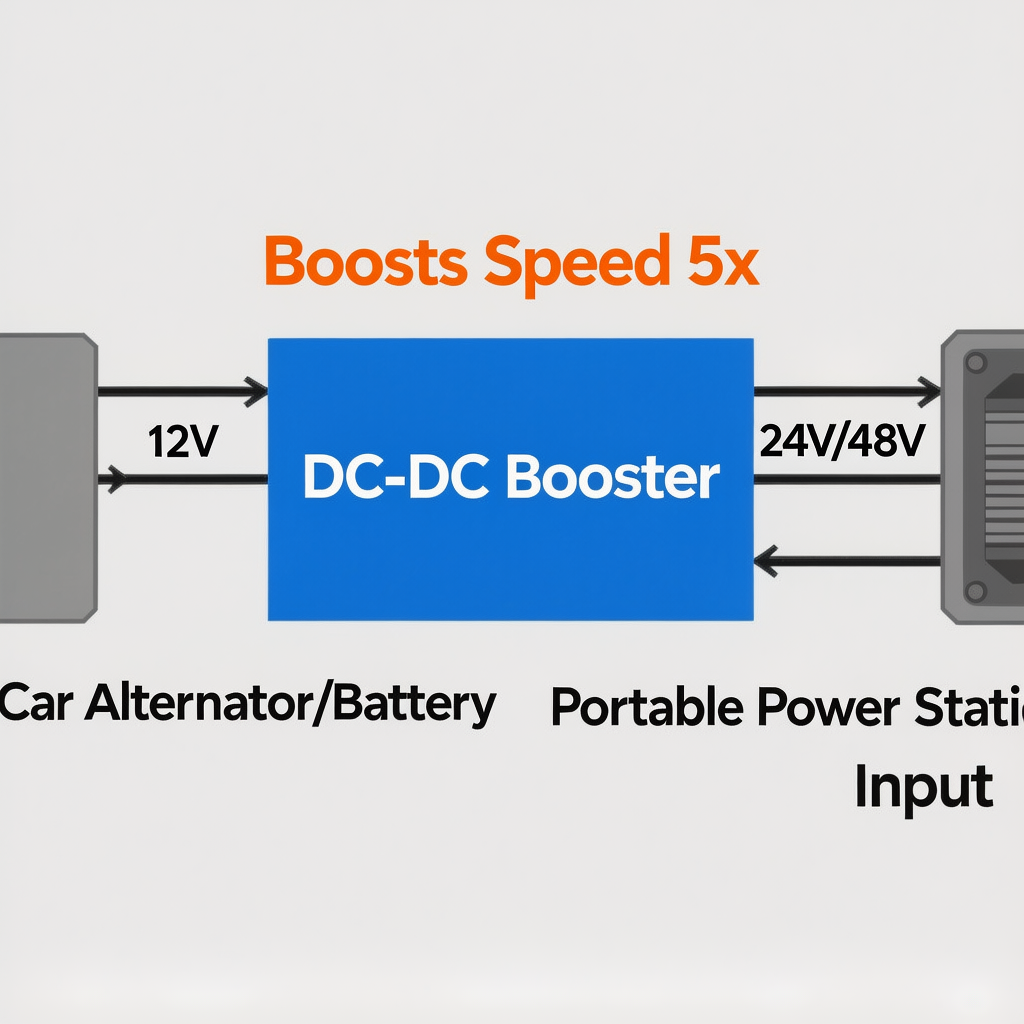
Level 2: The Voltage Booster (Step-Up Converter)
- The Device: A 12V-to-24V Step-Up Converter (Cost: ~$30 on Amazon).
- How it works: It takes 12V from your car and electronically boosts it to 24V constant output.
- The Trick: You wire this converter to the car battery (with a fuse), then plug the output into the Solar Input port of your power station (not the car input port).
- The Result: The power station thinks it is connected to a 24V solar panel. It pulls
24V at 8A = 192 Watts. - Warning: You MUST wire this directly to the battery with a 20A or 30A fuse. Do not run this through the cigarette lighter wiring, or you will melt the dash wires. The input side will draw 20 Amps to create that 24V output. This is a brilliant fix for power station car charging slow woes.
Level 3: The DC-DC Charger (The Pro Solution)
- The Device: Victron Orion-Tr Smart or EcoFlow Alternator Charger.
- How it works: These are industrial-grade chargers hardwired directly to the alternator/battery with thick 4AWG or 6AWG cable. They pull massive current (50A+).
- The Speed: 500W to 800W charging speeds.
- Result: Charges a Delta 2 in 1.5 hours instead of 10 hours. This completely eliminates the power station car charging slow problem. This is how #VanLife pros do it.
- Related Guide: Best portable power station for van life
Part 6: Why Charging Slows Down at 80%
You were getting 100W for hours, but now you are at 85% battery and the input dropped to 40W. You assume the power station car charging slow problem has returned.
No. This is the CV (Constant Voltage) charging curve.
- Lithium batteries are like a water bucket. You can fill them with a fire hose at the bottom (0-80%), but you have to slow down to a trickle at the top (80-100%) to avoid splashing.
- In battery terms, “splashing” means Over-Voltage and heat.
- The BMS automatically throttles the current as the battery voltage rises to its maximum.
- Technician’s Advice: If you are in a rush to reach the next campsite, stop charging at 80%. That last 20% takes almost as long as the first 80%. It is the “Law of Diminishing Returns” applied to batteries.
Part 7: The “AC Inverter” Loophole
There is one other way to bypass the power station car charging slow limit without hardwiring a DC-DC charger, but it comes with a catch.
The Method:
- Buy a Pure Sine Wave Inverter (300W or 500W) for your car.
- Plug the inverter into your car (Hardwired to battery is best, but small ones can plug into 12V sockets).
- Plug your power station’s AC Wall Charger into the car inverter.
The Logic:
Your AC wall charger charges at roughly 300W-400W (depending on model). By using the car inverter, you are feeding it AC power, so it charges at AC speeds.
The Catch:
- Efficiency Loss: Converting DC (Car) -> AC (Inverter) -> DC (Battery) is very inefficient. You lose about 20-30% of energy to heat and fan noise.
- Amperage Limit: If you use a cigarette lighter inverter, you are still limited to 120W. You must hardwire a 500W inverter to the battery to get 300W charging and solve the power station car charging slow limit.
- Engine Strain: This puts a heavy load on your alternator at idle. Ensure you are driving while doing this.
- Related Guide: Pure sine wave vs modified sine wave inverter
Part 8: The “Ecoflow XT60i” Cable Issue
If you own an EcoFlow (Delta or River) and you are experiencing power station car charging slow issues where it is stuck at exactly 8 Amps (approx 96W), check your cable.
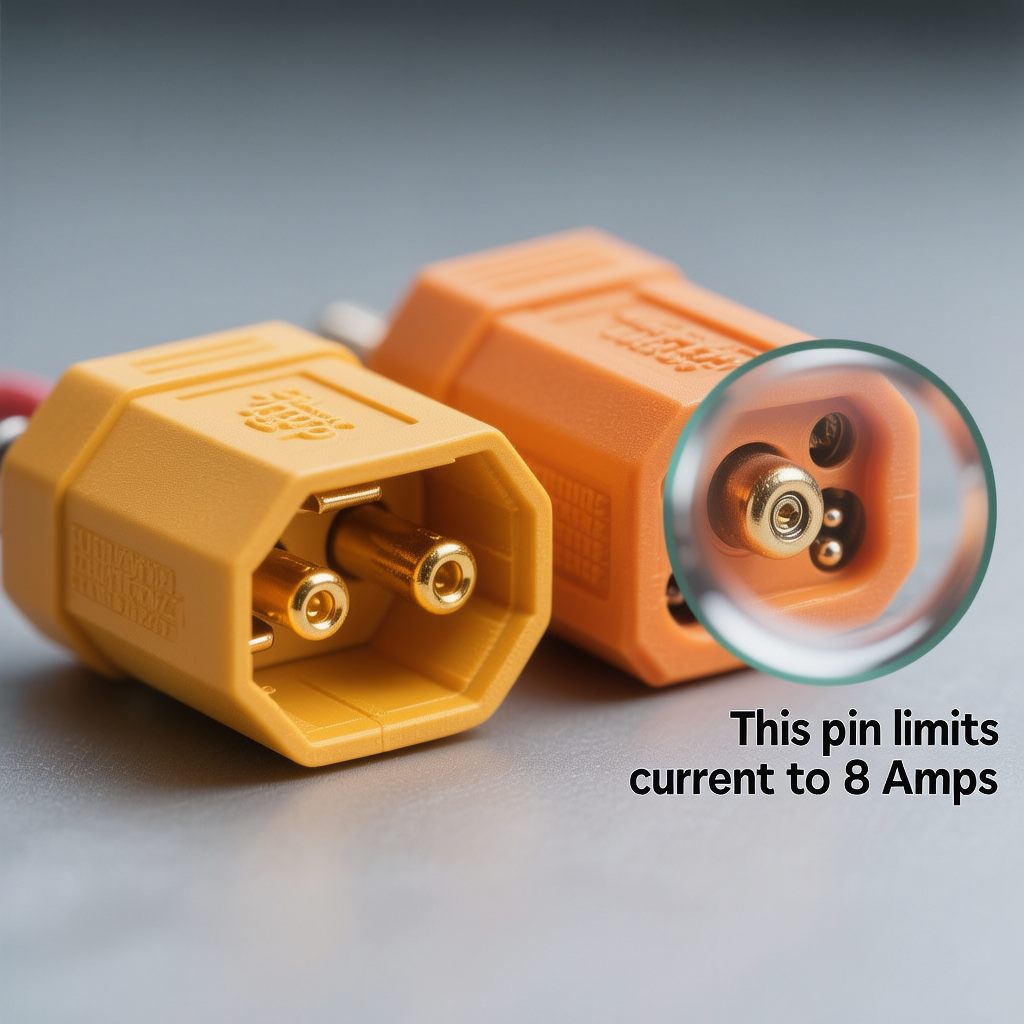
EcoFlow uses a proprietary connector called XT60i.
- Standard XT60 (Yellow): Has 2 pins (Positive/Negative).
- EcoFlow XT60i (Orange): Has 3 pins (Positive/Negative/Signal).
The Signal Pin:
This middle pin tells the EcoFlow unit, “I am a Car Charger.” When it sees this signal, it limits the current to 8A to be safe.
- The Hack: Some users tape over the middle pin or use a generic XT60 solar cable to trick the unit into thinking it is connected to Solar panels. In “Solar Mode,” the EcoFlow will try to pull up to 15A.
- The Risk: Pulling 15A from a 10A car fuse will blow the fuse immediately. Only do this “Solar Mode Hack” if you have hardwired a high-current line directly to the battery.
FAQ – User Questions about Slow Car Charging
Q: Will upgrading my car fuse to 20A allow faster charging?
A: NO. DO NOT DO THIS.
The fuse is rated to protect the wires. The wires in your dash are thin (18AWG). If you put a 20A fuse in, the power station might pull 15A. The wires will overheat, melt the insulation, and catch fire inside your dashboard before the 20A fuse ever blows. Never upgrade a fuse without upgrading the wiring to fix power station car charging slow issues.
Q: My plug is melting. Why?
A: High resistance. If the plug is loose, it creates an electrical arc. 100W is a lot of continuous power for a cheap plastic plug. If it is melting, you have a severe power station car charging slow issue caused by a bad connection. Replace the plug with a high-quality Bakelite (heat resistant) one, or switch to Anderson connectors.
Q: Does “Eco” mode on my car affect charging?
A: Yes. Many modern cars (Subaru, Honda, Toyota) reduce alternator voltage in Eco mode to save fuel. This can drop voltage to 12.0V or even 11.8V. The power station sees this low voltage and stops charging to “protect” the car battery. Switch to “Sport” or “Normal” mode to keep the alternator voltage high (14V).
Q: Why does my fridge stop working when I plug in the car charger?
A: Voltage Sag. The car charger pulls the system voltage down. The fridge (also plugged into the car’s 12V system) senses the drop and triggers its own “Low Voltage Cutoff” protection. You are overloading the car’s 12V bus capacity.
Q: Can I use two cigarette lighters at once to charge faster?
A: Only if your power station has dual inputs (like the EcoFlow Delta Pro or AC200MAX). If it has two inputs, you can run two cables to two different circuits in the car (e.g., one dash, one trunk) to get 200W total and mitigate the power station car charging slow bottleneck.
Conclusion: 100W is the Speed Limit, Not the Engine
If you are using the standard cigarette lighter plug, you must accept that 100 Watts is the speed limit. You aren’t doing anything wrong; the physics of the port simply cannot handle more. No software update or settings tweak will change the thickness of the wires in your dashboard.
If your power station car charging slow situation is untenable (e.g., you have a 3000Wh battery and need it full daily):
- Stop using the cigarette port. It is a toy.
- Hardwire an inverter or a DC-DC charger to your car battery.
- This is the only way to unlock 500W+ charging speeds while driving.
For most casual campers, the 100W trickle charge is just “maintenance” power to keep the fridge running while you drive. Rely on AC or Solar for the heavy lifting. But for the serious traveler, hardwiring is the only path to freedom from power station car charging slow frustrations.
For more technical tips on wiring and safety, check out how to crimp MC4 connectors or read our guide on solar system fusing guide.