
TL;DR: Running a fridge in winter SUV camping is actually easier on your battery than summer running. The colder ambient temperature means the fridge compressor runs less often, using 20 to 30 percent less power. A fridge that draws 4A average in summer may draw only 2.5 to 3A in winter. The bigger challenge in winter is your battery. Lead acid batteries lose 30 to 40 percent of their capacity in freezing temperatures. LiFePO4 batteries lose about 20 percent. A 100Ah LiFePO4 that provides 80Ah usable in summer provides only 64Ah usable in winter. Plan for this reduced capacity by oversizing your battery by 30 percent for winter trips.
I learned how to run a fridge in winter SUV camping during a January trip in Utah where nighttime temperatures dropped to -8C. My 200Ah LiFePO4 battery had worked flawlessly all summer. But on that winter trip, I noticed the fridge was running less but the battery was depleting faster than expected. I checked the battery monitor and saw the voltage dropping more quickly than I was used to. The cold had reduced my usable capacity by about 15 percent.
That trip taught me that winter camping with a fridge requires different planning than summer. The fridge uses less power but the battery delivers less power. You need to account for both factors when sizing your system for cold weather. Here is everything I have learned about how to run fridge in winter SUV camping over multiple cold weather trips.
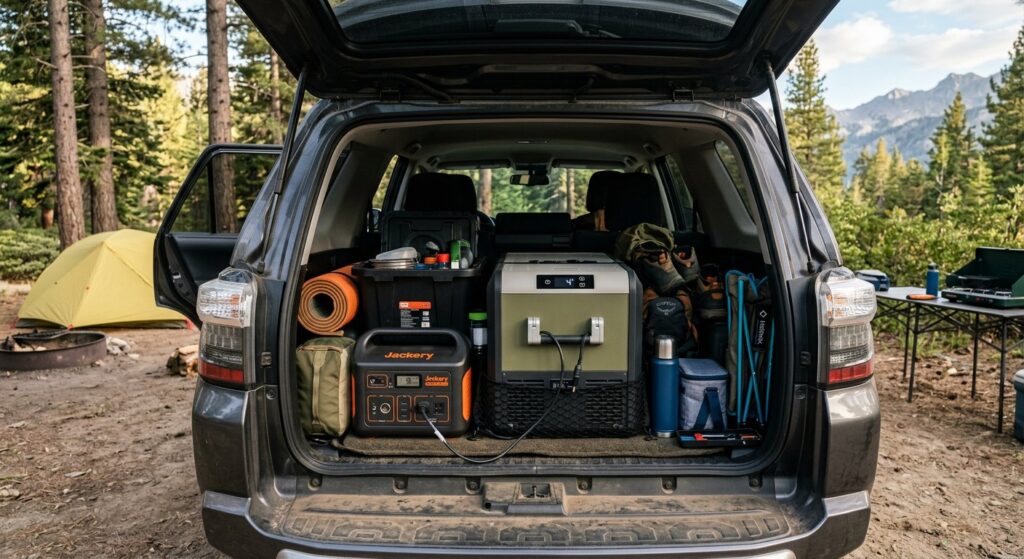
How to Run Fridge in Winter SUV Camping: Power Consumption Differences
Quick Answer: A 12V compressor fridge uses 20 to 30 percent less power in winter because the compressor cycles less often. In summer 95F weather, my fridge draws 4.5 to 5A average. In winter -5C weather, it draws 2.5 to 3A average. Over 10 hours, that is 45 to 50Ah in summer versus 25 to 30Ah in winter. The fridge is easier on the battery in winter.
I tested my Alpicool C15 fridge across multiple winter trips to get real data on how to run fridge in winter SUV camping correctly. Here are the numbers:
| Outside Temperature | Season | Average Amp Draw | 10 Hour Consumption | Compressor Run Time |
|---|---|---|---|---|
| 95F (35C) | Summer | 4.5-5.0A | 45-50Ah | 70-80% |
| 70F (21C) | Spring/Fall | 3.0-3.5A | 30-35Ah | 40-50% |
| 32F (0C) | Winter | 2.5-3.0A | 25-30Ah | 25-35% |
| 15F (-10C) | Deep Winter | 2.0-2.5A | 20-25Ah | 20-30% |
The fridge uses noticeably less power in winter. But there is a catch. The food inside the fridge does not need as much cooling because the ambient temperature is already low. However, if you keep the fridge set to the same temperature as summer (35 to 38F), the compressor still cycles on when needed. In very cold weather, the fridge may barely run at all if the ambient temperature is close to the set point.
Our how to run fridge in SUV camping overnight guide covers summer fridge operation in detail. Winter is different and this article covers those differences.
How to Run Fridge in Winter SUV Camping: Battery Capacity Loss
Quick Answer: Cold temperatures reduce battery capacity. Lead acid batteries lose 30 to 40 percent of usable capacity below freezing. LiFePO4 batteries lose 15 to 25 percent. A 100Ah LiFePO4 that provides 80Ah usable at 70F provides only about 60 to 65Ah usable at -10C. You need to oversize your battery by 30 percent for winter camping to compensate for this loss.
This is the part of how to run fridge in winter SUV camping that most people miss when planning their system. They calculate the fridge power draw based on summer numbers, then choose a battery that works in summer. In winter, the same battery delivers less usable capacity. The fridge may draw less power, but the battery also holds less power. You need to calculate both factors together.
| Battery Type | Rated Capacity | Usable at 70F | Usable at 32F | Usable at 15F | Capacity Loss |
|---|---|---|---|---|---|
| 50Ah Lead Acid | 50Ah | 25Ah | 17Ah | 14Ah | 32-44% |
| 100Ah Lead Acid | 100Ah | 50Ah | 35Ah | 30Ah | 30-40% |
| 50Ah LiFePO4 | 50Ah | 40Ah | 34Ah | 30Ah | 15-25% |
| 100Ah LiFePO4 | 100Ah | 80Ah | 68Ah | 60Ah | 15-25% |
| 200Ah LiFePO4 | 200Ah | 160Ah | 136Ah | 120Ah | 15-25% |
Here is the real-world calculation from my winter camping setup. My fridge draws 2.5A in winter. Over 10 hours that is 25Ah. My 200Ah LiFePO4 provides about 140Ah usable at -5C. After 2 nights of fridge use, I have used 50Ah and have 90Ah remaining. Even with the 25 percent capacity loss, my system runs the fridge for 5 nights without any charging.
If I had a 100Ah LiFePO4 battery, I would have about 70Ah usable in winter. Three nights at 25Ah each would use 75Ah. That is over the usable limit. The battery would be dead on the third morning. That is why I run a 200Ah battery for winter trips.
Our diesel heater drain car battery overnight guide covers similar cold weather battery calculations for diesel heater users.
How to Run Fridge in Winter SUV Camping: Fridge Placement and Ventilation
Quick Answer: In winter, place the fridge inside the vehicle cabin rather than in the cargo area if possible. The cabin stays warmer from body heat and the diesel heater. The fridge does not have to work as hard to maintain temperature. Make sure the fridge ventilation grilles are clear of snow and ice. Do not pack snow or ice around the fridge for insulation. The fridge needs airflow to operate efficiently.
Fridge placement in winter is different from summer. In summer, you want the fridge in a cool, ventilated spot out of direct sun. In winter, you want the fridge somewhere that stays above freezing so it does not have to work hard to keep the interior at 35F.
On my winter trips, I keep the fridge inside the rear passenger area of my 4Runner. The diesel heater keeps the cabin at about 60F overnight. The fridge compressor barely cycles. On one trip with outside temperatures at -10C, the fridge ran for only about 3 hours total over an entire 10-hour night. That is 30 percent run time versus 70 percent in summer.
Check the fridge ventilation grilles regularly in winter. Snow and ice can block the intake or exhaust vents. If the vents are blocked, the compressor overheats and the fridge stops cooling. I had this happen on a snowy trip. A 2-minute check and wipe of the vents fixed it.
How to Run Fridge in Winter SUV Camping: Battery Charging Challenges
Quick Answer: Charging a LiFePO4 battery below freezing requires special consideration. Most LiFePO4 batteries cannot be charged below 0C. The BMS disconnects the charging circuit to prevent lithium plating on the anode. If your battery is at -5C and you try to charge from the alternator or solar, the BMS will block the charge. You need a battery with a built-in heater or you need to keep the battery above freezing while charging.
This is a critical part of how to run a fridge in winter SUV camping that most people overlook. You can discharge LiFePO4 batteries down to -20C. That is fine. But you cannot charge them below 0C. If you drive to a new campsite in the morning and the battery is still below freezing, the alternator will not charge it. The battery stays at whatever SOC it was at.
The fix is to keep the battery inside the heated cabin or use a battery with self-heating function. Some LiFePO4 batteries like the Dakota Lithium and certain Battle Born models have built-in heating pads that warm the cells before allowing charging.
If your battery does not have self-heating, keep it inside the cabin where the diesel heater keeps temperatures above freezing. I keep my 200Ah LiFePO4 battery in a battery box inside the passenger cabin. Even when outside temperatures drop to -15C, the cabin stays at 5 to 10C from body heat and the heater. The battery stays warm enough to charge the next day.
Solar charging in winter is less effective anyway. Days are shorter and the sun is lower in the sky. A 100W panel that produces 400 to 500Wh in summer may produce only 150 to 250Wh in winter. Do not rely on solar alone for winter fridge operation. Use alternator charging when driving between campsites.
Our alternator not charging lithium battery fix guide covers what to do when your battery is too cold to accept a charge.
Winter Fridge Failure Case: Battery Too Cold to Charge
Quick Answer: The most common failure in winter fridge camping is a battery that cannot be recharged because it is below freezing. You arrive at a new campsite after driving for 2 hours. The alternator was running the whole time. But the battery stayed at 40 percent SOC because the BMS blocked charging. The next night, the fridge drains the remaining 40 percent. By morning, the battery is dead.
This happened to a friend on a winter trip in Colorado. He had a 100Ah LiFePO4 battery mounted under the hood of his truck. The battery was at -10C when he started driving. The alternator ran for 3 hours. The battery SOC did not increase at all because the BMS blocked charging below freezing. He arrived at camp with 50 percent battery. He ran the fridge overnight and used 30 percent. The next morning the battery was at 20 percent. He had to drive to town to warm the battery up and charge it.
The fix is to keep the battery inside the heated cabin. Or use a battery with self-heating pads. Or install a battery heating pad that turns on when temperatures drop below 5C. These pads draw about 30 to 50W and keep the cells warm enough for charging.
I run my battery inside the cabin and have never had this issue. If you are building a winter camping system, battery placement is as important as battery capacity.
How to Run Fridge in Winter SUV Camping: Optimization Tips
Quick Answer: Pre-cool the fridge at home before the trip. Use frozen water bottles as thermal mass. Keep the fridge inside the cabin where it is warmer. Use a battery with self-heating or keep the battery inside. Monitor both fridge consumption and battery temperature with a battery monitor. Adjust your fridge temperature setting based on ambient conditions.
Here are the specific winter optimization strategies I use for how to run fridge in winter SUV camping that work in subzero conditions:
Pre-cool at home. Same as summer. Start the fridge on AC power 12 hours before leaving. Load cold food. This is effective in any season.
Use frozen water bottles. In winter, the frozen bottles help maintain temperature. When the fridge is inside a warm cabin, the frozen bottles prevent the compressor from cycling too often. They also provide cold drinking water as they melt.
Keep the fridge inside the cabin. The warmer ambient temperature reduces fridge power draw. If the cabin is at 10C from the heater, the fridge barely runs. If the fridge is in the cargo area at -5C, it has to work harder to maintain 2C because the temperature difference is larger.
Monitor battery temperature. Use a battery monitor with temperature sensors. The Victron SmartShunt measures battery temperature. If it drops below 5C, move the battery to a warmer location or activate a heating pad.
Set the fridge to a slightly warmer temperature. In winter, food does not spoil as quickly. Setting the fridge to 40F (4C) instead of 35F (2C) saves 10 to 15 percent power. The food stays safe because the ambient temperature is already cold.
Our 12V fridge not cooling fix guide covers what to do if your fridge is not performing as expected in cold weather.
FAQ: How to Run Fridge in Winter SUV Camping
Does a 12V fridge use less power in winter?
Yes. A fridge draws 20 to 30 percent less power in winter because the compressor cycles less often. Expect 2.5 to 3A average instead of 4 to 5A in summer.
Can I use a lead acid battery for winter fridge camping?
You can, but lead acid loses 30 to 40 percent of capacity below freezing. A 100Ah lead acid battery provides only 30 to 35Ah usable in winter. That is barely enough for one night with a fridge. Lithium is strongly recommended for winter camping.
How do I charge my battery in winter if it is below freezing?
Keep the battery inside the heated cabin. Use a battery with self-heating pads. Or install a battery heating pad. Never try to charge a LiFePO4 battery below 0C.
What size battery do I need for winter fridge camping?
A 100Ah LiFePO4 battery works for 1 to 2 nights in winter. A 200Ah battery works for 4 to 5 nights. Oversize by 30 percent compared to summer because of cold-weather capacity loss.
Should I keep my fridge inside the cabin in winter?
Yes. The warmer cabin temperature reduces fridge power draw. If the cabin is at 10C, the fridge does not have to work as hard to maintain 2C. Just make sure the fridge ventilation grilles are clear.
Can I use solar to charge my fridge battery in winter?
Solar works in winter but at reduced output. Expect 30 to 50 percent of summer production on clear winter days. On cloudy winter days, expect 10 to 20 percent. Alternator charging is more reliable for winter camping.
For a complete guide on setting up your camping power system for all seasons, our best basic power setup for SUV bed camping covers battery selection, wiring, and cold weather considerations from scratch.
Conclusion
How to run fridge in winter SUV camping is different from summer in several important ways. The fridge uses less power because of the cold ambient temperature. But the battery delivers less capacity because of the same cold. You need to account for both factors when planning your winter camping power system.
The fridge draws 2.5 to 3A in winter versus 4 to 5A in summer. A 100Ah LiFePO4 battery provides about 65 to 70Ah usable in winter versus 80Ah in summer. The net effect is that a 100Ah battery supports about the same fridge runtime in winter as in summer, despite the reduced capacity, because the fridge draws less power.
For winter camping, keep the battery inside the cabin where it stays above freezing. Use a battery monitor to track both capacity and temperature. Pre-cool the fridge before the trip. And plan for reduced solar output if you rely on solar charging. With these adjustments, running a fridge in winter is straightforward and reliable.
My setup has worked through 3 winters of regular camping in temperatures down to -15C. The combination of a 200Ah LiFePO4 battery inside the cabin and a fridge set to 38F keeps food cold and beer cold without any issues. The battery never drops below 60 percent on a single overnight trip.
Sources
Battery University BU-808: Cold temperature effects on battery capacity and charging
Marine How To: LiFePO4 battery cold weather charging limits and BMS behavior
Victron Energy: Wiring Unlimited battery temperature monitoring and management