
The reality of outdoor travel is that power management can make or break your camping experience. Learning how to prevent SUV camping power loss overnight is essential for anyone who relies on refrigerators, lights, fans, and electronic devices during off-grid adventures.
Many campers underestimate their overnight electricity consumption. During my early trips, I often went to bed believing I had enough battery capacity, only to wake up with a dead battery and no reliable power source.
After years of testing different batteries, appliances, and charging methods, I discovered that how to prevent SUV camping power loss overnight is not simply about installing a larger battery. It requires understanding power consumption, reducing unnecessary loads, and building an efficient energy system.
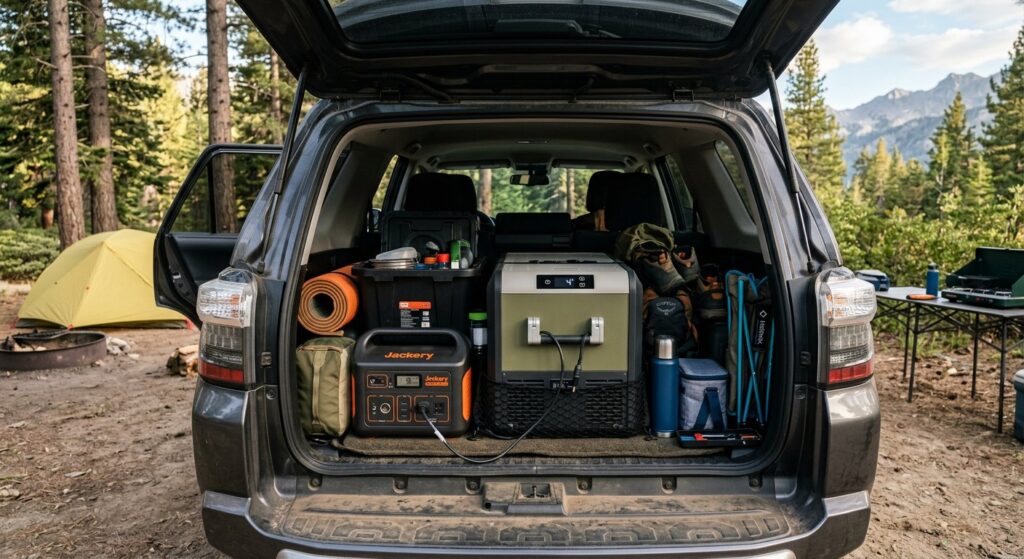
The Shocking Truth: Your Battery Drain Is Worse Than You Think
Let me share some hard numbers from my real-world testing. During my first comprehensive power audit, I discovered that my basic overnight setup was consuming far more power than I had anticipated.
In mild spring weather, my fridge, a couple of LED lights, and a small fan were drawing approximately 45 amp-hours overnight. But when the temperature climbed during summer trips, that number jumped to 70 amp-hours or more. On particularly hot nights in the desert, I was using nearly my entire 100 amp-hour battery capacity just to get through until morning.
The problem compounds in extreme temperatures. During a summer trip to the Mojave Desert, my battery drain was nearly double what I experienced in mild weather. The heat caused my fridge compressor to run almost continuously, and the additional cooling measures I employed only added to the power consumption.
This is why understanding how to prevent suv camping power loss overnight is so crucial for any serious camper.
The 7 Main Culprits of Overnight Power Drain
After years of testing and refinement, I have identified the seven primary causes of overnight power loss in SUV camping setups.
Culprit #1: Your 12V Fridge
Your refrigerator is likely the single largest consumer of power overnight. The exact consumption varies dramatically based on ambient temperature. In mild weather around 60-70°F, a typical 40-60L compressor fridge consumes 30-42 amp-hours overnight. But in hot weather of 85-95°F, that jumps to 54-66 amp-hours. In extreme heat above 100°F, it can reach 72-84 amp-hours as the compressor runs almost continuously to maintain temperature.
Culprit #2: Parasitic Electrical Loads
These are the silent power thieves that many campers overlook. Safety devices like CO and propane detectors typically draw 0.5-1 watt each. Your stereo system maintains memory, alarm systems draw power, GPS units in standby mode, and dashboard components all contribute to parasitic drain. In my testing, these loads were consuming 20-40 amp-hours overnight – equivalent to running my fridge for 4-8 hours with no benefit.
Culprit #3: Inefficient Lighting
Traditional incandescent bulbs draw 10-20 watts each, consuming 8-16 amp-hours overnight. Halogen bulbs are slightly better but still significant. LED bulbs, however, consume only 1-3 watts while providing equal or better illumination – just 0.8-2.4 amp-hours overnight.
Culprit #4: Temperature Control Systems
Electric space heaters draw 10-15 amps continuously. Portable AC units draw 10-20 amps. More efficient alternatives: propane heaters with 12V fans draw 1-2 amps, while 12V fans for cooling draw 0.5-1 amp.
Culprit #5: Device Charging
Smartphones draw 5-10 watts (4-8 amp-hours overnight), tablets 10-15 watts (8-12 amp-hours), laptops 30-60 watts (24-48 amp-hours). Charge all devices during the day when you have access to additional power sources.
Culprit #6: Inverter Standby Consumption
A 2000W inverter in standby mode can consume 12 amp-hours overnight – that is 12% of your battery capacity doing nothing useful. Only turn on your inverter when you actually need AC power.
Culprit #7: Battery Type Limitations
Lead-acid batteries provide only 50-60% of their rated capacity before damage occurs. LiFePO4 batteries offer 80-100% usable capacity, longer cycle life, and better efficiency for off-grid applications. You can learn more about lithium battery technology from Battle Born Batteries.
An older or poorly maintained battery may not deliver its full rated capacity.
7 Proven Solutions to Prevent SUV Camping Power Loss Overnight
Solution #1: Calculate Your Power Needs
The first step in understanding how to prevent SUV camping power loss overnight is knowing exactly how much electricity your camping setup uses.
Every device consumes power differently. A refrigerator, lighting system, fan, inverter, and charging devices can quickly drain a battery if consumption is not properly calculated.
List all devices you will run overnight, determine their power draw in amps, estimate runtime, and calculate total consumption. My typical setup: fridge 28Ah + LED lights 8Ah + fan 12Ah + CO detector 4Ah = 52Ah total. With a 100Ah LiFePO4 battery, I have 48Ah buffer.
Solution #2: Pre-Cool and Pre-Charge
Start cooling your fridge 24-48 hours before your trip. Pre-chill all food and beverages. Set the temperature 5°F colder before bed. This reduced my fridge consumption by 25-30%. Fully charge your battery before the trip and top up during the day.
Solution #3: Eliminate Parasitic Loads
Before bed: turn off all interior lights, unplug all device chargers, turn off stereo completely, disable GPS units, turn off inverter, check for dashboard lights, use battery-powered lanterns.
Solution #4: Optimize Fridge Usage
Set temperature to 35-40°F, minimize door openings, keep fridge full, use frozen water bottles, park in shade, ensure good ventilation, use insulated cover. These strategies can reduce consumption by 25-40%.
Solution #5: Use Efficient Lighting
Switch to LED lighting (1-3W) or battery-powered lanterns/headlamps. This reduces lighting consumption from 8-16Ah to 0.8-2.4Ah overnight – a 70-90% reduction.
Using efficient equipment is one of the easiest ways to improve your setup. When considering how to prevent SUV camping power loss overnight, reducing unnecessary energy consumption is often more effective than simply adding more battery capacity.
Solution #6: Manage Temperature Efficiently
For cold nights: use sleeping bags rated for the temperature, wear warm clothing, use propane heater with 12V fan (1-2A), pre-warm sleeping area, use hot water bottles.
For hot nights: park in shade, create cross-ventilation, use 12V fan (0.5-1A), sleep with damp towel, elevate sleeping area.
Solution #7: Charge Strategically During the Day
Morning drive 1-2 hours, solar charging at midday, additional driving in afternoon, and final top-up before nightfall. Using a properly designed solar charging system can greatly improve off-grid energy management. Professional solutions from Victron Energy are widely used in RV and off-grid power applications.
Real-World Results
With my optimized setup, I reduced overnight consumption from 60-70Ah to 40-50Ah – a 30% reduction. This experience showed me that how to prevent SUV camping power loss overnight is mainly about efficiency, preparation, and choosing the right equipment.
With my LiFePO4 battery upgrade, I now have 80-100Ah usable capacity, providing a comfortable 30-50Ah buffer each night. This allows me to extend trips from 1-2 nights to 3-5 nights without recharging.
Common Mistakes to Avoid
Mistake #1: Not knowing your power consumption. Solution: Use a battery monitor or calculate manually.
Mistake #2: Using inefficient devices. Solution: Upgrade to LED lighting and efficient appliances.
Mistake #3: Leaving devices plugged in. Solution: Unplug everything before bed.
Mistake #4: Not pre-cooling your fridge. Solution: Pre-cool 24-48 hours before the trip.
Mistake #5: Using AC devices without an inverter properly. Solution: Only use DC devices overnight or use inverter selectively.
Mistake #6: Ignoring parasitic loads. Solution: Turn off or unplug all non-essential devices.
Mistake #7: Not having a backup plan. Solution: Always have a contingency power source.
FAQ: Your Overnight Power Questions Answered
How to prevent SUV camping power loss overnight?
The best way to understand how to prevent SUV camping power loss overnight is to combine several strategies: calculate your power needs, pre-cool your fridge, remove unnecessary electrical loads, use efficient lighting, optimize temperature control, and recharge strategically during the day.
What is the biggest power drain in SUV camping?
Your 12V fridge is usually the single largest power consumer. In mild weather: 30-42Ah overnight. In hot weather: 54-66Ah overnight. In extreme heat: 72-84Ah overnight. Other significant drains include parasitic loads (20-40Ah), inefficient lighting (8-16Ah), and device charging (4-48Ah).
How much power does a 12V fridge use overnight?
This depends on ambient temperature, fridge size, insulation, usage patterns, and set temperature. General guidelines: small fridge (30-40L): 20-35Ah, medium fridge (40-60L): 35-50Ah, large fridge (60-80L): 50-70Ah in mild to moderate conditions.
For more detailed information, check out my article on how many Wh does a 12V fridge use per day.
How can I make my SUV fridge more efficient?
Seven effective strategies: pre-cool before the trip, pre-chill all food, set optimal temperature (35-40°F), minimize door openings, keep fridge full, use frozen water bottles, ensure good ventilation. These can collectively reduce consumption by 25-40%.
What is the best battery type for overnight SUV camping?
LiFePO4 batteries offer the best combination: 80-100% usable capacity, 10-15 year lifespan, and excellent efficiency. Lead-acid batteries provide only 50-60% usable capacity before damage and have shorter lifespans of 2-7 years.
How do I calculate my overnight power needs?
List all devices, determine power draw in amps, estimate runtime, calculate total consumption (Amps × Hours). For watts: Amps = Watts ÷ 12V. Add a 20-30% buffer for unexpected draws or inefficiencies.
How long will my battery last overnight?
Runtime (hours) = Usable Battery Capacity ÷ Total Power Draw (in amps). Example: 100Ah LiFePO4 ÷ 5A = 20 hours. 100Ah lead-acid (50Ah usable) ÷ 5A = 10 hours.
People Also Ask
How do I know if my SUV battery is draining overnight?
Signs: dead battery in the morning, dim lights, slow cranking, battery warning light, reduced performance from 12V devices. Check with a battery monitor or voltage measurements before bed and in the morning.
What is the minimum battery size for overnight SUV camping?
Basic setup: 50-100Ah. Moderate setup: 100-200Ah. Heavy setup: 200-300Ah. Extreme setup: 300Ah+. For most campers, 200Ah provides a good balance of capacity and portability.
How do I prevent my car battery from dying while camping?
For vehicle starting battery: use a dual battery setup with isolator, start vehicle daily, use jump starter as backup. For deep cycle: use separate battery, avoid discharging below 50% (lead acid) or 20% (LiFePO4), recharge regularly.
How do I keep my phone charged while camping?
Best methods: charge during the day (driving, solar), use power bank, use 12V USB chargers, enable low-power mode, download offline content, use airplane mode when not needed.
What is the best way to heat my SUV overnight?
Most efficient options: propane heater with 12V fan (1-2A), diesel heater (1-3A), electric blanket (3-5A), hot water bottles (0A), sleeping bags (0A). Avoid electric space heaters (10-15A).
How do I keep my SUV cool overnight?
Best methods: park in shade, create cross-ventilation, use 12V fan (0.5-1A), sleep with damp towel, elevate sleeping area. Avoid portable AC (10-20A).
What should I do if my battery dies overnight?
Immediate actions: stay calm, check for simple fixes, use jump starter, call for help. Prevention: calculate more accurately, increase capacity, improve charging, add backup power source.
For more on troubleshooting, check out my article on why is my SUV camping battery draining overnight.
How do I extend my battery life while camping?
Seven ways: reduce power consumption, pre-cool and pre-charge, eliminate parasitic loads, use DC devices, charge strategically, avoid deep discharges, maintain your battery properly.
Final Thoughts
Understanding how to prevent SUV camping power loss overnight is about knowledge, planning, and execution. A reliable camping power system does not always require the biggest battery or the most expensive equipment.
By calculating energy usage, improving efficiency, and choosing suitable charging solutions, you can turn overnight power loss from a common frustration into a problem that can be completely avoided.
What’s Next?
Now that you understand how to prevent overnight power loss, you might be interested in:
How Many Wh Does a 12V Fridge Use Per Day?
Why Is My SUV Camping Battery Draining Overnight?
How Do I Stop My Fridge from Killing My Power Station Overnight?