
Quick Direct Answer for Off-Grid Campers & Overlanders: A standard 35L to 50L portable 12V compressor fridge uses 350 to 500 Watt-hours (Wh) per 24 hours in moderate weather (70°F to 80°F / 21°C to 27°C). Under extreme summer heat (90°F to 105°F / 32°C to 41°C inside an enclosed vehicle), consumption climbs to 650 to 900 Watt-hours (Wh) per day.
To run a 12V camp fridge indefinitely without losing power, use a minimum 500Wh LiFePO4 portable power station paired with a 100W to 200W solar panel, powering the fridge strictly through a native 12V DC cigarette or Anderson port.
Determining exactly how many watt hours to run a 12v fridge camping are required is the foundation of any off-grid electrical setup. Unlike home appliances that run on constant AC grid power, a portable 12V camping fridge cycles on and off based on ambient cabin temperatures, insulation quality, and internal food volume.
Knowing how many watt hours to run a 12v fridge camping prevents you from waking up to spoiled groceries or finding your power station drained to 0%.
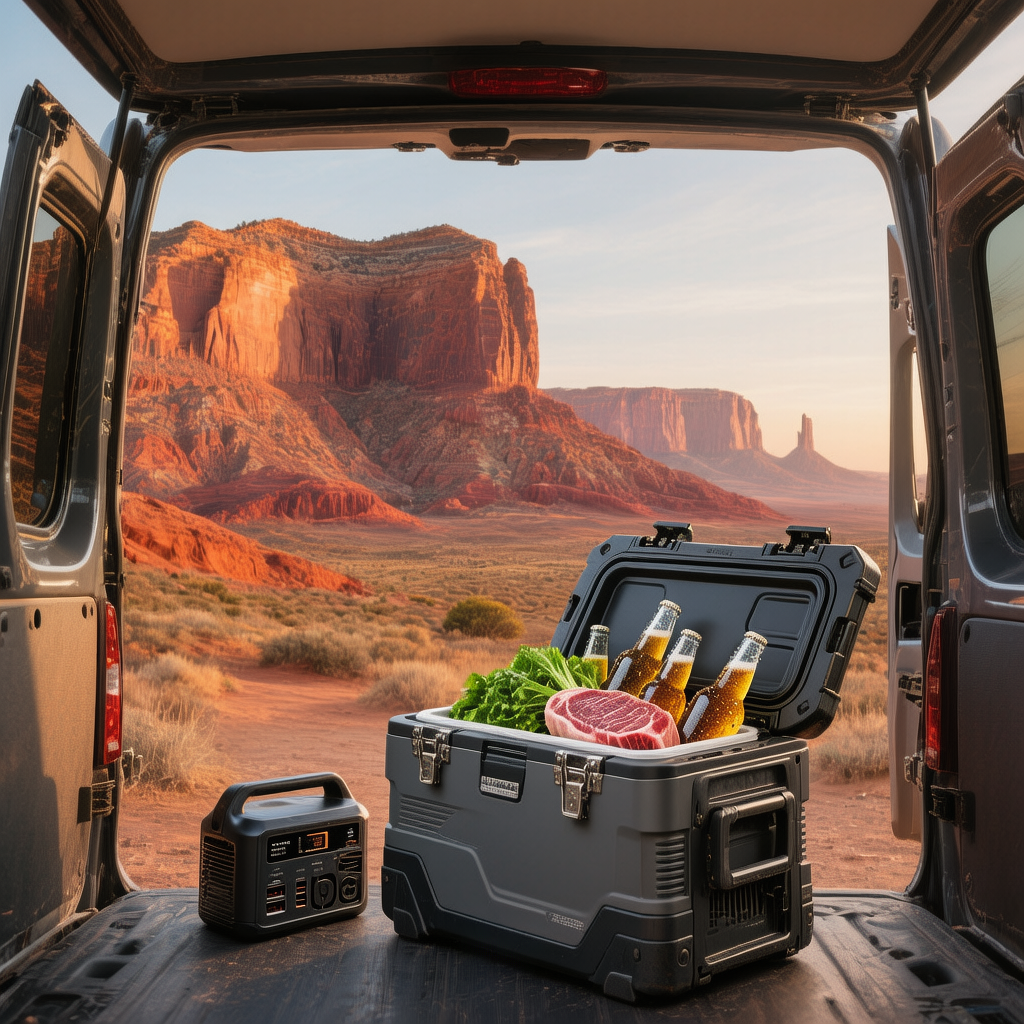
1. How Many Watt Hours to Run a 12V Fridge Camping: Duty Cycle vs. Continuous Watts
To calculate how many watt hours to run a 12v fridge camping, you must look past the rated wattage sticker and analyze the compressor’s hourly duty cycle.
[ Active Cooling Phase: 45W Draw ] ----> (Compressor reaches 35°F) ----> [ Idle Phase: <1W Standby ]
              |                                                                     |
              +<--------------- (Internal temp climbs to 38°F) <--------------------+
A quality 12V compressor cooler (such as Dometic, ICECO, or ARB) pulls between 40 Watts and 60 Watts while the motor is actively spinning. Once the compartment drops to your set temperature (typically 35°F / 2°C), the compressor disengages, drawing less than 1 Watt on standby.
The percentage of time the compressor runs each hour dictates your true 24-hour power drain:
- 25% Duty Cycle (Spring / 65°F Ambient): The compressor runs for 15 minutes per hour (45W X 0.25h = 11.25Wh/hour). Total daily consumption is 270 Watt-hours (Wh).
- 45% Duty Cycle (Summer / 85°F Ambient): The compressor runs for 27 minutes per hour (45W X 0.45h = 20.25Wh/hour). Total daily consumption is 486 Watt-hours (Wh).
- 75% Duty Cycle (Heatwave / 100°F+ Vehicle Cabin): The compressor runs for 45 minutes per hour (45W X 0.75h = 33.75Wh/hour). Total daily consumption is 810 Watt-hours (Wh).
This fluctuating duty cycle explains why figuring out how many watt hours to run a 12v fridge camping depends heavily on surrounding environmental temperatures. For standardized refrigeration testing protocols and off-grid efficiency benchmarks, review the U.S. Department of Energy Appliance and Energy Standards.
2. 24-Hour Power Consumption Benchmark Table
The reference table below outlines how many watt hours to run a 12v fridge camping across various seasonal temperatures and cooler sizes:
| Cooler Volume & Style | Compressor Draw | 24h Mild Weather (65°F–75°F) | 24h Hot Summer (85°F–100°F) | Minimum Power Station Needed |
| Compact Console (15L – 25L) | 35W – 45W | 200Wh – 280Wh | 400Wh – 500Wh | 300Wh LiFePO4 Battery |
| Mid-Size Single Zone (35L – 50L) | 45W – 55W | 320Wh – 450Wh | 650Wh – 850Wh | 500Wh – 1000Wh Battery |
| Large Dual Zone (65L – 95L) | 60W – 80W | 550Wh – 750Wh | 900Wh – 1300Wh | 1000Wh – 1500Wh Battery |
| Thermoelectric Cooler (Peltier) | 50W (Constant) | 1200Wh (100% Run) | Ineffective in Heat | Not Recommended for Camping |
Different internal capacities determine how many watt hours to run a 12v fridge camping you will consume over a 24-hour window. If your vehicle electrical architecture supports multiple overland accessories alongside your fridge, reference our complete pillar blueprint on building a car camping power setup.
3. The 5 Major Factors That Spike Daily Watt-Hour Drain
Understanding what spikes power consumption allows you to minimize battery depletion before you leave home:
       +-------------------------------------------------------------+
       |         Factors Influencing 12V Fridge Energy Draw          |
       +-------------------------------------------------------------+
              |                      |                      |
    [ Ambient Cabin Heat ]   [ Food Thermal Mass ]    [ Power Connection ]
    - 120°F in parked car    - Loading warm drinks    - AC Inverter vs Native DC
    - Triples duty cycle     - Draws 150Wh to chill   - Inverter wastes 250Wh/day
              |                      |                      |
              +----------------------+----------------------+
                                     |
                                     v
                 [ Total Daily Energy Accumulation (Wh) ]
1. In-Vehicle Ambient Temperature
Extreme cabin heat dramatically increases how many watt hours to run a 12v fridge camping by forcing the cooling mechanism to run almost continuously. An unventilated SUV trunk under full midday sun reaches 120°F to 140°F (49°C to 60°C). Under these conditions, the thermal gradient forces heat through the fridge walls rapidly.
2. Loading Unchilled Groceries
Putting warm drinks at 75°F into your camp cooler forces the compressor into high-speed turbo mode for hours. Cooling 10 pounds of warm food down to 35°F adds 150Wh to 200Wh of direct battery load.
3. AC Inverter Losses vs. Direct 12V DC
Plugging a 12V cooler into a power station’s 120V AC wall outlet forces the internal pure sine wave inverter to remain turned on. The inverter’s idle parasitic current burns 15W to 25W continuously, adding up to 300Wh of pure waste per day.
Using native 12V DC ports significantly reduces how many watt hours to run a 12v fridge camping compared to running an AC inverter. For real-world laboratory efficiency graphs, check our analysis on AC vs DC efficiency differences on power stations.
4. Ventilation Clearance Around Intake Vents
Compressor coils require cool airflow to expel extracted heat. Stacking sleeping pads or gear tight against the air vents causes heat buildup, longer cycle times, and inflated Watt-hour consumption.
5. Operating as a Deep Freezer
Setting your unit to 0°F (-18°C) to keep frozen goods solid triples compressor runtime compared to normal 35°F refrigeration, requiring over 900Wh daily.
4. Battery Sizing: How Many Watt Hours to Run a 12V Fridge Camping Off-Grid
Match your calculated daily energy load against your trip duration and charging equipment:
Scenario A: Weekend Trips (1 to 2 Nights / No Solar)
For a short weekend trip, calculating how many watt hours to run a 12v fridge camping helps you pick the right 500Wh battery bank. A 500Wh to 700Wh portable power station comfortably runs a 40L fridge for 24 to 36 hours at 75°F ambient temperature without any intermediate recharging.
Scenario B: Extended Off-Grid Camping (3+ Nights with Solar)
On multi-day overland journeys, tracking how many watt hours to run a 12v fridge camping ensures your solar panel array matches daily consumption. Pairing a 500Wh to 1000Wh power station with a 100W to 200W portable folding solar panel creates a balanced self-sustaining loop:
- Daily Fridge Draw: ~400Wh
- Daily 100W Solar Yield (4.5 Sun Hours): ~380Wh – 450Wh
- Net Daily Result: Zero battery deficit.
When charging your power bank from your vehicle while driving, be mindful of auxiliary port limits by reviewing our breakdown on cigarette lighter charging limits.
5. Field Tactics to Cut Fridge Power Consumption by 40%
Adopting smart thermal habits cuts your daily energy draw without sacrificing food safety:
+------------------------------------------------------------------------------------+
|                      12V Fridge Power-Saving Protocols                             |
+------------------------------------------------------------------------------------+
| [X] Pre-chill cooler to 34°F at home via AC grid 12 hours before packing.         |
| [X] Pre-cool all beverages and groceries inside your home kitchen refrigerator.   |
| [X] Fit an insulated transit thermal jacket around the fridge outer shell.         |
| [X] Power the cooler strictly through native 12V DC / Anderson power plugs.        |
| [X] Leave at least 3 inches of open clearance around compressor exhaust vents.    |
| [X] Crack vehicle windows 1/2 inch with rain guards to vent interior cabin heat.  |
+------------------------------------------------------------------------------------+
- Pre-Chill on Wall Power: Power the fridge from your residential wall outlet the night before your trip. Loading only pre-chilled goods eliminates the energy spike needed to pull down warm items. Keeping internal food temperatures below 40°F (4°C) is vital to stop foodborne bacteria, as specified by the USDA Food Safety and Inspection Service.
- Fit an Insulated Transit Jacket: Protective canvas and neoprene transit covers add an extra thermal barrier, reducing radiant heat absorption and cutting compressor runtimes by 20% in hot cabins.
- Prevent Starter Battery Depletion: If running directly from your car’s auxiliary sockets, learn why 12V fridges drain SUV batteries overnight and how built-in low voltage cutoffs prevent getting stranded.
Implementing thermal insulation practices reduces how many watt hours to run a 12v fridge camping by up to 40%.
6. Frequently Asked Questions
How many watt hours to run a 12v fridge camping for 24 hours on a 500Wh battery?
Understanding how many watt hours to run a 12v fridge camping shows that a 500Wh battery supports a 40L cooler for roughly 24 to 36 hours in moderate weather ($75^\circ\text{F} / 24^\circ\text{C}$). In high summer heat exceeding $95^\circ\text{F}$ ($35^\circ\text{C}$), that same 500Wh capacity will be depleted in approximately 14 to 18 hours.
How many solar watts do I need to keep a 12V fridge running indefinitely?
A 100W to 120W portable solar panel generating 4 to 5 peak sun hours delivers roughly 360Wh to 480Wh per day, perfectly matching the daily power demand of an efficient 40L compressor fridge. For extreme summer heat or overcast regions, a 200W solar panel provides the necessary safety buffer.
What is the difference between Watt-hours (Wh) and Amp-hours (Ah) for a 12V fridge?
Amp-hours measure electrical charge, while Watt-hours measure total energy. To convert Amp-hours to Watt-hours at 12 Volts, multiply Ah by 12 ($\text{Watt-hours} = \text{Amp-hours} \times 12\text{V}$). A fridge drawing 30Ah per day at 12V consumes 360 Watt-hours (Wh).
Summary & Actionable Recommendations
Budgeting 350 to 500 Watt-hours per day covers standard 35L to 50L camping fridges in normal seasonal weather. Pairing a 500Wh LiFePO4 battery with a 100W to 200W solar panel and powering the cooler directly over 12V DC delivers a sustainable off-grid setup that keeps your food fresh indefinitely.