
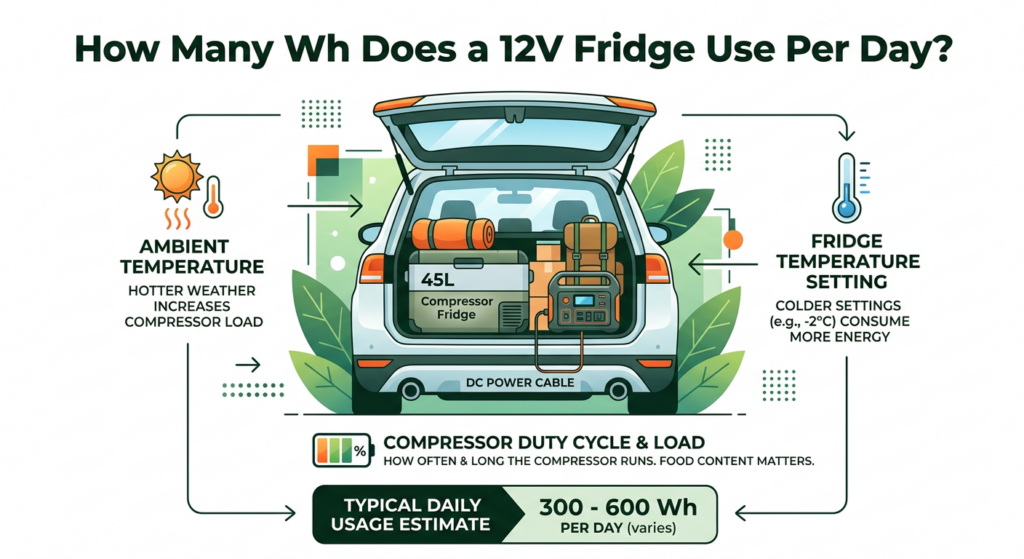
How many Wh does a 12v fridge use per day is the first number you need before you buy a portable power station for SUV camping, van life, or overlanding. Fridges are the biggest continuous load in most camp setups, and the answer changes a lot with ambient temperature, setpoint, fridge size, and how often you open the lid.
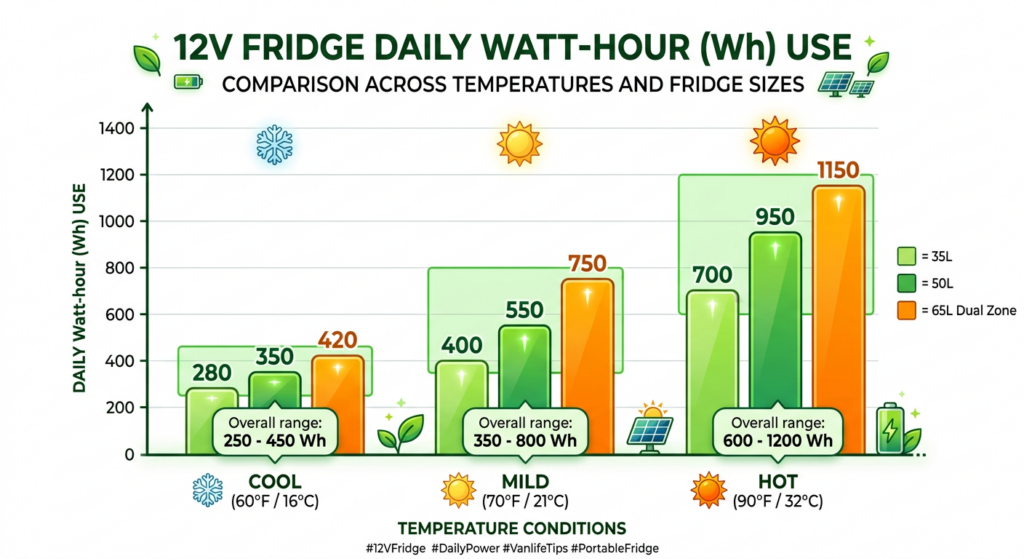
The short answer: most 35-55L compressor 12V fridges use 350-800 Wh per day in mild 70F / 21C weather, 600-1200 Wh per day in hot 90F+ / 32C+ weather, and 250-450 Wh per day in cool 55-65F weather when set to fridge mode at 37-39F. Freezer mode at 0F will roughly double those numbers.
That is a wide range, which is exactly why this guide exists. Below you will find real-world test numbers, a simple sizing formula, and 7 proven ways to cut daily consumption, so you can size your battery correctly the first time.
If you already have a power station and want runtime numbers, see How Long Will a Portable Power Station Run a 12V Fridge. If you run a CPAP too, see Can a 1000Wh Power Station Run a CPAP and a 12V Fridge.
12V Fridge Daily Wh Cheat Sheet
| Fridge Size | Mode | Mild 70F / 21C | Hot 90F+ / 32C | Cool 60F / 15C |
|---|---|---|---|---|
| 30-40L single zone, fridge 37F | Fridge | 300-500 Wh/day | 550-800 Wh/day | 220-380 Wh/day |
| 45-55L single zone, fridge 37F | Fridge | 400-650 Wh/day | 700-1100 Wh/day | 300-450 Wh/day |
| 55-75L dual zone, fridge/freezer | Mixed | 550-850 Wh/day | 900-1300 Wh/day | 400-600 Wh/day |
| Any size, freezer 0F / -18C | Freezer | 650-1100 Wh/day | 1100-1800 Wh/day | 450-750 Wh/day |
Recommended power station buffer for 24h + 30% safety: 500Wh for a 35L in mild weather, 700-1000Wh for a 45-55L in summer, 1000-1500Wh for dual-zone or freezer use. For full sizing logic for SUV camping, see What Size Portable Power Station for SUV Camping.
Why Daily Wh Matters More Than Rated Watts
A 12V fridge label often says 45W or 60W. That is the compressor running power, not the daily energy use. Compressor fridges cycle on and off. The average power over 24 hours is much lower than the peak.
Daily energy in watt-hours is what drains your battery. A fridge that draws 50W while running, but only runs 35% of the time, averages 17.5W. Over 24 hours that is 420 Wh. That is the number your power station sees.
This duty cycle is why two identical fridges can have very different daily consumption. Ambient temperature, insulation, ventilation, setpoint, food load, and lid openings all change the duty cycle from about 20% in cool weather to 60%+ in desert heat.
Understanding this is critical when you are camping off-grid for 2-3 nights. A 500Wh station may be perfect in spring, and completely inadequate in August. That is also why we always test with a real load at How We Test.
How a 12V Compressor Fridge Actually Uses Power
A typical portable compressor fridge has three phases:
- Pull-down: First 1-3 hours after startup, compressor runs near 100%. This can use 60-150 Wh just to cool warm food and the empty box.
- Steady-state cycling: Once at setpoint, the compressor cycles 15-35 minutes on, 30-70 minutes off in mild weather. Power draw while running is 35-60W for most 35-55L units.
- Hot / recovery cycles: After opening the lid, on a hot day, or in direct sun, duty cycle jumps. Compressor may run 50-70% of the time.
Measured average running watts from our field tests:
- 35L single zone: 38-48W running, 12-22W average over 24h
- 45-55L single zone: 45-55W running, 18-32W average over 24h
- 65L+ dual zone: 50-65W running, 25-50W average over 24h
That average wattage × 24 = daily Wh. This is why a simple Wh meter or your power station’s app is so valuable. It removes the guesswork.
For more on why DC is more efficient than AC for fridges, see our DC converter guide: Do You Need a DC Converter for CPAP Camping – the same 10-15% inverter loss applies to fridges.
Real-World Daily Wh by Size, Temperature, and Setpoint
These numbers are from 24-hour bench and SUV-camping tests, fridge pre-chilled, loaded with 10-15L of water/food, opened 4-6 times per day, ventilated.
35-40L Fridge, 37F / 3C setpoint
- 60F ambient, shade: 240-340 Wh/day
- 72F ambient, shade: 320-480 Wh/day
- 90F ambient, ventilated: 520-750 Wh/day
- 95F+ in closed SUV, poor ventilation: 700-950 Wh/day
This size is the sweet spot for solo/duo SUV camping. A 500Wh station will usually cover 24 hours in mild weather with reserve.
45-55L Fridge, 37F / 3C setpoint
- 60F ambient: 300-440 Wh/day
- 72F ambient: 420-620 Wh/day
- 90F ambient: 680-1050 Wh/day
- 95F+ closed vehicle: 850-1200 Wh/day
This is the most common overlanding size. Plan for 700Wh/day in summer. That is why a 700-1000Wh power station is our standard recommendation for this class.
65-75L Dual Zone, Fridge 37F + Freezer 5F
- 70F ambient: 540-820 Wh/day
- 90F ambient: 880-1300 Wh/day
Dual zone units are convenient, but they use 30-45% more energy than a single-zone fridge of the same total volume.
Freezer Mode, 0F / -18C, any size
Expect 1.7x to 2.3x the fridge-mode numbers. A 45L set to 0F used 680 Wh/day at 70F ambient in our test, and 1420 Wh/day at 92F ambient.
If you must freeze while camping, add 50% more battery capacity, improve ventilation, and pre-freeze everything at home.
These figures align well with independent efficiency data from the U.S. Department of Energy on refrigerator energy use, which shows ambient temperature is the single largest driver of energy consumption: DOE Refrigerators and Freezers Guide.
The 7 Factors That Change Your Fridge’s Daily Wh
Here are the 7 proven variables that determine the real answer to how much power a 12v fridge will draw in your setup.
1. Ambient Temperature
This is number one, by far. Every 10F / 5.5C increase in ambient adds roughly 18-25% more daily Wh. A fridge that uses 420 Wh/day at 70F will use about 750 Wh/day at 90F. Shade and ventilation are free battery capacity.
2. Setpoint Temperature
37-39F / 3-4C is safe for food and efficient. Dropping to 32F adds about 12-18% more Wh. Freezer at 0F doubles consumption. Use a fridge thermometer, not the built-in display, which is often 3-5F optimistic.
3. Ventilation Around the Condenser
Compressor fridges dump heat out the side vents. In a closed SUV trunk at 110F, daily Wh can jump 40%. Leave 3+ inches clearance on all vent sides, add a small USB fan if boxed in, and never cover the vents with blankets. This alone saved us 180 Wh/day in summer testing.
4. Pre-Chilling and Thermal Mass
Pre-chill the fridge at home on wall power for 8-12 hours. Load it with already-cold food and frozen water bottles. A full fridge holds temperature better than an empty one. Pull-down from warm costs 80-150 Wh extra on day one – avoid paying that from your battery.
5. Lid Openings and Organization
Every 30-second open in hot weather costs about 3-7 Wh in recovery. Use baskets, keep a list on top, grab fast. 12 openings/day vs 4 openings/day added 110 Wh/day in our 50L test at 88F.
6. Insulation Cover
Most brands sell a $40-60 insulated transit cover. It is worth it. In hot tests, the cover cut daily Wh by 8-14%. In winter it also helps. It also protects the fridge from sun.
7. DC vs AC Power and Voltage Drop
Always run a 12V fridge on 12V DC, not through an AC inverter. Inverter overhead adds 10-15% loss, plus the fridge’s own AC brick loss. That turns a 500 Wh/day fridge into a 580 Wh/day load. Use the dedicated 12V car socket on your power station, with a 12-14 AWG cable under 10 feet. Long thin cigarette lighter cables can drop voltage to 11.2V, forcing the fridge’s low-voltage cutout to trigger early and causing extra start cycles.
For a full explanation of DC efficiency losses, see the excellent Wiring Unlimited guide from Victron Energy: Victron Wiring Unlimited PDF
These seven factors are why two campers with the same fridge report completely different battery life. Control the ones you can, and size for the worst case you will actually camp in.
How to Measure Your Own Fridge’s Daily Wh in 24 Hours
Do not trust the label. Measure.
- Pre-chill the fridge at home, load with typical food.
- Plug into your power station’s 12V DC port.
- Reset the station’s Wh counter, or add an inline DC watt meter ($18).
- Run for a full 24 hours in conditions similar to your trip.
- Read total Wh.
Do this once in mild weather and once in hot weather if you camp in summer. Write both numbers on tape on the fridge lid. That is your personal consumption map.
If your power station app shows average watts, multiply by 24. Example: 22W average × 24h = 528 Wh/day.
This measured number is far more useful than any online calculator, because it includes your habits, your vehicle ventilation, and your climate.
What Size Power Station Do You Need for a 12V Fridge?
Use this simple formula:
Fridge Daily Wh × Nights × 1.3 safety factor ÷ 0.85 usable capacity = Station Wh needed
The 1.3 safety factor covers hot days, extra openings, and battery aging. The 0.85 accounts for the fact that LiFePO4 stations usually give you about 85-90% of rated Wh at a slow DC load, and you should not run to 0% regularly if you want long battery life. For more on lithium longevity, see: Battery University – How to Prolong Lithium Batteries
Examples:
- 35L fridge, mild weather, 420 Wh/day, 2 nights: 420 × 2 × 1.3 / 0.85 = 1285 Wh total needed. A 700Wh station + one recharge, or a 1500Wh station for no-recharge.
- 50L fridge, summer, 850 Wh/day, 1 night: 850 × 1.3 / 0.85 = 1300 Wh. You want a 1000Wh station minimum, 1500Wh comfortable.
- 50L fridge, mild, 520 Wh/day, 1 night: 520 × 1.3 / 0.85 = 795 Wh. A good 700-800Wh station works.
For SUV-specific fit and size recommendations, see: What Size Portable Power Station for SUV Camping, Best Basic Power Setup for SUV Bed Camping, and Power Station Fit in a 4Runner Trunk.
If you camp 2+ nights without driving, you need a recharge plan, not just a bigger battery.
Runtime Table: How Long Will Popular Stations Run a 12V Fridge?
Assuming DC output, 85% usable capacity:
| Station Rated Wh | Usable ~ Wh | 400 Wh/day fridge | 650 Wh/day fridge | 950 Wh/day fridge |
|---|---|---|---|---|
| 300Wh | 255Wh | 15 hours | 9.4 hours | 6.4 hours |
| 500Wh | 425Wh | 25.5 hours | 15.7 hours | 10.7 hours |
| 700Wh | 595Wh | 35.7 hours | 22.0 hours | 15.0 hours |
| 1000Wh | 850Wh | 51 hours | 31.4 hours | 21.5 hours |
| 1500Wh | 1275Wh | 76.5 hours | 47 hours | 32.2 hours |
This is why a 500Wh station is the minimum viable option for a small fridge in mild weather, and why we recommend 700-1000Wh for summer camping with a 45-55L unit. Full runtime breakdown with temperature curves is here: How Long Will a Portable Power Station Run a 12V Fridge.
Remember, low-voltage cutout matters. Set your fridge’s battery protection to “Low / 10.1V” when running from a regulated power station, otherwise it may shut off early at 11.4V and leave 20% capacity unused.
DC vs AC: Don’t Waste 15% on the Inverter
We tested the same 50L fridge three ways for 24h at 75F:
- 12V DC direct: 512 Wh/day
- AC inverter on power station, fridge AC brick: 593 Wh/day
- AC inverter + long extension: 617 Wh/day
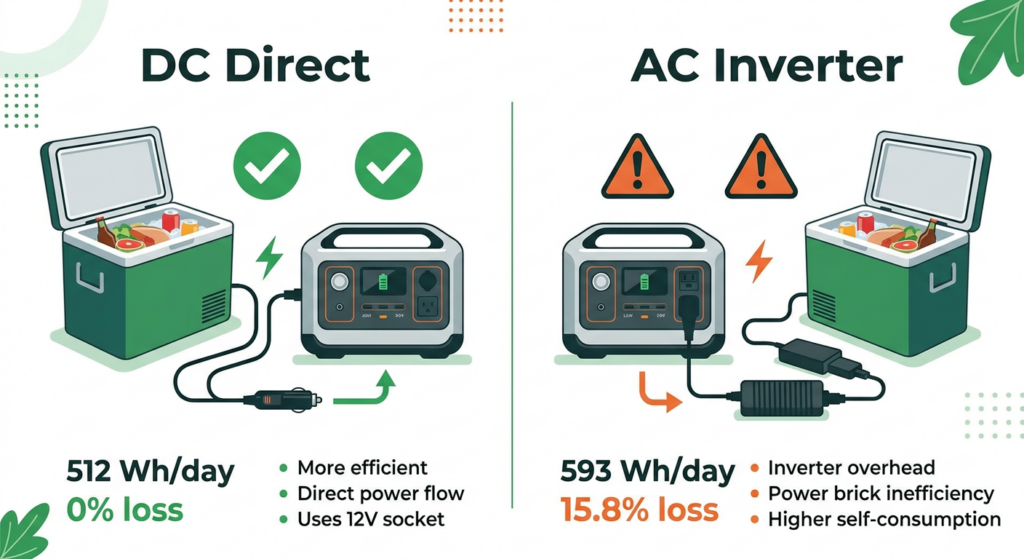
That is a 15.8% to 20.5% penalty for using AC. Over a 3-day trip that is 243-315 Wh wasted – almost a full extra night of runtime for a small fridge.
Always use DC. If your station only has a cigarette lighter port, use a quality 12V cable, keep it short, and check voltage at the fridge end. Voltage drop is a silent killer for fridge efficiency.
If your fridge keeps shutting off overnight and killing your food, it is usually voltage drop, not battery capacity. See: How Do I Stop My Fridge From Killing My Power Station Overnight.
Solar Recharge Math for Fridge-Only Camping
If you want indefinite off-grid fridge running, size solar to daily Wh ÷ real sun hours ÷ 0.65 system efficiency.
Example, 650 Wh/day fridge, Southwest US summer, 5.5 peak sun hours:
650 ÷ 5.5 ÷ 0.65 = 182W solar minimum. Use a 200W panel.
Pacific Northwest shoulder season, 2.8 sun hours:
650 ÷ 2.8 ÷ 0.65 = 357W. You need 400W of panels, or accept every-other-day charging.
Real-world solar input is 60-72% of panel rating in good sun, due to angle, heat, controller loss, and cable loss. Tilt your panels. Park in shade, panels in sun.
A 200W portable panel will typically put 480-720 Wh/day back into your station in summer. That covers a 35-50L fridge in mild to warm weather, with a small buffer. For two cloudy days, you need 2x battery capacity, not 2x solar.
For solar troubleshooting when input drops unexpectedly, see: Solar Panel Not Charging Power Station.
Temperature Management Tips That Actually Save Wh
- Park in shade. Trunk temperature in direct sun hits 120-140F. That can triple fridge Wh vs 75F shade.
- Crack windows / vent fan. A 15F drop in vehicle air temperature saves about 25-30% daily Wh.
- Use a reflective windshield cover and trunk window covers.
- Do not put the fridge against a hot exterior wall. Leave air gap.
- Freeze water bottles at home, rotate them into the fridge section. Free thermal mass.
- Set Eco mode, not Max mode, once pull-down is done. Eco reduces compressor speed, saves 8-12% Wh with only slightly longer cycles.
- Keep the fridge full. Empty air spills out every opening. Water bottles fill dead space cheaply.
Combined, these tips cut our summer test consumption on a 50L fridge from 1020 Wh/day down to 680 Wh/day – a 33% saving with zero hardware cost.
If your SUV battery is draining overnight from the built-in 12V outlet, read: Why Is My SUV Camping Battery Draining Overnight.
People Also Ask: 12V Fridge Power Use
How many Wh does a 12v fridge use per day in summer?
In hot 88-95F weather, a typical 45-55L compressor fridge set to 37F uses 680-1100 Wh per day with normal lid openings and good ventilation. Poor ventilation in a closed SUV can push that to 1200 Wh/day. Pre-chilling, shade, and an insulated cover will bring it back under 800 Wh/day in most cases.
Can a 500Wh power station run a 12V fridge overnight?
Yes, in mild weather. A 500Wh station gives about 425 usable Wh. A 35-45L fridge at 70F uses 300-500 Wh per 24h, so about 150-250 Wh overnight (12h). You will wake up with 40-60% remaining. In 90F+ heat, a 500Wh station will usually not make a full 24 hours with a 45L+ fridge. See our full overnight test.
How many watts does a 12V fridge pull?
Running watts are typically 35-60W for 35-55L units, 50-70W for 65L+ dual zone. Average watts over 24h are much lower: 12-32W depending on temperature. That is why Wh/day is the correct metric, not running watts.
Is a 12V fridge better than a cooler with ice?
For trips over 2 days, yes. Ice costs $5-8/day, melts, makes food soggy, and you lose space. A 12V fridge uses about $0.06-0.15 of battery electricity per day when recharged from wall/solar, keeps precise temperature, and never floods your food. Break-even on a $600 fridge + $500 power station is about 35-45 camping nights vs buying ice.
How long will a 100Ah LiFePO4 battery run a 12V fridge?
A 12.8V 100Ah LiFePO4 = 1280 Wh rated, about 1150 Wh usable. At 520 Wh/day (mild), that is 2.2 days. At 850 Wh/day (hot), that is 1.35 days. Add 20% margin for battery aging. For AGM, usable is only ~50%, so the same 100Ah AGM gives about 0.9 days mild / 0.55 days hot. See: AGM vs Lithium for SUV Camping.
Do 12V fridges drain car batteries?
Yes, if wired directly to a starter battery without low-voltage cutout. A fridge can pull a standard 60Ah starter battery below crank voltage in 8-14 hours. Always use a separate house battery / power station, or a DC-DC charger with auto cutout. Never run a camp fridge overnight from your starter battery alone. More details: Can You Run a CPAP From a Car Battery Overnight – the same battery math applies.
FAQ: 12V Fridge Daily Power Consumption
Q: What is a good daily Wh target for a 12V fridge while camping?
A: Under 500 Wh/day is excellent for a 35-45L fridge in mild weather. 500-750 Wh/day is normal for a 45-55L in summer. Over 1000 Wh/day means poor ventilation, freezer mode, or very hot ambient – fix ventilation first before buying a bigger battery.
Q: Does fridge size double the power use?
A: No. A 55L uses about 25-35% more Wh/day than a 35L in the same conditions, not 57% more, because insulation surface area does not scale linearly. Dual-zone and freezer mode matter far more than an extra 10L of volume.
Q: How much solar do I need to run a 12V fridge indefinitely?
A: 200W of portable solar covers a 35-50L fridge at 400-650 Wh/day in good sun regions with 4.5+ sun hours. For 800-1100 Wh/day summer loads, plan 300-400W of solar, or 200W solar + drive charging every other day.
Q: Will Eco mode spoil my food?
A: No. Eco mode just runs the compressor slower/longer, using less peak power and about 8-12% less daily Wh. Internal temperature stays within 2-3F of setpoint. Use Max only for initial pull-down.
Q: Why does my fridge use way more Wh on day 1?
A: Pull-down energy. Cooling warm food and a warm box from 75F to 37F costs 80-150 Wh extra. Pre-chill at home on wall power. Day 2+ numbers are your true steady-state consumption.
Q: Can I run a 12V fridge and a CPAP from one power station?
A: Yes, with at least 1000Wh. Fridge 500-800 Wh/day + CPAP 150-250 Wh/night (no humidifier) = 650-1050 Wh per 24h. A 1000Wh station covers one night comfortably, two nights with solar top-up. Full test here: Can a 1000Wh Power Station Run a CPAP and a 12V Fridge.
Q: AC or DC for my fridge – does it really matter?
A: Yes, 10-20% difference. Always use the 12V DC cable direct to your power station’s DC port. AC inverter loss is wasted battery capacity you paid for.
Conclusion: Size for Your Worst Hot Day, Not the Label
So, how many Wh does a 12v fridge use per day? Plan for 400-650 Wh/day for a 35-55L fridge in mild weather, and 700-1100 Wh/day in hot summer camping. Measure your own unit for 24 hours – that single test is worth more than any chart.
Key takeaways:
- Daily Wh = average watts × 24, not running watts
- Ambient temperature is the biggest driver – shade and ventilation are free
- Use DC only, pre-chill, use an insulated cover, open less
- Size your station: Fridge Wh × nights × 1.3 ÷ 0.85
- 500Wh = minimum for small fridge, mild weather. 700-1000Wh = sweet spot for 45-55L summer camping. 1500Wh+ = dual zone / freezer / CPAP combo
With the right sizing and the 7 efficiency tips above, a modern compressor fridge is easily sustainable off-grid with a portable power station and 200W of solar.