
It is the most frustrating moment in the off-grid world. You are standing under a blazing sun, your expensive solar panels are deployed, and your “solar generator” display reads a pathetic “0 Watts Input.” You check the cables. You angle the panels. Nothing happens. You bought this gear for independence, but right now, you are dead in the water.
If your portable power station not charging solar setup is failing, it isn’t usually bad luck. It is physics.
As an electrical engineer, I see this daily. Marketing teams sell you “Plug and Play,” but they conveniently forget to mention Open Circuit Voltage (VOC), MPPT activation thresholds, and the polarity nightmares of MC4 connectors. You aren’t just plugging a lamp into a wall; you are trying to handshake two variable DC electrical systems. If the voltage isn’t exactly where the Charge Controller expects it to be, the electronic gate stays shut.
This guide is your multimeter. We are going to strip away the “easy-to-use” lies and troubleshoot the electrical reality of why your system is failing. Whether it’s a voltage mismatch or a blown fuse, we will fix your portable power station not charging solar problem.
The Engineering Reality: It’s All About VOC and the MPPT Handshake
Before we start ripping cables apart, you need to understand how the charging logic works. Inside your portable power station is a component called the MPPT (Maximum Power Point Tracking) controller. Its job is to look at the chaotic voltage coming from the panels and convert it to the stable voltage the battery needs (usually 12V, 24V, or 48V).
The #1 reason for a portable power station not charging solar scenario is violating the Input Voltage Limits.
Every station has a spec sheet. It will say something like “Solar Input: 12V-60V / 10A Max.”
- If you send 11V: The MPPT won’t wake up. It thinks it is night.
- If you send 65V: You will fry the capacitors inside the controller instantly. This is non-reversible damage.
The panel voltage isn’t static. According to Energy.gov, a “12V panel” can actually output 22V (Open Circuit Voltage or VOC) when it isn’t connected to a load. If you string three of them together in series, you are sending 66V. Pop. Smoke. Game over.
B) The Troubleshooting Playbook
If you are staring at a blank screen, follow this logical flow. Do not guess.
1. The STOP Rules (Immediate Safety Halts)
We deal with DC electricity which, while lower voltage than AC, can sustain hazardous arcs.
- STOP if you are trying to connect panels in series (daisy-chained) without calculating the total VOC. Exceeding the max voltage limit is the fastest way to cause a portable power station not charging solar failure permanently.
- STOP if the unit is extremely cold (below 0°C/32°F). Lithium batteries cannot accept a charge below freezing. The BMS (Battery Management System) will physically cut the input to prevent lithium plating. For more on safe handling, refer to Battery University.
- STOP if you smell burning electronics near the input port. If you do, read my guide on inverter smells like burning plastic immediately.
- STOP using DIY adapter cables with exposed wires. A short circuit on a solar array in full sun can create an arc flash. The NFPA (National Fire Protection Association) provides strict guidelines on DC wiring safety for a reason.
2. Assumptions vs. Reality
I’ve heard every excuse for a portable power station not charging solar panels. Let’s correct the record.
| The Assumption | The Engineering Reality |
|---|---|
| “It’s sunny, so it should charge.” | False. If the sun is behind a thin layer of cloud or haze, amperage drops drastically. An MPPT controller needs a minimum start-up current (usually 0.5A to 1A) to engage. |
| “I can charge through a window.” | False. Modern windows use Low-E (Low Emissivity) glass designed to block heat (IR) and UV light. This blocks the photon energy your panels need. You will likely see a portable power station not charging solar error or <5W input. |
| “My 100W panel will give 100W.” | False. “100W” is a lab rating at Standard Test Conditions (STC). In the real world, expect 70-80W max. Getting 0W is a fault; getting 60W is normal physics. |
| “All solar connectors are the same.” | False. MC4 connectors are notorious for having “Reverse Polarity” depending on the brand of cable adapter you bought. Positive isn’t always Positive. |
3. Diagnostic Logic: “If You See X, It Means Y”
Use this logic tree to diagnose your portable power station not charging solar failure.
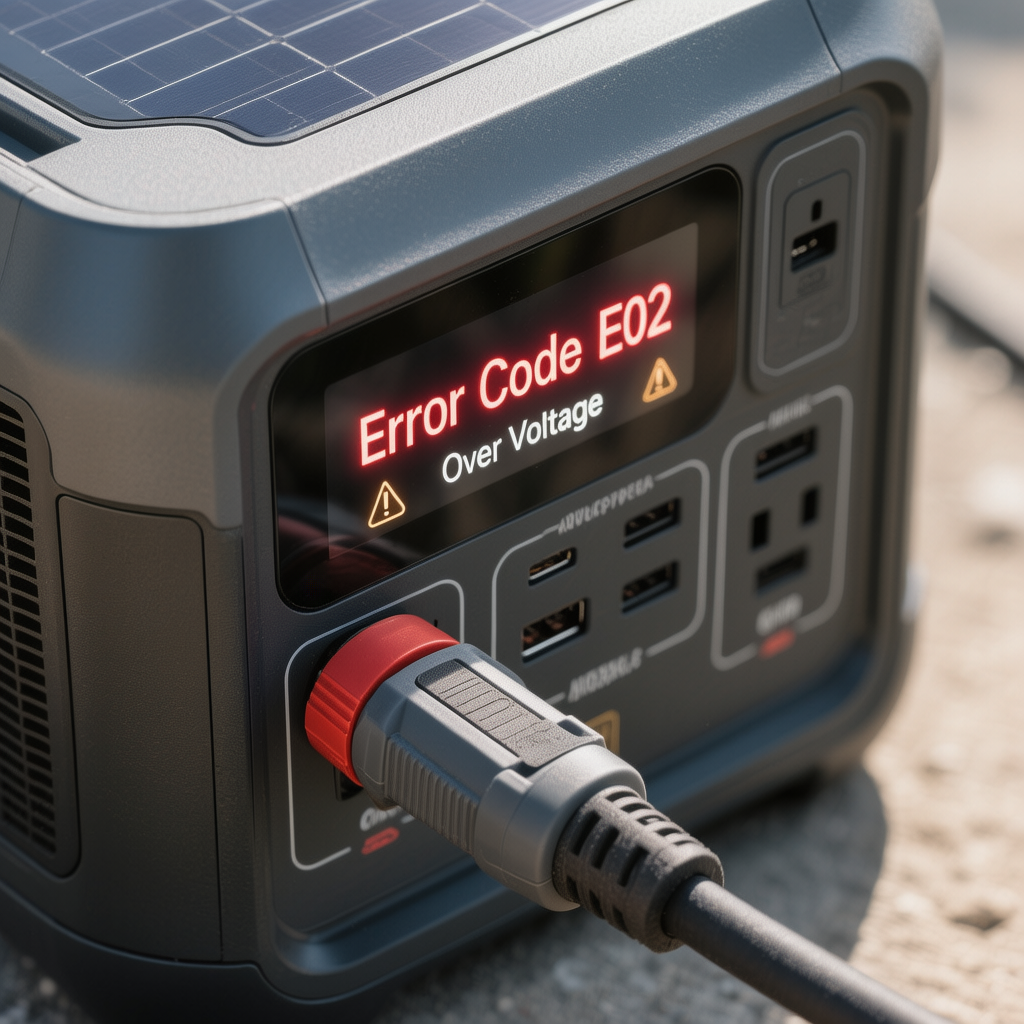
- If you see “Input Overload” or “OVP” (Over Voltage Protection) on the screen…
- It usually means your panels are wired in Series, and the total voltage exceeds the station’s limit. You must rewire them in Parallel.
- If you see 0 Watts input, but the “Charging” icon is blinking…
- It usually means the voltage is too low to initiate the MPPT “sweep.” This happens with flexible panels or folded blankets that have poor connections.
- If you see the input wattage fluctuate wildly (0W -> 50W -> 0W)…
- It usually means the MPPT controller is “hunting.” This occurs when the panel voltage is right on the edge of the minimum startup limit. Adding a second panel in series (if within limits) usually fixes this portable power station not charging solar glitch.
- If you see the station charge from the wall AC but fail on Solar DC…
- It usually means the input fuse or the MPPT MOSFETs are blown, likely from a previous reverse polarity connection.
4. The “Reverse Polarity” Trap (The Silent Killer)
This is the most common reason for a portable power station not charging solar panels when using third-party cables.
Solar panels use MC4 connectors. The standard set by manufacturers like Staubli (creators of MC4) dictates that the connector with the red O-ring is “Female” but carries the “Positive” wire. However, when you buy a generic “MC4 to Anderson” or “MC4 to DC7909” adapter from Amazon, some manufacturers wire them backwards.
The Test:
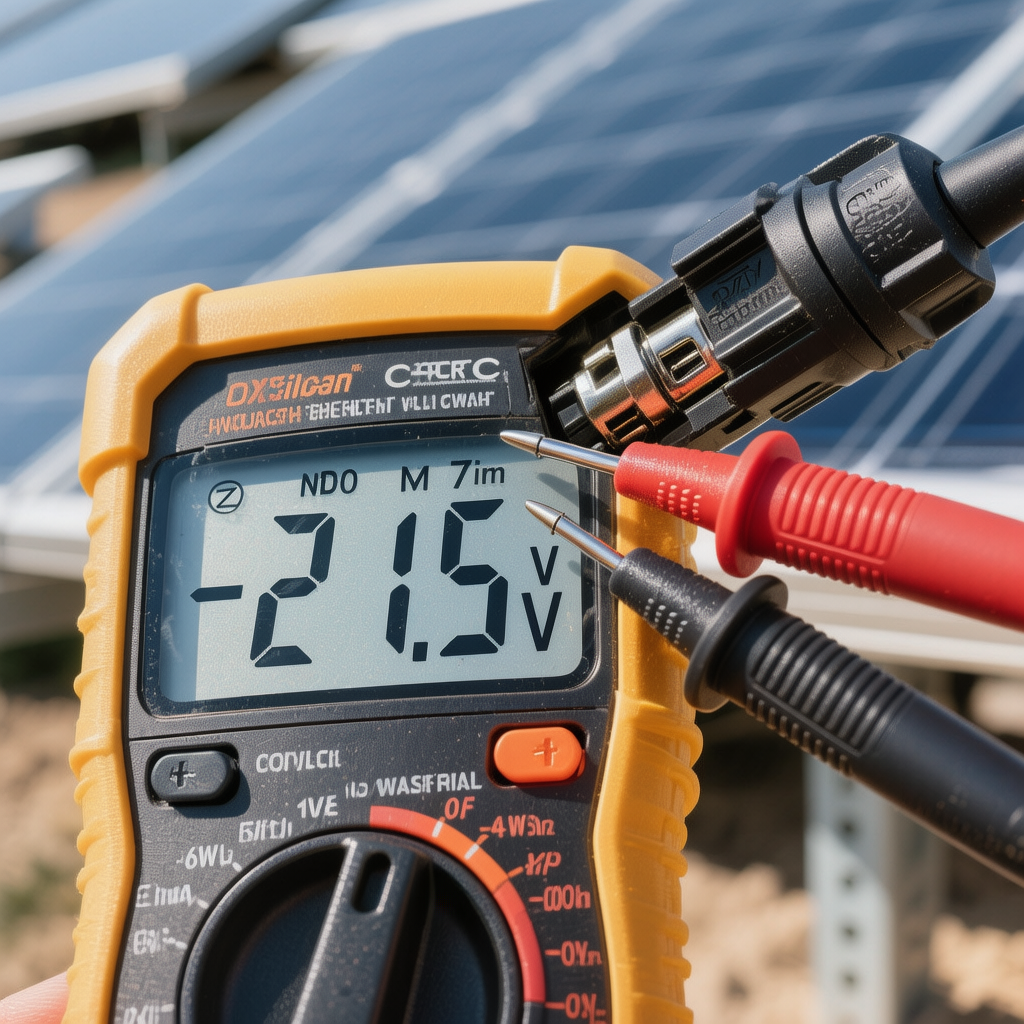
You need a digital multimeter (like a Fluke or Klein Tools).
- Put the panel in the sun.
- Set multimeter to DC Volts (200V scale).
- Touch the red probe to the pin you think is positive on your adapter cable, and black to negative.
- Result: If the multimeter reads a negative number (e.g., -19.5V), your polarity is reversed. The power station is protecting itself by blocking the current. This is why you have a portable power station not charging solar situation. You need a “Polarity Reverse Adapter.”
5. Worked Numbers Example: The Series vs. Parallel Voltage Trap
Let’s run the math. This is where most people unknowingly break their gear, resulting in a portable power station not charging solar permanently.
The Gear:
- Power Station Input Limit: 12-30V DC / 100W Max.
- Solar Panels: Two 100W Rigid Panels.
- Specs: VOC (Open Circuit Voltage) = 22V.
- Imp (Max Power Current) = 5.5A.
Scenario A: Wired in Series (Daisy Chained)
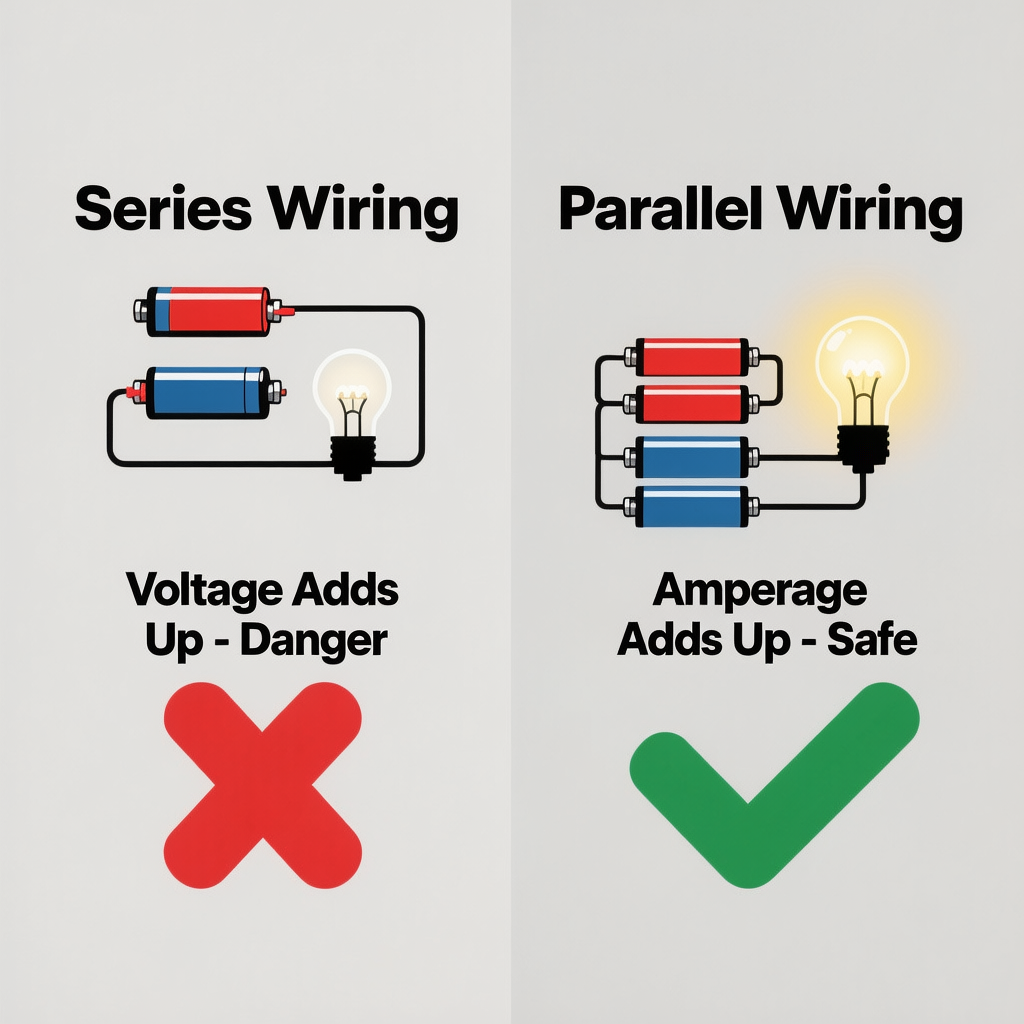
- Physics: Voltage adds up. Amperage stays the same.
- Total Voltage: 22V + 22V = 44V.
- Result: 44V is > 30V (The Limit).
- Outcome: The power station displays “Overload” or blows an internal fuse. It will accept 0 Watts. This is a classic portable power station not charging solar error caused by user wiring.
Scenario B: Wired in Parallel (Using a Y-Branch Connector)
- Physics: Voltage stays the same. Amperage adds up.
- Total Voltage: 22V (Safe).
- Total Amperage: 5.5A + 5.5A = 11A.
- Outcome: The voltage is safe. The station accepts the charge. It might “clip” the amperage if it can only handle 8A, but it will work safely.
Understanding this math is critical. If you need help sizing a system for specific appliances, like a fridge, check my guide on the best solar generator for refrigerator.
6. Temperature Coefficients: Why Cold Kills Equipment
Here is an advanced tip most people miss. Solar panels produce higher voltage when they are cold.
According to data from PV Education, voltage increases by about 0.3% for every degree Celsius drop. If you design your system to be exactly at the limit (e.g., 29V input on a 30V limit) on a warm summer day, come winter, that same panel might output 32V.
This winter voltage spike triggers the Over Voltage Protection (OVP), leading to a portable power station not charging solar in January when you need it most. Always leave a 10-15% voltage safety buffer.
7. Risk Matrix & Decision Tree
How do you proceed to fix the portable power station not charging solar issue?
- GREEN (Safe to Test):
- Condition: Single panel.
- Check: Verify panel VOC is lower than station Max Input Voltage.
- Action: Check cable continuity with a multimeter. Clean panel surface.
- YELLOW (Proceed with Caution):
- Condition: Charging in extreme heat (>104°F/40°C).
- Check: Battery temp.
- Action: If battery is too hot, move station to shade. Lithium stops charging to prevent thermal runaway. See lifepo4 vs nmc portable power station for temp limits.
- RED (Stop Immediately):
- Condition: Using an extension cord longer than 50ft.
- Issue: Voltage Drop.
- Action: Thin cables cause voltage to drop below the minimum “wake up” threshold. Use 10AWG cables. Read portable power station extension cord safety.
8. Proprietary Input Weirdness
Sometimes, the issue isn’t voltage; it’s the pinout.
- Jackery: Uses an 8mm barrel (DC7909). The center pin is positive.
- EcoFlow/Bluetti: Often use XT60 or Aviation plugs.
- The Problem: Some third-party cables look like they fit but don’t make contact with the internal pin. I have seen 8mm connectors where the center pin is 1mm too short. The plug fits physically, but electrically, it is an “air gap.” This mechanical failure results in a portable power station not charging solar.
If you suspect your cable is the culprit, try charging the station via the car charging cable (12V cigarette lighter). If that works, your MPPT is fine, and the solar cable is the failure point.
9. Why “Passthrough Charging” Complicates Things
If you are trying to charge a portable power station while using it, the display might deceive you.
If you are inputting 60W of solar, but running a 60W laptop, the battery net gain is zero. The display might show “0 Watts” or “Net 0” depending on the UI. Ensure you turn off all AC and DC loads when testing solar input to see the raw data. Read more on the physics of can you charge a portable power station while using it.
10. The “Fake Solar” Test
If you don’t have a multimeter, you can trick the MPPT to diagnose why you have a portable power station not charging solar.
- Take your Car Charge cable (Cigarette lighter to input port).
- Plug it into your car (running).
- Plug it into the Solar/DC input port.
- Result: If the station charges from the car, the internal controller is alive. The problem is definitely your solar panel, the solar cable, or the sun conditions.
- Result: If it does not charge from the car, the DC input fuse inside the station is likely blown or the port is melted. You need a warranty repair.
For readers in the UK, consult Electrical Safety First for guidance on safe product returns and consumer rights regarding faulty electrical goods.
FAQ
1. Why is my portable power station not charging solar even in full sun?
The most common cause is loose wiring or reversed polarity in the adapter cable. Also, check if the panel’s “Open Circuit Voltage” (VOC) is too high for the power station. If the panel puts out 22V and the station cuts off at 20V, you will experience a portable power station not charging solar error.
2. Can I use any solar panel with my power station?
No. You must match the voltage. If your power station accepts 12-30V, you cannot use a large residential 400W panel (which might be 48V or 60V). This will trigger over-voltage protection or damage the unit, leading to a portable power station not charging solar status.
3. Does the length of the solar cable matter?
Yes. DC power suffers from “Voltage Drop.” If you use a 50-foot, thin (16AWG) cable, a 18V panel might only deliver 14V to the station. If the station needs 15V to start, you will have a portable power station not charging solar problem. OSHA recommends proper gauge selection for all electrical cords to prevent heating and loss.
4. Can I mix different brands of solar panels?
It is not recommended. Different panels have different resistance and amperage curves. If you mix a 100W panel (18V) with a 200W panel (24V), the system will be dragged down to the performance of the weakest link, or the voltages will fight each other, causing a portable power station not charging solar efficiently.
5. What do I do if my input port smells like burning?
Disconnect everything immediately. You have likely melted the port due to high resistance (bad connection) or over-voltage. Do not try to use it again. Refer to inverter smells like burning plastic.
Final Verdict
Fixing a portable power station not charging solar panels is rarely about fixing the station itself. 90% of the time, it is an external mismatch.
You are either feeding it too much voltage (Series wiring mistake), confusing the polarity (Cable mistake), or starving it of current (Shading/Cloud mistake).
Get a multimeter. Check the polarity. Verify your VOC limits. The sun provides free energy, but the laws of physics charge a strict admission fee. Pay attention to the specs, and you’ll get your power back.