
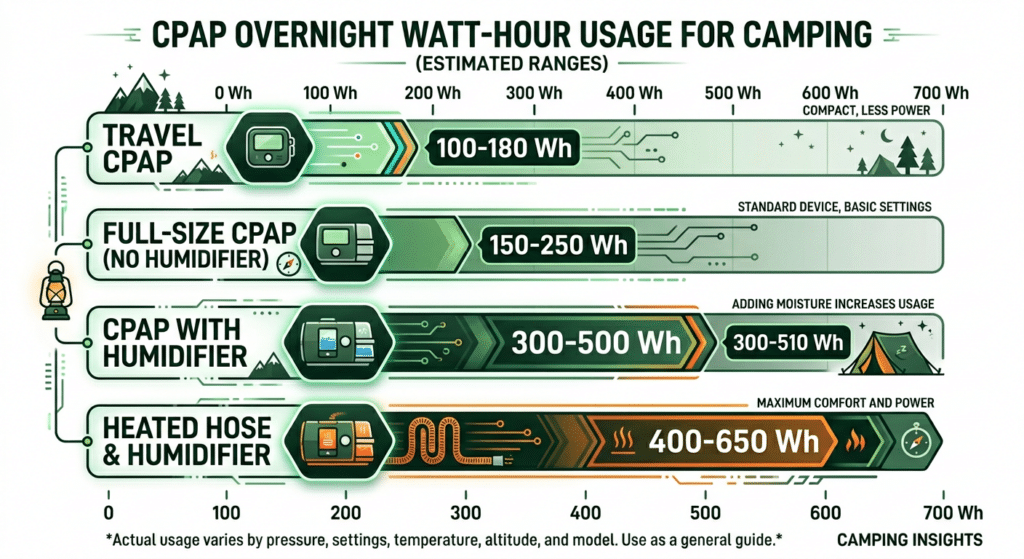
How many Wh do you need for a CPAP while camping depends mostly on one thing: whether you run the humidifier and heated hose. For many campers, a CPAP without heat uses about 150Wh to 250Wh per night, while a full-size machine with humidifier can use 300Wh to 500Wh or more. That is why some people get through the night on a small battery and others kill a 300Wh power station before sunrise.

If you want the short version, here it is: most SUV campers should plan on at least 300Wh for a very light CPAP setup, 500Wh for a more realistic overnight setup, and 700Wh to 1000Wh if comfort features are turned on or the trip lasts more than one night.
This article focuses on one narrow question only: how many Wh do you need for a CPAP while camping. If you also run a fridge, fan, heater, or lights, then your real battery size needs to be calculated as a full camp power system. In that case, also read What Size Portable Power Station for SUV Camping.
CPAP Camping Wh Chart
| CPAP Setup | Typical Wh Per Night | Recommended Battery Size |
|---|---|---|
| Travel CPAP, no humidifier | 100–180Wh | 300Wh |
| Full-size CPAP, no humidifier | 150–250Wh | 300–500Wh |
| Full-size CPAP, humidifier on | 300–500Wh | 700–1000Wh |
| Heated hose + humidifier + cold weather | 400–650Wh | 1000Wh+ |
| CPAP + lights + phone charging | 220–320Wh | 500Wh |
| CPAP + fridge + multi-night camping | 1000Wh+ per day | 1000–2000Wh+ |
Why Wh Matters More Than Watts for CPAP Camping
A lot of people confuse watts and watt-hours.
- Watts (W) tell you how much power the machine is pulling right now.
- Watt-hours (Wh) tell you how much battery capacity you need to get through the night.
For CPAP camping, Wh is the number that actually matters most.
For example, a CPAP might only pull 25W while running. That sounds small. But over an 8-hour sleep window, that becomes:
- 25W × 8 hours = 200Wh
That is your overnight battery demand before factoring in inverter loss, cold weather, battery reserve, and any extra accessories.
This is why how many Wh do you need for a CPAP while camping is a better question than “how many watts does my CPAP use?”
The National Heart, Lung, and Blood Institute treats CPAP as a full-night therapy, so when you calculate Wh, always size for a full sleep window, not a best-case nap.
Real CPAP Battery Usage by Setup Type
The biggest factor is not the machine brand. It is the setup.
| Setup Type | Typical Overnight Wh | Real-World Notes |
|---|---|---|
| Travel CPAP | 100–180Wh | easiest to power |
| Standard CPAP, no humidifier | 150–250Wh | common SUV camping setup |
| Standard CPAP, humidifier on | 300–500Wh | battery use jumps fast |
| Humidifier + heated hose | 400–650Wh | comfort-heavy setup |
| Older machine with inefficiencies | 250–500Wh+ | check your own numbers |
If you are asking how many Wh do you need for a CPAP while camping, the answer changes dramatically when you add heat. Turning off the humidifier is usually the fastest way to cut your overnight battery demand.
7 Real Examples: How Many Wh Do You Need for a CPAP While Camping?
Example 1: Travel CPAP, one summer night
- machine draw: light
- humidifier: off
- heated hose: off
- overnight use: ~140Wh
- recommended battery: 300Wh
This is the easiest version of how many Wh do you need for a CPAP while camping. A compact LiFePO4 power station usually covers it without stress.
Example 2: Full-size CPAP, no humidifier, normal 8-hour sleep
- overnight use: ~200Wh
- phone charging: 20Wh
- LED light: 15Wh
- total: ~235Wh
- recommended battery: 300Wh to 500Wh
This is one of the most common weekend SUV camping cases.
Example 3: Full-size CPAP, no humidifier, two nights
- one night CPAP use: ~220Wh
- two nights CPAP only: ~440Wh
- with small accessories and reserve: ~550Wh+
- recommended battery: 500Wh to 700Wh
Now the answer to how many Wh do you need for a CPAP while camping is no longer just “one night math.” It becomes trip math.
Example 4: CPAP with humidifier on
- overnight use: ~380Wh
- phone + light: ~40Wh
- total: ~420Wh
- with reserve and conversion loss: ~520Wh+
- recommended battery: 700Wh
This is where many people get surprised. They think their CPAP is a “small device,” but the comfort features make it a medium battery load.
Example 5: CPAP with humidifier and heated hose in cold weather
- overnight use: ~500Wh
- reserve and losses: ~650Wh+
- recommended battery: 700Wh to 1000Wh
If you camp in shoulder season or winter, this is the version of how many Wh do you need for a CPAP while camping that matters most.
Example 6: CPAP plus phone, lights, and fan
- CPAP: 220Wh
- phone: 25Wh
- LED light: 20Wh
- small fan: 40Wh
- total: 305Wh
- with buffer: ~400Wh
- recommended battery: 500Wh
This is a much more realistic real-world answer than sizing the battery around the CPAP alone.
Example 7: CPAP plus fridge on a multi-night SUV trip
- CPAP: 220Wh
- fridge: 800–1200Wh/day depending on weather
- lights and charging: 60Wh
- total daily demand: 1080–1480Wh
- with buffer: 1400–1900Wh
- recommended battery: 1000Wh to 2000Wh+, depending on solar and trip length
Once you add a fridge, how many Wh do you need for a CPAP while camping becomes part of a whole-camp sizing problem. If that is your setup, read How Long Will a Portable Power Station Run a 12V Fridge and How Do I Stop My Fridge from Killing My Power Station Overnight.
Is 300Wh Enough for CPAP Camping?
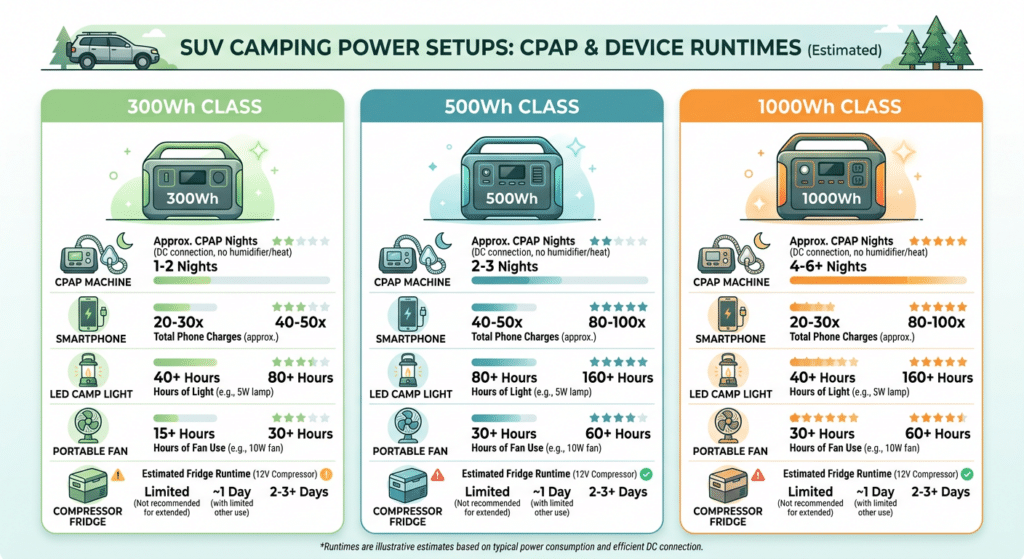
Sometimes yes, often no.
A 300Wh battery is enough if:
- you use a travel CPAP
- humidifier is off
- heated hose is off
- it is only one night
- you are not powering much else
A 300Wh battery is usually not enough if:
- you use a full-size machine with humidifier
- you camp for two nights
- you charge other devices too
- weather is cold
- you use AC output with significant conversion loss
So if you are serious about how many Wh do you need for a CPAP while camping, 300Wh is best treated as a lightweight minimum, not the safe default.
Is 500Wh the Best Size for Most Campers?
For many people, yes.
A 500Wh LiFePO4 portable power station is often the practical sweet spot because it can handle:
- one full-size CPAP overnight without humidifier
- one to two nights of a lighter CPAP setup
- some extra charging and lighting
- more reserve than a tiny emergency battery
This is also why many campers researching how many Wh do you need for a CPAP while camping end up in the 500Wh class even if the raw machine math looks smaller on paper.
If you are comparing battery form factors, How to Power a CPAP While SUV Camping explains the difference between a portable power station, auxiliary battery, and vehicle battery approach.
DC vs AC: Why Your Battery Runtime Changes
If your CPAP supports a DC cable, use it.
A DC path is usually more efficient because it avoids wasteful conversion:
- battery stores DC
- inverter converts to AC
- CPAP brick converts back to DC
That conversion chain burns power.
So when you ask how many Wh do you need for a CPAP while camping, the answer may be noticeably smaller if you run the machine through an efficient DC cable rather than AC.
This same efficiency problem shows up with other camping electronics too, especially overnight loads. If you are troubleshooting weird overnight battery drain, Why Is My SUV Camping Battery Draining Overnight is a useful companion read.
How to Estimate Your Own CPAP Wh Need in 3 Steps
If you want a quick way to answer how many Wh do you need for a CPAP while camping for your own exact machine, use this process:
Step 1: Start with your likely overnight use range
- travel CPAP: 100–180Wh
- standard CPAP, no humidifier: 150–250Wh
- humidifier on: 300–500Wh
- heated hose + cold weather: 400–650Wh
Step 2: Add your extra overnight loads
Add any devices you really use during the same overnight window:
- phone charging
- fan
- LED lights
- watch charging
- anything else on the same battery
Step 3: Add 25% to 30% buffer
Do not size to zero. Add margin for:
- conversion loss
- battery aging
- colder weather
- longer sleep
- inaccurate manufacturer specs
That final number is your true answer to how many Wh do you need for a CPAP while camping.
Common Mistakes When Sizing a CPAP Battery
Mistake 1: Looking only at the power brick label
The adapter rating is not your overnight Wh number.
Mistake 2: Forgetting the humidifier
This is usually the biggest jump in real consumption.
Mistake 3: Ignoring the rest of camp power
CPAP rarely runs alone in a real vehicle setup.
Mistake 4: Trusting the starter battery
That turns a medical device problem into a vehicle-starting problem.
Mistake 5: Buying for one perfect summer night
Real camping means margin matters.
People Also Ask
How many Wh does a CPAP use in 8 hours?
Many CPAP machines use around 150Wh to 250Wh in 8 hours without humidifier, and 300Wh to 500Wh or more with heated humidity features turned on.
Is 500Wh enough for a CPAP?
Often yes, especially for one normal overnight session without humidifier. But if you use heat or stay out longer, 500Wh may feel tight.
Can a 300Wh power station run a CPAP?
Yes, sometimes. It works best for travel CPAP machines or one light overnight session without humidifier.
What is the best battery for CPAP camping?
For most campers, a LiFePO4 portable power station is the best balance of safety, simplicity, and usable capacity.
Should I turn off my humidifier while camping?
If runtime matters more than comfort, yes. That is one of the easiest ways to reduce overnight Wh use.
Final Answer: How Many Wh Do You Need for a CPAP While Camping?
For most people, the answer to how many Wh do you need for a CPAP while camping is:
- 300Wh for very light, one-night travel CPAP use
- 500Wh for a more realistic overnight setup
- 700Wh to 1000Wh if you use humidifier, heated hose, or need extra margin
- 1000Wh+ if CPAP is only one part of a larger SUV camping power system
If you want the safest middle ground, start at 500Wh LiFePO4 and size up if you use comfort features or camp for multiple nights.