
Key Takeaways
- portable power station extension cord safety is mostly about heat at the plug ends and voltage drop on long runs, not just “does it turn on.”
- In the US (120V), the same watt load pulls more amps than UK/AU (230V), so cord gauge and outlet quality matter more.
- Motors and compressors (fridges, pumps) stress cords with surge and cycling; treat them as “special loads.”
- The safest approach is boring: shortest cord, thicker gauge, fully uncoiled, and a quick heat check.
Intro
During a blackout, extension cords turn a portable power station into “power wherever you need it.” That convenience is exactly why people get into trouble. Most cord failures don’t happen because the power station “can’t handle it.” They happen because the cord and plug become a small heater—quietly—until something smells hot or melts.
So let’s answer the real question: portable solar generator guide power station inverter fan noise guide station extension cord safety. What makes an extension cord safe (or unsafe) when it’s feeding a fridge, a router, or a sump pump from a power station?
We’ll keep the engineering simple using a water analogy:
- Voltage (V) = water pressure
- Current (A) = water flow
- Watts (W) = pressure × flow (how much power right now)
- A long thin cord is like a long thin hose: more friction, less pressure at the end, and more wasted energy as heat
By the end, you’ll know how to pick gauge and length, how to spot overheating early, and how to build a safe, repeatable setup for US/UK/Australia homes.
Why Extension Cords Are the #1 “Weak Link” in Blackout Setups
A portable power station usually has:
- inverter overload protection
- temperature sensors
- battery protection (BMS)
An extension cord usually has:
-…copper and plastic.
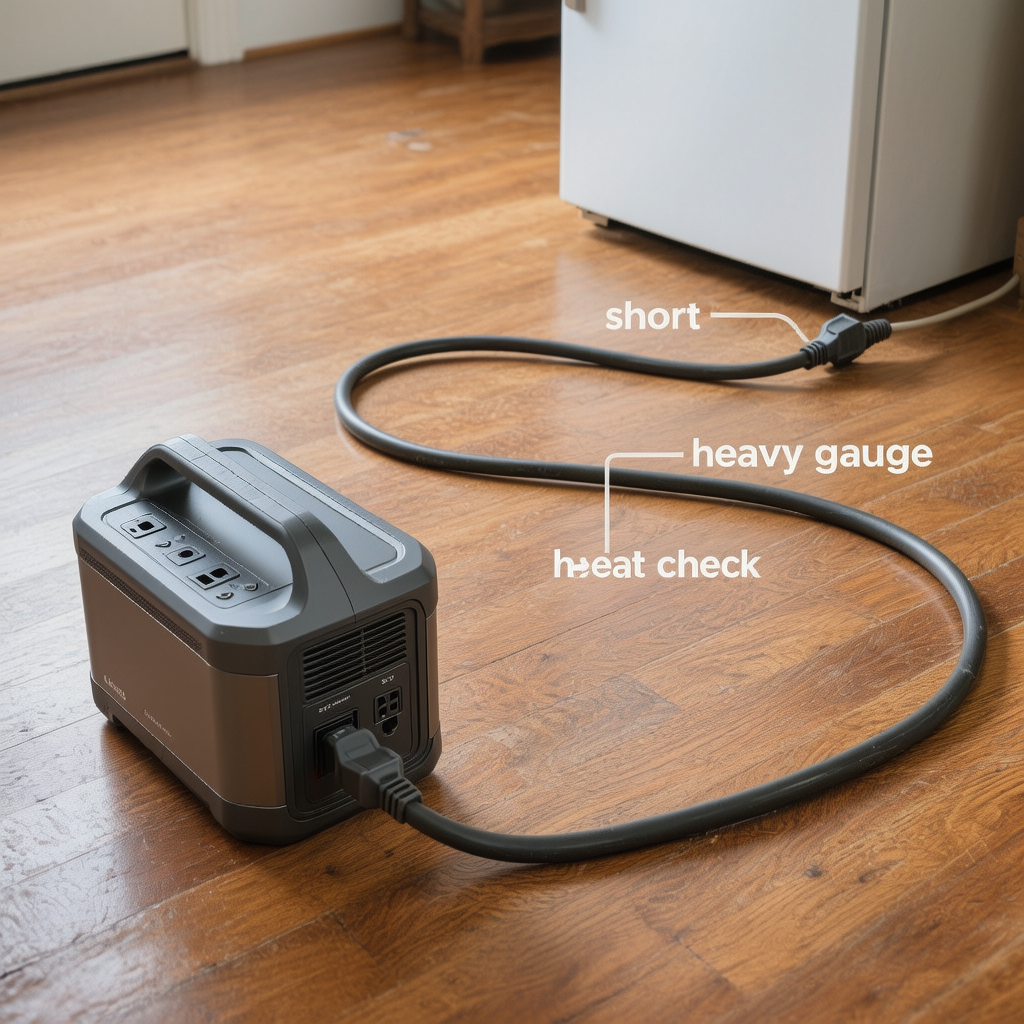
The station can shut itself off. The cord can’t. That’s why portable power station extension cord safety is about choosing the right cord and using it correctly.
Two failure modes dominate:
- Heat at connections (danger)
- Voltage drop (performance + stress)
The Engineering Basics You Actually Need
Current is the heat multiplier
Heat in wiring goes up very fast with current (amps). So anything that increases current increases risk:
- higher watt loads
- lower voltage (US 120V draws more current than 230V)
- motor surges
- poor connections
Voltage drop is “pressure loss”
Voltage drop means your appliance sees lower voltage. Symptoms:
- fridge compressor struggles or clicks
- lights flicker when a motor starts
- inverter trips unexpectedly
- device runs hotter than normal
Both problems become worse as the cord gets longer and thinner.
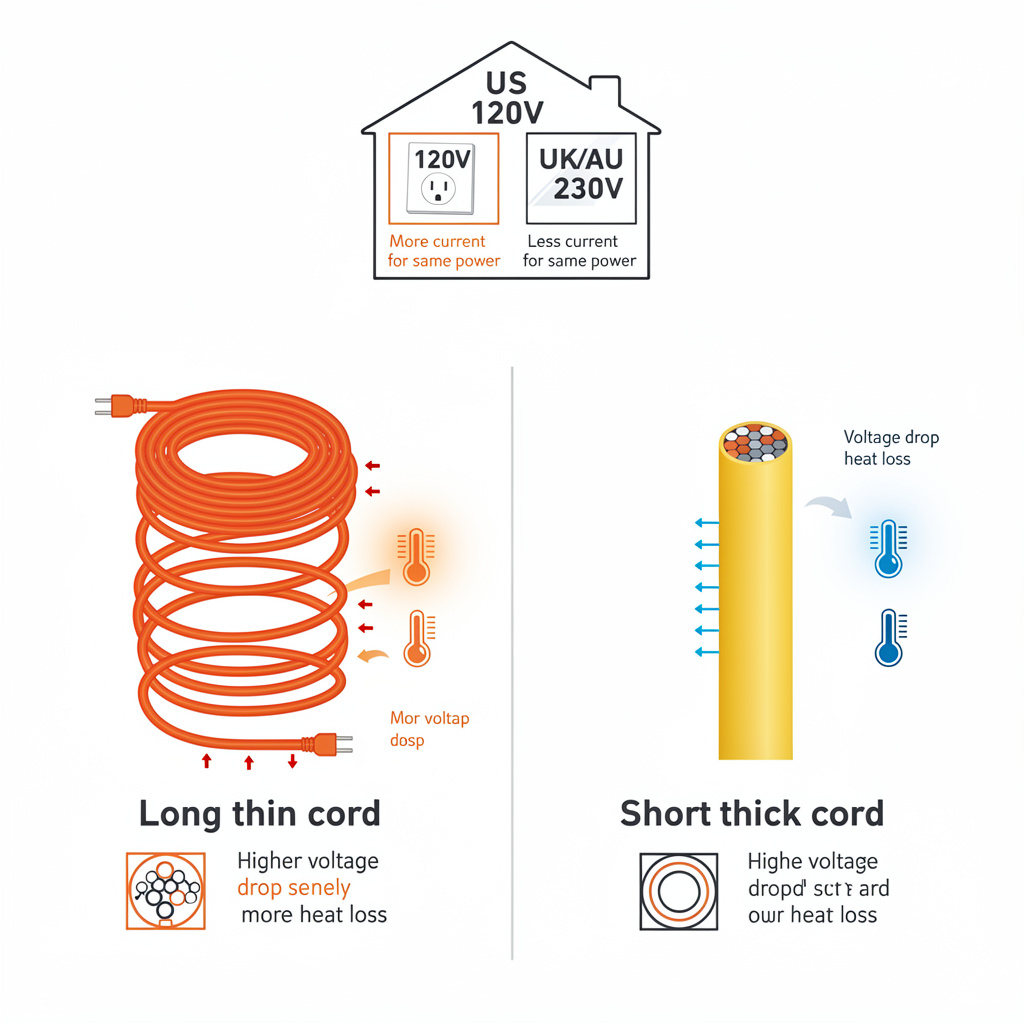
US vs UK/AU: Why 120V Makes Cord Choice Less Forgiving
This isn’t politics. It’s math.
- Watts = Volts × Amps
If you run a 1200W load:
- US 120V: 1200 ÷ 120 = 10A
- UK/AU 230V: 1200 ÷ 230 ≈ 5.2A
So US setups push roughly double the current for the same watts—meaning:
- more heat at loose plugs
- more losses on long cords
- more reason to use thick gauge and short runs
This is a core reason portable power station extension cord safety advice must mention voltage region.
1) Gauge: What It Means and What “Bigger” Really Is
US cords: AWG
- Lower AWG number = thicker conductor = less resistance
- Example: 12 AWG is thicker than 14 AWG, which is thicker than 16 AWG
UK/AU cords: mm²
- Higher mm² = thicker conductor
- Example: 1.5 mm² is thicker than 1.0 mm²
If you only remember one rule:
- When in doubt, choose the thicker cord, especially for anything above a few hundred watts.
2) Length: The Quiet Runtime Killer and Heat Creator
Long cords cause:
- more voltage drop
- more wasted energy as heat
- less stable startup for motor loads
Practical advice:
- Use the shortest cord that reaches.
- Don’t buy a 50 ft / 15 m cord because “it might be useful someday” and then use it for your fridge today.
If the station can be safely moved closer to the load, moving the station is usually better than adding cord length.
3) Why Plug Ends Overheat Before the Cable Does
Most “melted cord” incidents happen at:
- the female receptacle of the extension cord
- the male plug blades
- the power strip connection
Why:
- tiny contact area
- loose tension = micro-arcing = heat
- cheap metallurgy and thin contact springs
This is why a perfect-looking cable can still be unsafe if the ends are junk.
So portable power station extension cord safety is as much about connector quality as wire gauge.
4) Coiled Cords: A Real-World Hazard People Underestimate
A coiled cord is like a blanket wrapped around a heater:
- heat can’t escape
- internal temperature rises faster
- insulation softens
Rule:
- Fully uncoil any cord for medium or high loads.
- If you’re using a reel, pull it all the way out.
5) Load Type: Steady Loads vs Motor/Compressor Loads
A 150W laptop setup and a 150W fridge average are not equal.
Steady loads (easy mode)
- router/modem
- LED lights
- device chargers
Cycling motor loads (hard mode)
- fridge/freezer compressors
- dehumidifiers
- some fans
Motor loads:
- draw surge current at startup
- cycle frequently
- stress the plug ends repeatedly
If you’re designing for fridge backup, use this dedicated guide (it’s built around compressor behavior and surge reality):
https://wildsmartgear.com/best-solar-generator-for-refrigerator/
6) A Simple, Practical Voltage Drop Rule (No Calculator Needed)
You can calculate voltage drop, but most homeowners won’t. Here’s a field rule that works:
If any of these happens, treat it as a voltage-drop or connection problem:
- fridge clicks and fails to start
- lights flicker strongly when the compressor starts
- cord ends get warm quickly at modest loads
- inverter trips even when “watts should be under the limit”
Fix it by:
- shortening the cord
- using thicker gauge
- removing power strips/daisy chains
- improving plug fit
Comparison Table: Cord Choices and Safe Use Cases
| Scenario | Typical power | Cord risk level | Best practice |
|---|---|---|---|
| Wi‑Fi + charging station | 30–200W | Low | Short cord, decent quality |
| TV + a lamp | 100–300W | Low–Medium | Shorter is better; check plug warmth |
| Refrigerator | variable + surge | Medium–High | Short, heavy gauge; no daisy chains; monitor heat |
| Sump pump | high + surge | High | Heavy gauge only; shortest possible; watch inverter surge limits |
| Space heater (not recommended) | 1000–1800W | High | Avoid on power stations; if used, cord must be heavy/short and monitored |
The “Touch Test” That Prevents Most Failures
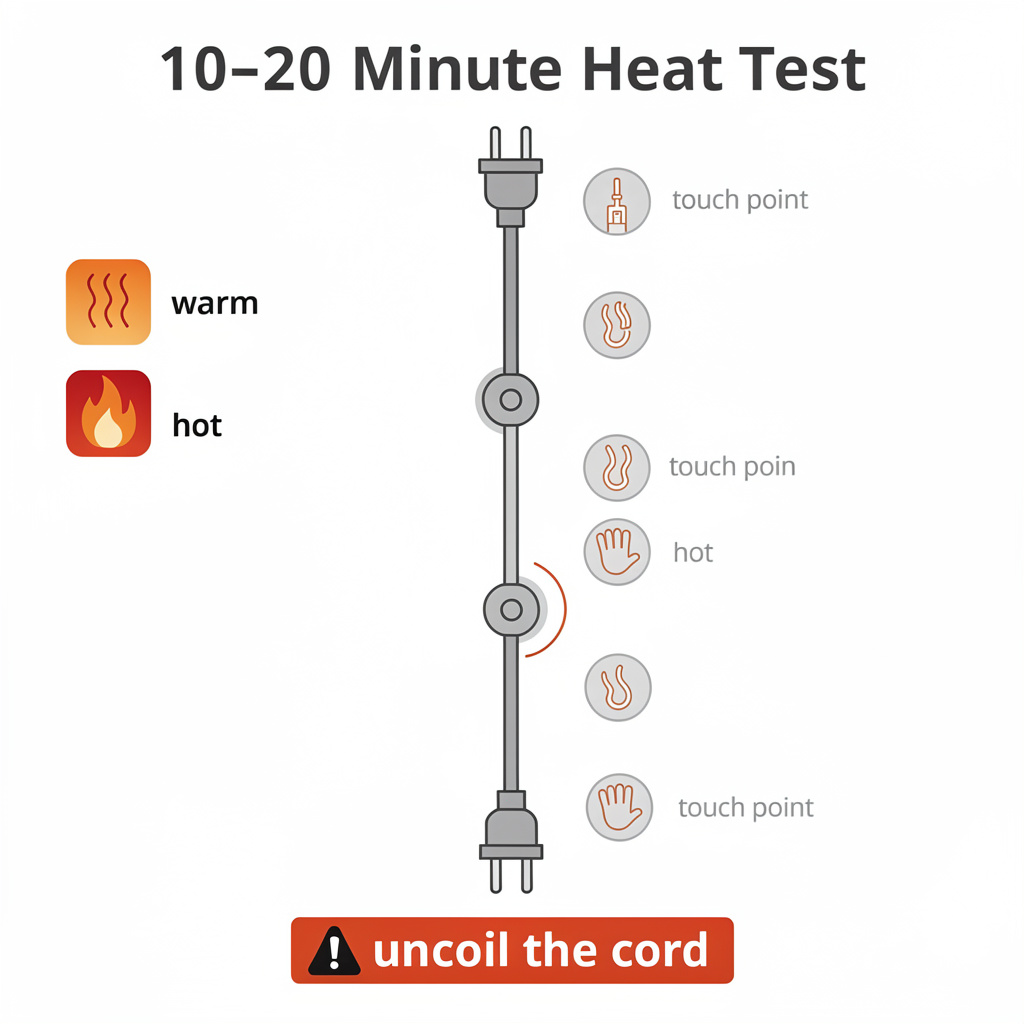
Here’s a no-tools test that dramatically improves portable power station extension cord safety:
After 10–20 minutes of real operation:
- touch the cord ends (near plugs)
- touch the plug heads (carefully)
- touch the cord mid-run
- check if any section is hot
Warm is normal. Hot is a warning.
Repeat after:
- 1 hour
- 3 hours
- any time you change loads
Heat is cumulative.
Safe Setup: A Real-World Blackout Layout That Works
A) Place the power station safely
- hard surface
- airflow around vents
- not under blankets, not inside cabinets
B) Run a single short cord to a “low-power zone”
Use one extension cord to feed:
- router/modem
- chargers
- one LED lamp
Keep this zone under ~200–300W if possible.
C) Plug big loads directly into the station if possible
If your fridge cable reaches, plug it directly into the station. This removes one failure point.
D) Avoid daisy chaining
Don’t do:
- extension cord → power strip → extension cord
- power strip into power strip
Each connection is another heat point.
Step-by-Step: Portable Power Station Extension Cord Safety Checklist
- Identify your load type: steady electronics or motor/compressor?
- Write down expected watts (and note surge loads).
- Choose the shortest cord that reaches.
- Choose thicker gauge for anything above a few hundred watts, especially in the US.
- Fully uncoil the cord.
- Avoid power strips for motor loads; plug motors directly if possible.
- Keep cords visible (not under rugs) and away from doors.
- Run the system for 10–20 minutes and do the touch test.
- Re-check for heat every few hours.
- If anything gets hot, reduce load or upgrade cord/setup immediately.
FAQ
1) Can I use a regular household extension cord with a portable power station?
Sometimes, for low-power electronics. For fridges, pumps, or anything above a few hundred watts, you should use a heavier cord and keep it short. portable power station extension cord safety depends on both gauge and connector quality.
2) Why does my cord get warm even when I’m under the inverter’s watt rating?
Because heat is about current through resistance. Loose plugs, thin wire, and long cords increase resistance and create hot spots regardless of inverter rating.
3) Is it safer to use a longer cord so the power station can sit farther away?
No. Longer cords increase voltage drop and heat. If you need distance for noise, compensate with thicker gauge and monitor heat.
4) Do UK/AU users need to worry less because of 230V?
You often have more margin at the same watts because current is lower, but poor connectors and cheap cords can still overheat. The same rules apply.
5) Should I power a refrigerator through an extension cord during an outage?
Only if needed, and then use a short, heavy-duty cord, avoid extra connections, and monitor plug heat. If possible, move the power station closer and plug the fridge directly.
Conclusion
portable power station extension cord safety is not complicated, but it is strict: short cords, thick conductors, fully uncoiled runs, and frequent heat checks—especially for fridges, pumps, and other surge loads. A power station’s protections help, but they can’t prevent a cheap plug from overheating.
For deeper planning:
- Family backup guide: https://wildsmartgear.com/best-portable-power-station-for-family-backup/
- Refrigerator surge and runtime planning: https://wildsmartgear.com/best-solar-generator-for-refrigerator/
Outbound Links
- Electricity units and kWh basics (EIA): https://www.eia.gov/energyexplained/electricity/measuring-electricity.php
- Wire gauge reference (AWG): https://en.wikipedia.org/wiki/American_wire_gauge
- Voltage drop concept overview: https://en.wikipedia.org/wiki/Voltage_drop
Pro Tips for Maximum Performance
Getting the most from your portable power station involves more than just plugging in devices. Here are expert recommendations based on extensive field testing:
Optimize charging habits: Whenever possible, use the standard charge mode instead of fast charge. Slow charging generates less heat and places less stress on battery cells, which can extend overall battery lifespan by up to 40%. If you’re not in a hurry, standard charging is always the better choice.
Manage temperature carefully: Battery performance degrades significantly in extreme temperatures. Below freezing (32°F/0°C), LiFePO4 batteries can still deliver power but should not be charged. Above 104°F/40°C, both charging and discharging efficiency drop while internal resistance increases. Store and operate your power station in the 50-80°F (10-27°C) range whenever possible.
Use DC outputs for efficiency: Running small devices through the AC inverter wastes 10-15% of power in the DC-to-AC conversion. For any device that accepts USB-C or 12V DC input (phones, tablets, cameras, LED lights, and many small appliances), use the DC outputs directly. This simple habit can extend your usable runtime by 10-20% per charge cycle.
Perform regular maintenance cycles: If you store your power station for more than 30 days without use, discharge it to about 50% capacity before storage. Every 3 months, perform a full discharge-recharge cycle to calibrate the battery management system (BMS) and keep the cells balanced. This prevents the common problem of inaccurate remaining capacity readings.
Monitor for firmware updates: Many modern power stations from brands like EcoFlow, Bluetti, and Jackery receive firmware updates that improve charging algorithms, fix BMS calibration issues, and occasionally add new features. Check the manufacturer’s app or website every few months to ensure your unit is running the latest firmware.