
A diesel heater E01 fault is the most common code on Chinese 2kW and 5kW air heaters, and it is also the most misleading. On most controllers E01 does not mean one fault — it means the controller could not confirm that combustion started. Six different conditions produce it, and the cheapest ones to fix are usually not the ones owners try first.
This page covers what E01 usually reports on a diesel heater, the diagnostic order that finds the cause in the fewest steps, why voltage is the culprit more often than any component, and what to do when the code clears and then returns.
What E01 actually reports
Code definitions vary by controller, so treat any diesel heater table as a starting point rather than gospel. For the established European brands, the manufacturer documentation is authoritative: Eberspächer and Webasto both publish fault-code tables by model.
That said, across the common controller families there is a pattern.
| Controller family | E01 meaning |
|---|---|
| Most 2kW/5kW Chinese controllers | Start failure / no flame detected |
| Some variants | Undervoltage at start |
| Some variants | Flame sensor no signal |
| Autoterm / Planar | Differs by model — check the manual |
| Eberspacher / Webasto | Different code system entirely |
The common controller family sold through retailers such as VEVOR follows this pattern. The important reading: on the dominant controller family, E01 is a symptom code. It reports that the startup sequence did not reach a confirmed flame within the timeout. Anything that prevents combustion — fuel, air, glow plug, voltage, sensor — produces the same E01.
Check your own diesel heater controller manual first. If it maps E01 to something specific, follow that. If it does not, use the diagnostic order below.
The diagnostic order that works
Work this diesel heater sequence in order. It is ordered by the ratio of probability to effort, so the common causes get ruled out before anything is disassembled.
- Measure battery voltage at the heater plug, under load. Not at the battery terminals, and not with the heater off. This catches more faults than every other step combined.
- Check fuel level and pickup. A tank below a quarter, a pickup above the fuel line, or a kinked line will prevent the pump from priming.
- Listen to the fuel pump during startup. It should tick audibly for 60 to 90 seconds. Silence means no fuel command, no power, or a dead pump.
- Listen to the fan and check airflow. Blocked intake or exhaust causes combustion failure or an overheat shutdown that reads as E01.
- Check the glow plug resistance. Typically 0.3 to 1.5 ohms cold, depending on model. Open circuit means a failed plug.
- Check the flame sensor and its wiring. Last, because it is the hardest to access.
The step most people skip: measuring voltage at the heater plug while the glow plug is energised. A battery reading 12.4V at rest can drop below 10.5V at the heater during the glow phase, because the glow plug draws 8 to 12A for the first two minutes. Many controllers abort with E01 at that point and report it as a start failure rather than a voltage fault.
Why voltage causes so many E01 faults
This is the single most useful thing on the page for a diesel heater start fault.
The diesel heater startup sequence draws far more current than steady-state running. A 2kW heater idles at 8 to 12W once running, but during the first 90 to 180 seconds the glow plug alone pulls 8 to 12A at 12V. Add the fan and the fuel pump and you are at 100 to 150W briefly.
Three consequences for a diesel heater install:
- Small batteries sag. A 20Ah lithium pack that runs the heater fine for six hours may fail to start it, because the startup pulse is beyond its capability.
- Long cable runs lose voltage. A 5m run of thin cable at 10A drops more than a volt. The heater sees 10.5V while your battery monitor shows 12.5V.
- Corroded connections add resistance. A slightly green terminal will start the heater in summer and fail in winter, which is exactly when you need it.
Test properly: connect a meter at the heater’s own power connector. For the nominal 12V supply conventions involved, Victron’s battery documentation covers what a healthy bank should hold under this kind of pulsed load, start the heater, and read the minimum voltage during the glow phase. Below 10.5V on a 12V system is a fault in its own right, regardless of what the battery says.
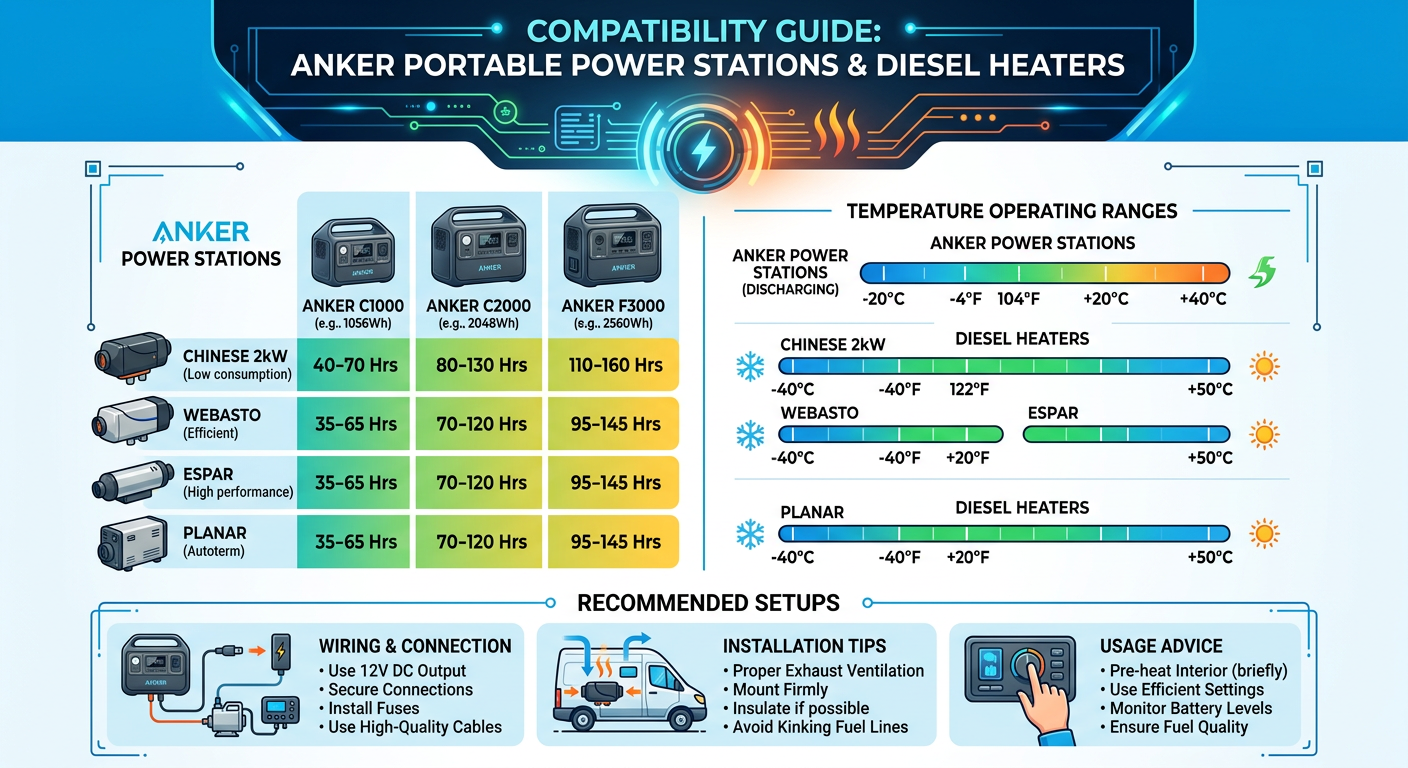
Fixes for a diesel heater voltage fault, in order of effectiveness: shorten or thicken the cable, clean and tighten every terminal, and add battery capacity. If the heater runs from a portable station, check the station’s 12V output current limit — many cap at 10A and a 5kW heater’s glow plug plus fan exceeds that.
Fuel system faults
If voltage checks out on a diesel heater, fuel is next, and it is the second most common cause.
Air in the line. The most common diesel heater fuel fault. A new install, a run-dry event, or a loose fitting lets air into the fuel line. The pump ticks but pushes air, and combustion never establishes. Priming takes 2 to 5 minutes of continuous ticking on most units, longer on a long line.
Fuel pickup position. The pickup must sit near the bottom of the tank but not on it. Too high and it runs dry at a quarter tank. Too low and it pulls sediment, which blocks the pump.
Pump orientation. Most pumps are directional and gravity-assisted — mounted at 15 to 35 degrees with the outlet slightly upward. Mounted flat or upside down they prime unreliably.
Line restriction. Kinks, a crushed section under a floor mat, or a blocked inline filter. Disconnect at the heater and crank the pump to see whether fuel arrives.
Wrong fuel. These heaters run on diesel, kerosene or HVO depending on the model, and the fuel specifications published by Autoterm are a useful reference for what a given unit accepts. Petrol or a high-biodiesel blend can cause coking and hard starting. Kerosene in cold weather is the common deliberate choice and works on most units.
Diagnostic shortcut: hold the fuel line at the heater end in a clear container and run the priming sequence. Fuel arriving in pulses means the pump and line are fine and the problem is downstream. Nothing arriving means you have found the fault.
Air and exhaust restrictions
A diesel heater needs air in and exhaust out, and a blockage produces the same E01 as a fuel fault.
Check these on a diesel heater in order:
- Intake silencer and filter. Clogged with dust after a season of use. Often overlooked because it is inside the case.
- Exhaust outlet. Snow, mud, insects, or a crushed pipe. A blocked exhaust will fail to start and can be genuinely dangerous if partially blocked.
- Combustion chamber carbon. After 500 to 1,000 hours these chambers coke up. Symptoms are a heater that starts then shuts down, or E01 only at high altitude.
- Altitude. Above about 1,500m the reduced oxygen causes rich running and start failures. Some controllers have an altitude mode; most do not.
An exhaust that is partially blocked is the one item on this list to treat as safety-critical rather than inconvenient. Carbon monoxide goes into the living space if the exhaust path is compromised — the heater itself is sealed, but the through-hull fitting and the pipe are not.
Glow plug and flame sensor
If voltage, fuel and air are all good on a diesel heater, the igniter is next.
Glow plug. Test diesel heater glow plug resistance cold with a meter across the plug terminals. Typical values are 0.3 to 1.5 ohms depending on model. Open circuit is a failed plug. A plug that reads correctly can still be weak — a partially failed plug glows but not hot enough to ignite fuel. Visual inspection after a start attempt helps: it should be glowing orange.
Flame sensor. Usually a photoresistor or a thermocouple at the combustion chamber. It reports that flame was established. A dirty or failed sensor causes a heater that fires, runs briefly, then shuts down with a start fault even though combustion clearly happened. Clean the sensor face first; it accumulates soot.
On many units the glow plug and flame sensor are the same component pair and arrive as a service kit. Replacing both together at the first sign of trouble is usually cheaper than two rounds of diagnosis.
What E01 costs in power
Worth planning for, because a diesel heater that fails to start often fails by draining the battery trying.
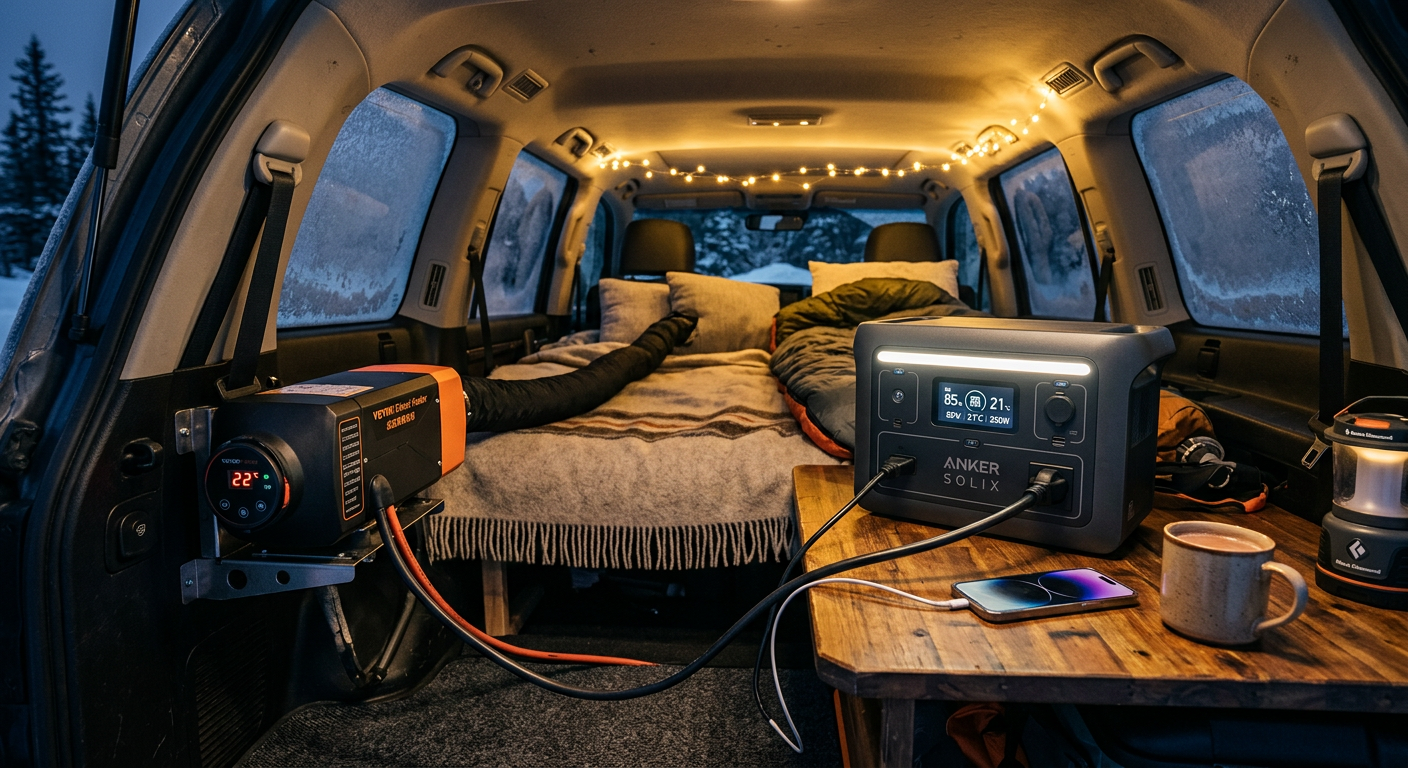
Energy budgeting conventions for small DC loads like this are set out in the DOE solar technology primer. A start attempt runs 90 to 180 seconds with the glow plug at 100W plus the fan. Call it 5 to 8Wh per attempt. The controller usually allows 2 to 3 attempts before locking out with E01, so a failed start costs 15 to 25Wh and leaves you cold.
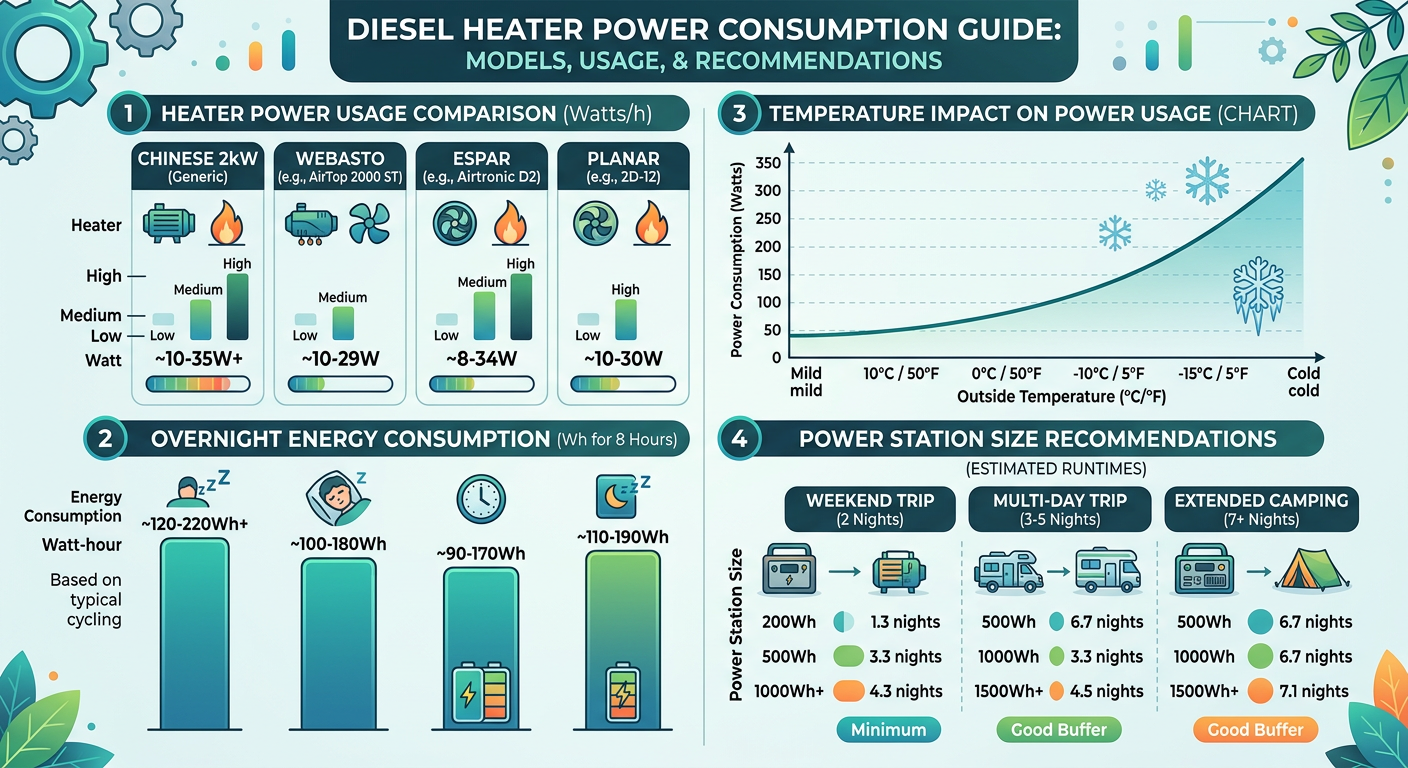
Once running, a 2kW diesel heater on medium draws 10 to 28W, of which most is the fan and fuel pump — combustion heat comes from the fuel. A night at 60 percent duty is 60 to 170Wh. That is the number to budget, and it is modest compared with a fridge.
So the real cost of an E01 fault is not the electricity, it is the trip. Which is why a five-minute voltage check before you leave is worth more than any spare part.
When the code clears and comes back
Intermittent E01 on a diesel heater is the frustrating case, and it usually has one of three causes.
Marginal voltage. Starts fine at 12.8V, fails at 12.2V. The heater is telling you the truth about your battery’s condition. Check the voltage during a successful start and compare with a failed one.
Air in the line that re-enters. A small leak at a fitting lets air in when the pump is off. The heater primes, runs, stops, and next time has to re-prime with air present. Look for a damp fitting or a fuel smell.
Thermal fault. A heater that starts cold and fails hot is overheating — often from restricted airflow or a failing fan bearing. The overheat protection cuts fuel and the result looks like a start fault on restart.
The diesel heater pattern of when it fails is the diagnostic. Fails cold means fuel or glow plug. Fails warm means airflow or sensor. Fails at random means voltage or air ingress.
Preventive maintenance that avoids E01
Four diesel heater maintenance items, once a season:
- Run it for 10 minutes on high before storing. This burns off carbon deposits, which is the main cause of progressive starting difficulty.
- Clean or replace the intake filter. Cheap, and the single most neglected service item.
- Check every connection torque. Vibration loosens terminals on vehicle installs.
- Use fresh, clean fuel. Diesel degrades and grows microbes over months. Old fuel in the tank is a reliable source of pump and nozzle problems.
Run a diesel heater monthly during the season even when you do not need heat. A heater that sits unused for months is a heater that cokes up and fails on the first cold trip.
E01 against the other codes
Knowing where E01 sits in the controller’s code set tells you whether you are chasing the right thing.
| Code | Typical meaning | First check |
|---|---|---|
| E01 | Start failure / no flame confirmed | Voltage at the heater during glow |
| E02 | Flame-out during running | Fuel supply, air intake |
| E03 | Overheat / sensor over temperature | Airflow, intake and exhaust restriction |
| E04 | Voltage out of range | Supply voltage, cable gauge |
| E05 | Flame sensor or glow plug circuit fault | Resistance test on both |
| E06 / E07 | Pump or controller communication | Wiring, controller connection |
| E10 / E11 | Model specific | Controller manual |
Codes vary by controller, so verify against your manual. But the pattern holds: E01 is the general start fault, and the specific component codes usually appear only after the controller has isolated something. A diesel heater reporting E01 on every attempt, with no second code, is telling you the controller never got far enough to diagnose further.
That is why the diagnostic order above works: E01 does not narrow it down for you, so you narrow it down by measurement.
Installation faults that produce a repeat E01
A diesel heater that worked on the bench and fails in the vehicle is almost always an installation issue, and four are common on DIY builds.
Intake and exhaust on the same side. The exhaust can be drawn back into the intake, which starves combustion of oxygen and produces a start failure that looks exactly like a fuel fault. Separate them by at least 200mm and ideally put them on different faces.
Exhaust pointing into the airflow under the vehicle. While driving, ram air pressure can force exhaust back up the pipe. Angle the outlet rearward or downward.
Fuel line dipping below the tank pickup. Creates an air trap that the pump cannot clear without extended priming. Route the line with a continuous rise from tank to pump, or fit a non-return valve.
Glow plug power taken from a shared circuit. Tapping the same feed as a fridge or lights means the heater sees voltage sag whenever those loads cycle. Run a dedicated feed from the battery with an appropriately rated fuse.
Each of these produces an intermittent or repeat diesel heater E01 that resists component-level diagnosis, because no component is faulty. The install is.
2kW versus 5kW: different failure patterns
The two diesel heater sizes behave differently, and the difference affects what E01 means.
2kW units are physically smaller with a lower fuel rate, typically 0.1 to 0.25 litres per hour. They are more sensitive to fuel quality and to air in the line because the pump delivers so little per pulse that a small air bubble is a significant fraction of a stroke. They are also less tolerant of a restricted intake.
5kW units draw more current during the glow phase — 10 to 12A rather than 8 to 10A — so voltage faults surface sooner. They also coke up faster if run at low output for long periods, because low output means a cooler combustion chamber and poorer burn.
Practical consequence for a van build: a 2kW unit run at medium is more reliable than a 5kW unit run at minimum. Running these heaters at their lowest setting for extended periods is a recognised cause of progressive coking and eventual start failure.
If your diesel heater only fails after a long period of low-output running, that is the mechanism. Run it on high for 15 minutes every few days to burn the deposits off.
When the fault is the controller
Rarely, but it happens: a diesel heater controller reports E01 and everything on the unit checks out.
Signs that point at the diesel heater controller rather than the unit itself:
- The fan and pump never run at all when you start it. A real start failure still runs the startup sequence. Silence means the controller never issued the command.
- Codes cycle rapidly or the display flickers through several codes in seconds.
- Known-good components from another unit produce the same fault.
- Voltage at the controller is fine but the heater connector shows no power during a start attempt.
Test by swapping in a known-good controller if you have access to one — the cheapest diagnostic for this case. On the common Chinese controllers a replacement board costs $15 to $40, so it is worth ruling in or out early rather than after a full teardown.
The cold-weather starting checklist
Before a winter trip, five minutes of diesel heater checks that prevent almost every field E01:
- Run the heater for 10 minutes. If it starts today at 15°C, it will probably start at -5°C. If it is hesitant now, it will fail then.
- Measure voltage at the heater connector during the glow phase. Below 10.5V is the fault. Fix the cable, the terminals or the battery.
- Fill the tank. Under a quarter tank invites pickup problems on a slope.
- Check the intake filter. One minute, and it is the most neglected item on the unit.
- Top up the battery. A diesel heater start attempt on a half-empty battery is the classic cold-weather failure.
Do those five and the remaining causes are component failures, which are rare and usually announced by a gradual decline rather than a sudden stop.
What a service kit should contain
If you are keeping a diesel heater long-term, the parts that fail are predictable enough to stock.
| Part | Typical life | Cost |
|---|---|---|
| Glow plug | 1–3 seasons | $10–$25 |
| Flame sensor | 2–4 seasons | $8–$20 |
| Fuel pump | 3–5 seasons | $20–$40 |
| Combustion chamber gasket | Each teardown | $5–$12 |
| Intake filter | 1 season | $3–$10 |
| Controller board | Variable | $15–$40 |
Carrying a glow plug, a filter and a spare fuel pump for a diesel heater covers the overwhelming majority of field failures for under $70, and it is far more useful than carrying tools to diagnose a part you do not have.
For the electrical side of a diesel heater install in a vehicle, charging while driving covers how to keep the bank up on the road, and power station versus car battery compares the two supply options.
Two questions that decide the build
What does E01 mean on a diesel heater? On most 2kW and 5kW controllers it means the startup sequence did not confirm combustion within the timeout. It is a symptom rather than a component code, and the cause is voltage, fuel supply, air, glow plug or flame sensor. Measure voltage at the heater plug during the glow phase first — it rules out the most common cause with one meter reading.
Can I clear E01 and keep running? You can usually clear it by power-cycling the controller, and it will often clear and run. But a diesel heater E01 that recurs is telling you something is marginal, and the usual candidate is the battery sagging under the glow load. A heater that clears and runs cold may still leave you without heat on the night it matters. Diagnose the voltage before the trip rather than during it.
For the power side of a heater install, diesel heater runtime on a power station covers the consumption arithmetic, and load planning covers how to fit it into a nightly budget with a fridge.