
🛑 QUICK ANSWER: Overnight Battery Drain Fix
If you have ever woken up in the backcountry and asked yourself, “why does my 12v fridge drain my suv battery overnight?”, the short answer is that a vehicle starting battery is chemically designed only to deliver short, high-amp bursts to start your engine—not to run continuous deep-cycle loads.
A standard 12V portable compressor fridge consumes approximately 30Ah to 45Ah over a 10-hour night in summer. This massive draw deep-discharges your primary starter battery below its safe 80% threshold, leading to lead plate sulfation and leaving your engine unable to fire. To prevent this, you must run your fridge from an isolated secondary battery bank or a regulated portable power station.
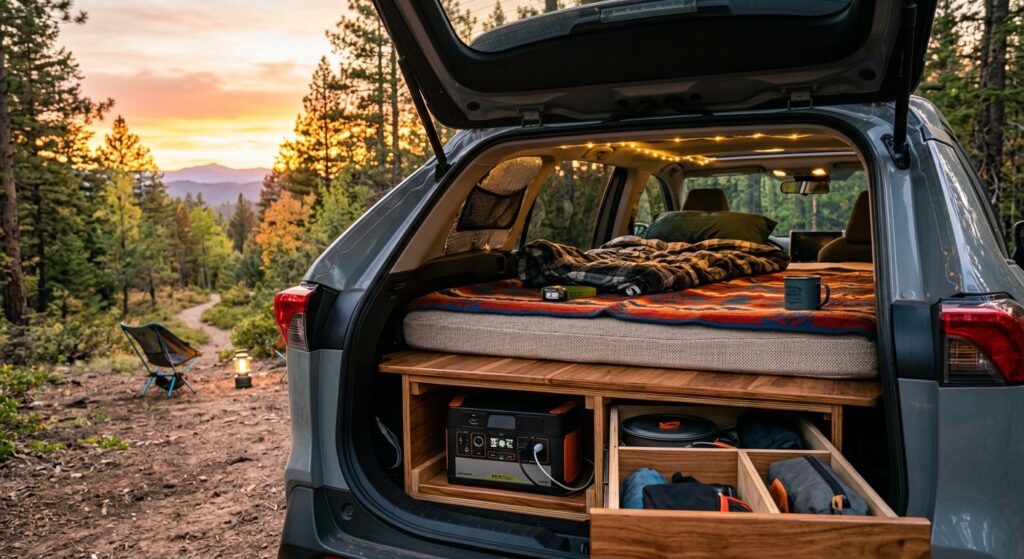
Answering exactly why does my 12v fridge drain my suv battery overnight is a vital troubleshooting step for any overlander planning a vehicle-based off-grid camping setup. I learned this lesson the hard way during my second overlanding season in Idaho’s backcountry. I built a simple plywood sleeping platform in my 2018 Subaru Outback, plugged my Alpicool C15 portable compressor fridge directly into my cargo area’s 12V port, and went to sleep under my platform. At 5:00 a.m., I turned the key to start my engine.
Nothing happened except a series of rapid clicks. My starter battery was completely flat.
If you are planning an SUV bed-camping build, isolating your camp accessories from your starting battery is crucial. This comprehensive guide uses our standardized troubleshooting framework to explain why compressor fridges quickly drain starting batteries, review real-world summer power logs, and outline the 3 best fixes to keep your battery bank healthy and your engine ready to start.
Why Does My 12V Fridge Drain My SUV Battery Overnight: Sizing Your Starting Battery Capacity Limits
To accurately calculate your system limits, we must measure the exact amp-hour consumption of your fridge against your battery’s chemical capacity.
A standard 12V portable compressor fridge (such as the Dometic CFX3 45 or Alpicool C15) pulls an average of 1.5 to 2.0 Amps of current in moderate 75°F (24°C) weather.
Here is how different battery types handle this load over a 24-hour cycle:
| Battery Chemistry & Sizing (12V) | Rated Capacity (Ah) | Safe Depth of Discharge (DoD) | Usable Capacity (Ah) | Average Fridge Runtime |
| Standard Car Starting Battery | 80 Ah | 20% Maximum (CCA Only) | 16 Ah | 8 to 10 Hours (Dead Starter!) |
| Deep-Cycle AGM | 100 Ah | 50% Maximum | 50 Ah | 25 to 33 Hours |
| Lithium Iron Phosphate (LiFePO4) | 100 Ah | 100% Regulated | 100 Ah | 50 to 66 Hours |
The “Starting Battery vs. Deep-Cycle” Capacity Trap
If you are using your vehicle’s primary starting battery to run your fridge, you cannot discharge it below 20% of its capacity without risking a complete starting failure.
Starting batteries use thin lead plates designed to deliver massive, short bursts of current (Cold Cranking Amps) to start your engine. This means your starting battery only provides 16Ah of usable power before its voltage drops below the starting threshold (12.0V). At an average draw of 1.8 Amps per hour, your 12V fridge will consume 18Ah over a 10-hour night, completely draining your starting battery and leaving you stranded in the wild. This math perfectly illustrates why does my 12v fridge drain my suv battery overnight.

Why Your Starting Battery Still Dies in a Dual-Battery Setup
Many overlanders struggle to understand how a fridge connected solely to an auxiliary battery can still drain the primary starting battery. If you’re wondering why does my 12v fridge drain my suv battery overnight even with a dual setup, this parasitic drain occurs due to two main system failures:
- The Missing (or Stuck) Battery Isolator: To charge your auxiliary battery while driving, you must connect it to your vehicle alternator’s positive terminal. If you use a simple, cheap manual switch or connect the two batteries directly with a copper cable, they will remain linked when the engine is turned off. At camp, the low-voltage auxiliary battery will naturally pull current from your starting battery to balance the voltage.
- Ignition-Sensing Delay Errors: If you use an ignition-sensing relay (solenoid) to isolate the batteries, the solenoid must disconnect as soon as the key is turned to the off position. If the solenoid gets stuck closed due to carbon arc welding on the internal contacts, the batteries will remain linked.
How Does It Work?
Understanding why does my 12v fridge drain my suv battery overnight setups requires looking at how compressor fridges pull energy. Unlike thermoelectric coolers, which run continuously and draw a constant load, a compressor fridge cycles on and off based on ambient temperatures.
- Compressor Idle State: 2.5 Watts (Control board only).
- Compressor Active State: 45 to 55 Watts (Cooling phase).
In cool 65°F (18°C) weather, the compressor might only cycle on for 15 minutes out of every hour. However, in a warm SUV cabin where the daytime heat has soaked into your vehicle interior, the compressor must run for 45 minutes out of every hour to maintain its internal temperature. This dramatic increase in “duty cycle” can cause your daily power consumption to spike from a manageable 150 Watt-hours (Wh) to a massive 480 Wh!
Real-World Example: Stranded in the Idaho Backcountry
During a summer road trip through Idaho, my Alpicool compressor fridge drained my starting battery down to 10.5V overnight. I assumed that because the fridge had an internal “battery protection” setting, my starting battery was completely safe.
However, because the protection setting was set to “Low”, the fridge continued to draw power until the battery voltage dropped to 10.5V, which is too low to start the engine. I woke up to lukewarm bacon, warm beer, and an engine that refused to turn over. I had finally learned the hard way why does my 12v fridge drain my suv battery overnight.
Mistakes That Explain Why Does My 12V Fridge Drain My SUV Battery Overnight
When planning your off-grid camping setup, overlanders often make these five common power management blunders:
- Mistake #1: Connecting Auxiliary Batteries Directly. Wiring an auxiliary battery directly to your starting battery without an isolator solenoid (VSR) or DC-to-DC charger will drain both batteries overnight, leaving you stranded.
- Mistake #2: Under-sizing the Auxiliary Wire Gauge. Using thin 16-gauge or 18-gauge wire to run power to your trunk cargo area causes massive voltage drop and heat, triggering early low-voltage fridge shutdowns.
- Mistake #3: Running Starter Batteries to 0% Capacity. Deep-discharging a standard car starting battery below 80% capacity overnight causes rapid plate sulfation, ruining its starting capacity.
- Mistake #4: Blockading Active Cooling Vents. Stashing your portable power station inside a tight cargo drawer or under luggage blocks the fan vents, causing the internal inverter to overheat and trip.
- Mistake #5: Running Small 100W Solar Panels Flat. Laying small solar panels flat on hot sand traps heat and triggers silicon’s temperature coefficient, dropping your charging output by up to 15%.
Step-by-Step Fixes to Stop the Overnight Drain
To ensure you never have to ask why does my 12v fridge drain my suv battery overnight again, apply these three quick settings modifications before your next trip:
- Install a Smart Battery Isolator (VSR): Mount a Voltage Sensitive Relay (VSR) near your primary starting battery under the hood. Run a positive red wire from your starter battery, through a 50A inline fuse, to the VSR input terminal. This ensures that when the engine stops, the batteries are unlinked, protecting your starter battery completely.
- Switch Battery Protection to HIGH: Access your fridge’s internal menu and adjust the battery protection setting to “High”. When set to High, the fridge will automatically shut down its compressor once the input voltage drops below 11.8V, preventing your starting battery from entering the deep-discharge danger zone.
- Pre-Cool on Home Utility Power: Never load warm food or warm drinks into your camping fridge. Instead, plug your fridge into your home wall outlet for 12 hours before your trip. Put pre-chilled food inside. Only plug it into your auxiliary battery once the internal temperature has fully stabilized at 36°F.
Troubleshooting Checklist
- ✓ Measure starting battery voltage (ensure it reads above 12.4V before sleeping).
- ✓ Verify your fridge’s battery protection mode is set to “High” or “Medium” if running on a starting battery.
- ✓ Inspect all inline MIDI fuses located near both battery positive terminals.
- ✓ Inspect the ground terminal (verify negative cables are bolted to clean, bare metal).
- ✓ Check for hot spots along your charging cable (warm wires indicate high resistance or under-sized gauge).
Key Takeaways
- Understanding why does my 12v fridge drain my suv battery overnight ultimately comes down to the mismatch between starting battery chemistry and continuous deep-cycle loads.
- A standard starter battery is designed only for starting bursts; deep-discharging it causes rapid sulfation.
- A 1,000Wh class battery bank (like a Jackery 1000 v2) is the ultimate sweet spot for full-time overlanding.
- Smart battery isolators (VSR) automatically unlink your batteries once the starting battery’s voltage drops below 12.8V.
- A clean, bare-metal chassis ground connection is critical to prevent electrical resistance.
FAQ
Why does my 12v fridge drain my suv battery overnight?
A standard starting battery is chemically designed only to deliver short, high-amp bursts to start your engine—not to run continuous deep-cycle loads. A standard 12V portable compressor fridge consumes approximately 30Ah to 45Ah over a 10-hour night in summer, which deep-discharges your primary starter battery below its safe starting capacity.
What is the difference between a starting battery and an auxiliary deep-cycle battery?
A starting battery is designed to deliver a massive burst of high current (CCA) to turn over your engine. An auxiliary deep-cycle battery (such as AGM or LiFePO4) is engineered to deliver a slow, stable current over many hours, and can be discharged repeatedly without damage.
How does an auxiliary battery charge while I am driving?
Your vehicle’s engine alternator generates electricity while driving. By connecting your auxiliary battery to the alternator loop via a smart isolator solenoid or a DC-to-DC charger, both batteries will charge simultaneously.
What wire gauge do I need to route power to my cargo area?
For a standard 12-to-15 foot run inside an SUV drawing 30 to 50 Amps of current, you should run a high-quality 10-gauge (AWG) or 8-gauge marine-grade copper wire with an inline fuse.
Is LiFePO4 safe to sleep next to inside my SUV cabin?
Yes. Lithium Iron Phosphate (LiFePO4) chemistry is highly stable, non-flammable, and produces zero emissions or off-gassing, making it 100% safe to sleep next to inside your vehicle’s cabin.
Why does my smart isolator solenoid click continuously?
This “chattering” typically occurs because of high resistance in your ground connections, or because your starting battery’s voltage is dropping under load, causing the isolator to connect and disconnect repeatedly. Clean your grounds to bare metal to resolve this.
Can I run my SUV solar setup with a roof-mounted panel?
Yes, but roof-mounted rigid glass panels increase wind resistance, lower fuel economy, and cannot be easily angled toward the sun. Ultra-compact folding panels stored in your trunk are highly recommended.
How much power does a 12V compressor fridge use per hour?
In moderate weather (75°F), a standard compressor fridge pulls about 45W-55W when the compressor is actively running, and around 2W-3W when idling. On average, it consumes between 15Wh and 25Wh per hour.
To build a fully integrated off-grid electrical setup inside your vehicle, navigate through our comprehensive, interconnected technical series:
- Pillar Blueprint: The Ultimate Guide to SUV Bed Camping & Off-Grid Solar Power — Sizing batteries, calculating load, and wiring panels.
- Part 1 (RAV4 Fits): Which Power Station Fits Your RAV4 Bed Platform? — Sizing guidelines and clearances.
- Part 2 (Moab Fridge Test): Why Did My 12V Fridge Kill My Portable Power Station Overnight? — Compressor spikes and settings.
- Part 3 (Cigarette Lighter): How to Fix Slow Cigarette Lighter Charging Limits When SUV Camping — Alternator bottlenecks and step-up converter runs.
- Part 4 (Hot Car Battery): Is It Safe to Leave Lithium Batteries in a Hot Car Trunk? — Real-world cabin temperature data and tips to shield your cells from degradation.
- Part 5 (Solar output): Why Folding Solar Panels Deliver Half Their Advertised Output in Summer — Understanding heat coefficients, sun angles, and series wiring.
References & External Citations
To ensure your overlanding setup is built safely, we highly recommend reviewing the technical specifications and chemical limits provided by industry leaders:
- Understanding Battery Sulfation: To learn exactly why deep-discharging your starting battery ruins its internal lead plates, read Optima Batteries’ technical guide on What is Battery Sulfation.
- Compressor Amp Draw Specifications: For accurate power consumption benchmarks of high-end 12V compressor units, review the technical spec sheets for models like the Dometic CFX3 Series Electric Coolers.
- Lead-Acid Chemistry Constraints: For a deep dive into the chemical differences between starting batteries and deep-cycle applications, refer to the foundational data on Lead-Acid Battery Mechanics.