
If you’re wondering whether do power stations overheat in summer suv camping trips, here’s the brutal reality: a closed vehicle cabin can easily blast past 140°F (60°C) in under an hour.
I ran into this exact headache during my first summer road trip through Moab, Utah. The daytime heat was a sweltering 98°F (37°C). I wanted to hit the trail for a 4-hour hike, but I was terrified that leaving my $700 portable power station locked inside my RAV4 would trigger a thermal shutdown or, worse, permanently kill its capacity.
If you’re building out a rig for off-grid camping, managing heat is just as crucial as measuring your sleeping platform. Portable lithium setups are highly sensitive to thermal extremes. In this guide, we’ll break down the actual thermal limits of lithium cells, look at my real-world cabin temperature logs, and dive into 3 safe cooling hacks to safeguard your gear in the wild.

Moab Desert 120-Minute Experiment
To get some real numbers and see exactly when and how do power stations overheat in summer suv camping setups, I parked my 2020 Toyota RAV4 in direct sunlight on a clear, 85°F (29°C) summer afternoon—windows rolled up, engine off, and zero AC running.
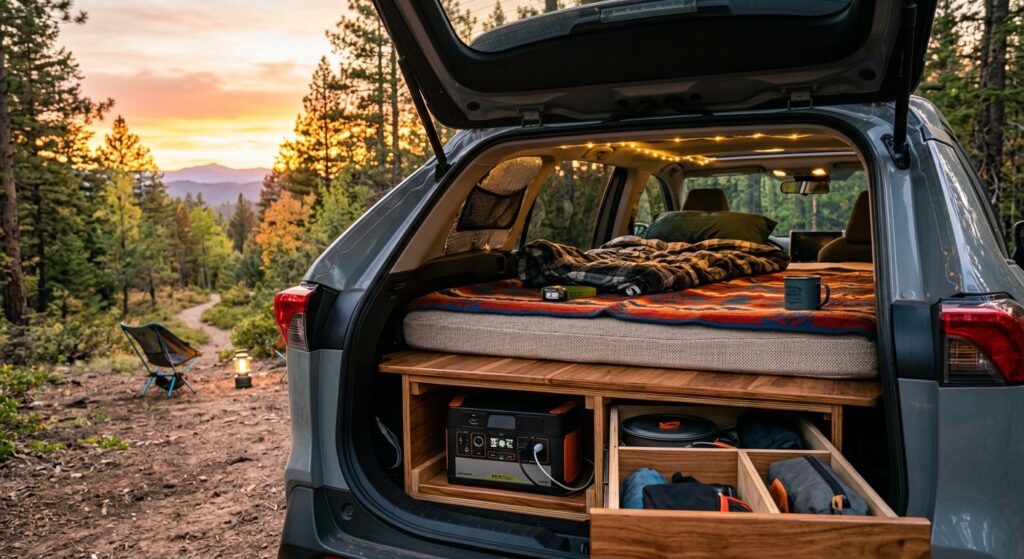
Then, I routed four digital thermometer sensors to a Bluetooth logger to track how fast the cabin turned into an oven every 15 minutes. One sensor was placed directly on the dashboard, one on the rear cargo floor underneath my plywood sleeping platform, one inside a dry insulated cooler, and one monitored the outside ambient air.
Here is the exact temperature log showing how rapidly cabin heat can spike:
| Exposure Time (Minutes) | Outside Temp | Front Dashboard (Direct Sun) | Rear Cargo Floor (Under Platform) | Inside Insulated Cooler |
| 0 Minutes | 85.0°F | 85.0°F | 85.0°F | 72.0°F |
| 15 Minutes | 85.0°F | 108.0°F | 92.0°F | 72.2°F |
| 30 Minutes | 85.0°F | 124.0°F | 102.0°F | 72.5°F |
| 45 Minutes | 85.0°F | 131.0°F | 108.0°F | 72.8°F |
| 60 Minutes | 85.0°F | 138.0°F | 114.0°F | 73.1°F |
| 90 Minutes | 85.0°F | 142.0°F | 118.0°F | 73.6°F |
| 120 Minutes | 85.0°F | 145.0°F | 122.0°F | 74.0°F |
Key Takeaways from the Test
- The Dashboard Danger Zone: Within one hour, any electronic device left on your dashboard or passenger seat will reach 138°F (59°C). This is hot enough to cause permanent physical damage to LCD screens and circuit boards.
- The Trunk Is Not Safe: While the area under my custom plywood sleeping platform was cooler than the dashboard, it still hit 114°F in one hour and 122°F in two hours. This completely violates the safe 113°F charging threshold for LiFePO4 batteries.
This experiment proves that you must never leave lithium batteries in a hot car environment without applying active insulation or ventilation.
Why High Cabin Heat Degrades Your Battery Investment
To understand why summer heat is so dangerous, we must look at the internal chemical structure of modern portable power stations. High-quality batteries (like the Jackery Explorer 1000 v2 or EcoFlow Delta 2) use Lithium Iron Phosphate (LiFePO4) chemistry, while older, cheaper units use standard Lithium Nickel Manganese Cobalt (NMC) chemistry.
While LiFePO4 cells are highly stable and chemically safe inside your rig, both chemistries experience severe physical issues under high temperatures:
Accelerated SEI Layer Growth
High heat causes rapid growth of the Solid Electrolyte Interphase (SEI) layer inside the cells. This layer is a protective film that forms on the anode during initial cycles. However, sustained temperatures above 113°F (45°C) cause this layer to grow too thick. This process permanently locks away active lithium ions, reducing your total storage capacity by up to 20% in a single season.
Thermal Safety Shutdowns
All quality portable power stations feature a built-in Battery Management System (BMS) that automatically cuts off all inputs and outputs once internal cell temperatures hit 113°F (45°C) for charging or 131°F (55°C) for discharging. If your battery triggers a high-temperature shutdown, your 12V portable fridge will cut out immediately, spoiling your food.
If you want to understand how this thermal stress impacts your power setup under a platform, navigate to our Internal Hub Guide: Do Power Stations Overheat in Summer SUV Camping Ecosystems? to review the baseline rules.
Electrolyte Decomposition
In extreme cases where temperatures exceed 140°F (60°C), the liquid organic electrolyte inside NMC batteries can begin to decompose, releasing volatile organic gases. This causes the cell casings to swell, ruining the internal contacts and creating a potential safety hazard inside your vehicle cabin.
The Chemical Physics of Thermal Runaway
⚠️ Critical Safety Warning for Overlanders
Many overlanders frequently ask do power stations overheat in summer suv camping setups, and the core of this question usually centers around catastrophic fire safety concerns. To solve this dilemma, we have built an internal troubleshooting network. You can explore our related analysis onwhy your 12V fridge kills your portable power station overnightto safeguard your complete setup.
In traditional NMC batteries, the cathode material begins to decompose at approximately 140°F (60°C), releasing oxygen gas into the sealed cell. This oxygen reacts violently with the organic liquid electrolyte, causing rapid self-heating. Once self-heating begins, the temperature spikes to over 900°F (482°C) within seconds, resulting in a toxic, hard-to-extinguish fire.
On the other hand, LiFePO4 batteries feature incredibly strong covalent bonds between the phosphorus and oxygen atoms. The good news? The cathode won’t start releasing oxygen until it hits a scorching 212°F (100°C). This massive thermal stability is exactly why LiFePO4 is the only chemistry you should trust inside a closed vehicle cabin. But remember: even if your LiFePO4 pack doesn’t catch fire, baking it in summer heat will still quietly ruin its overall lifespan.
3 Physics-Backed Methods to Keep Your Battery Bank Cool
If your travel itinerary requires you to leave your vehicle parked in the sun for several hours, use these three professional methods to ensure your do power stations overheat in summer suv camping worries don’t become a costly reality:
Method 1: Move to the Passenger Footwell (Stash it Low)
During peak summer, heat naturally rises to the top of your rig, and direct sunlight beaming through the windshield creates a massive greenhouse effect. Unplug your power station from your sleeping platform and slide it down onto the front passenger footwell floor. Push the passenger seat all the way up to block direct sun rays coming through the side glass. The floorboard can run up to 20°F cooler than the dashboard or your elevated cargo deck.
Method 2: Deploy Reflective Window Covers (Block Solar Gain)
Direct solar gain is the single largest contributor to extreme cabin heat. Cut a set of custom reflective window covers using double-sided Reflectix material. Install these covers in your windshield, front passenger windows, and cargo area glass whenever you park at a trailhead. These covers bounce solar radiation directly away from your vehicle, lowering internal cabin temperatures by up to 15°F over a three-hour period.
Method 3: Store in a Dry Insulation Cooler (Build a Thermal Shield)
If you are leaving your vehicle for an extended period, you can use a high-end roto-molded cooler (like a Yeti or RTIC) as a thermal barrier. Ensure the inside of the cooler is completely dry. Do not add ice or cold packs. Lay a thin towel at the bottom, place your portable power station inside, and close the heavy-duty latches. The thick polyurethane walls of the cooler will prevent the extreme cabin heat from penetrating your battery’s core cells for up to 8 hours.
Technical Audit: Identifying Potential Overheating Hazards
When evaluating your electrical configuration, you must identify and eliminate potential thermal hazards. Always monitor these critical safety boundaries during your summer overlanding trips:
- Cooling Vent Obstruction: Always maintain at least 3 inches of open clearance around the active fan vents of your power station. If you pack sleeping bags or luggage tightly against the vents, the internal inverter will overheat and trigger an E02 overload code within 15 minutes of running a load.
- Direct Solar Gain: Never allow sun rays to shine directly through your vehicle’s glass onto the black casing of your power station. Black plastic absorbs solar radiation at an extreme rate, driving cell temperatures up to 30°F higher than the surrounding ambient air.
- Charging While Hot: If your power station has been sitting in a hot cabin, do not plug in a 200W solar panel immediately. Allow the battery to cool down in the shade or run your car’s air conditioning for 10 minutes first. Charging a hot battery accelerates cell degradation. If you notice your charging input is lower than expected during hot days, check out our analysis on why folding solar panels deliver half their output in summer to optimize your solar gain.
Choosing a Heat-Resistant Power Station: What to Look For
If you are shopping for a battery bank and want to optimize for hot conditions, look for these specific thermal management features:
- Active Cooling Ventilation: Ensure the unit uses high-CFM (Cubic Feet per Minute) temperature-controlled forced-air fans. Some premium heavy-duty units feature advanced internal aluminum heat sinks or heat pipes that transfer thermal energy away from the core cells much more efficiently than basic plastic housings.
- BMS Sophistication: Look for a regulated Battery Management System that monitors multiple individual cell temperature zones rather than relying on just a single sensor on the main circuit board. A quality BMS prevents localized hot spots from damaging individual cells.
- LiFePO4 Chemistry: As discussed, LiFePO4 has a thermal runaway threshold of 212°F (100°C), making it vastly safer than older lithium-ion chemistries inside a warm vehicle cabin. If you are still trying to figure out your spatial layout, dive into our technical guide on which power station fits your RAV4 bed platform to balance battery capacity with ventilation clearance.
The SUV Bed-Camping Power Series
To build a fully integrated off-grid electrical setup inside your vehicle, navigate through our comprehensive, interconnected technical series:
- Core Pillar Guide: The Ultimate Guide to SUV Bed Camping & Off-Grid Solar Power — Our complete master blueprint for sizing batteries, calculating load, and wiring panels.
- Part 1: Which Power Station Fits Your RAV4 Bed Platform? — Prevent rear tailgate latch damage and water leaks by choosing a battery under 9.0 inches.
- Part 2: Why Did My 12V Fridge Kill My Portable Power Station Overnight? — Master compressor duty cycles and avoid dead battery surprises at camp.
- Part 3: How to Fix Slow Cigarette Lighter Charging Limits When SUV Camping — Move beyond the slow 80W dashboard charge limit with specialized heavy-gauge charging
External Technical References
- Battery University: Charging Lithium-ion at Extreme Temperatures
- National Highway Traffic Safety Administration (NHTSA): Vehicle Cabin Heat Logs