

Analyzing what size power station fits in a rav4 bed build is a critical first step before spending your hard-earned money on gear. I spent $899 on an EcoFlow Delta 2, built a gorgeous birch sleeping platform in my 2020 RAV4 Hybrid, and assumed everything would fit. On night three of my road trip, I went to shut the tailgate. The latch wouldn’t click. The battery was half an inch too tall. Consequently, the cargo light stayed on, draining my starting battery by morning. I had to sell the Delta 2 on Facebook Marketplace for $650, losing $249 in the process.
If you are planning a DIY bed-camping build, the cargo area geometry of fifth-generation (2019–2024+) Toyota RAV4s is completely unforgiving.
This hands-on fitment guide breaks down the raw cargo dimensions, tests six popular power stations, and explains the woodworking modifications required to fit a large battery bank safely.
Fifth-Gen RAV4 Cargo Height Limits
To find out what size power station fits in a rav4 bed build, we must calculate the exact space between the folded seat back and the closed rear glass.
I took these measurements in my 2020 Hybrid Limited. While gas-only or Adventure trims might vary by $\pm0.3$ inches, the structural limits are identical.
- Raw Floor-to-Ceiling Height (Seats Folded): 15.0 Inches
- Subtract: Inflated Luno Life 2.0 Air Mattress: -4.0 Inches
- Subtract: 3/4-inch Birch Plywood Platform: -0.75 Inches
- Subtract: Tailgate Latch Gasket Compression Buffer: -1.2 Inches
- The Net Limit: 9.0 Inches of Maximum Battery Height
Why Mattress Compression is a Dangerous Myth
Many DIYers assume that because an adult’s body weight compresses a 4-inch air mattress by 1.5 inches, they can squeeze a 10-inch battery underneath. This is a massive mistake.
The mattress does not compress in mid-air over your storage compartment. A battery taller than 9.0 inches acts as a hard pivot point. The mattress will bulge upward, putting high mechanical tension on your rear tailgate door latch and hinges. Over time, this tension misaligns the rear door, leading to rainwater leaks through the rubber seals.
6 Power Stations Tested: Will They Fit in Your Rig?
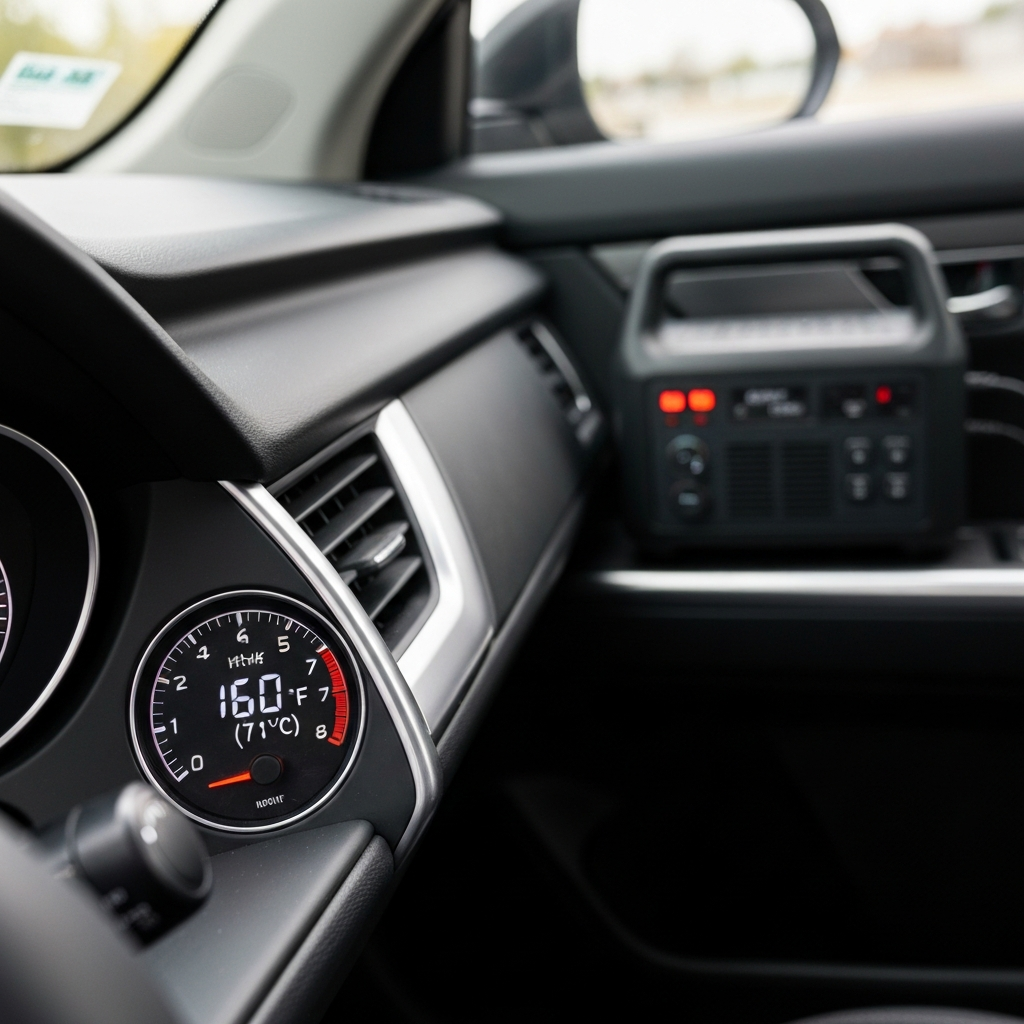
I loaded six different portable battery banks into my RAV4 cargo bay to test how they align under a standard 9-inch plywood platform.
1. Jackery Explorer 300 (6.5″ Tall)
Fits perfectly with a generous 2.5-inch clearance gap. Best for minimalists running phone chargers and LED string lights. It weighs only 7.3 lbs, making it incredibly easy to pull out and charge in the front seat.
2. Jackery Explorer 500 (7.3″ Tall)
Fits easily with a comfortable 1.7-inch clearance. Slide it in and out of the rear passenger footwell with ease. This has been the standard recommendation for casual weekenders for years because of its rugged handle and dependable output.
3. EcoFlow River 2 (8.7″ Tall)
Fits tightly with a slim 0.3-inch safety buffer. This is the largest no-modification battery bank available. It charges incredibly fast from an AC outlet, making it a great choice for quick turnarounds between weekend trips.
4. Jackery Explorer 1000 v2 (9.7″ Tall)
Violates the 9-inch rule. It hits the plywood deck unless you construct a lower mounting recess. However, at 25.4 lbs, it is the performance sweet spot for running a compressor fridge and charging laptops, making a platform modification well worth the effort.
5. BLUETTI AC180 (11.6″ Tall)
Too tall. It completely blocks the mattress and prevents the tailgate latch from engaging. At 35.3 lbs, it is also highly unwieldy to handle inside a tight vehicle cabin. If you happen to build out a larger setup down the line, you might look at options like portable power for Wrangler overnight camping which accommodate these taller square shapes much better.
6. EcoFlow Delta 2 (12.2″ Tall)
My expensive $249 mistake. Totally incompatible with standard under-platform layouts. It blocks the trunk latch completely and causes rainwater leaks due to forced tailgate closure.
How to Fit a 1,000Wh Battery: The 2-Inch Drop-Box Hack
If you run a 12V compressor fridge, a 500Wh battery (like the Jackery 500) is simply too small. For instance, you can read our deep dive on why does my 12V fridge drain my Jackery overnight to see exactly how a compressor fridge consumes 430–480Wh in summer, draining a small battery in less than a day.
You need a 1,000Wh unit like the Jackery 1000 v2. However, at 9.7 inches tall, it exceeds our vertical threshold. To solve this, you can build a lower wooden recess pocket:
Plywood Platform Recess Profile:

[Mattress (Flat)] ──> ═══════════════════════ [Platform Deck]
                        │               │
                        └─[ Lowered ]───┘ <─── Drop-Box (lowers battery by 2")
1.Mark Your Lines:5 min.
Place your platform deck on sawhorses. Trace a 14″ x 10″ rectangle on your plywood deck directly over the passenger-side cargo floor near the rear wheel well bulges.
2.Cut the Deck:5 min.
Use a jigsaw to carefully cut out the marked 14″ × 10″ rectangular opening in your 3/4″ plywood sleeping deck.
3.Build the Drop-Box:10 min.
Underneath the newly cut opening, screw and wood-glue 1×2 pine structural support strips around the perimeter. Mount a scrap piece of 1/2-inch plywood to the bottom of these strips.
4.Drop-In Placement:2 min.
Drop your Jackery 1000 v2 into the drop-box. This lowers the battery’s resting point by 2 inches, keeping the top of the battery completely flush with the platform deck.
- Cost: ~$8 in scrap lumber
- Time: 20 minutes
- Result: Perfect tailgate latch clearance and twice the overnight battery capacity!
Alternatives If You Already Own an Oversized Power Station
If you already own an EcoFlow Delta 2 or BLUETTI AC180, do not force them under your sleeping platform. Instead, apply these layout workarounds:
- Move to the Front Footwell: Place the heavy battery on the front passenger-side footwell floor. Route a heavy-duty, 12-gauge DC extension cable underneath your floor mats back to your fridge.
- Rooftop Box Storage: Mount the battery inside a weather-resistant rooftop cargo box and run your cables through the door seals. However, be careful—extreme summer temperatures inside a black cargo box can degrade your battery cells.
- Downsize on the Used Market: Sell your oversized battery on local marketplaces and buy a Jackery Explorer 1000 v2. Saving $100 on a used sale is far cheaper than repairing a bent rear vehicle tailgate.
Sizing Your Solar Panels to Match Fridge Draws
If you want your off-grid system to run forever, you must pair your battery bank with the correct solar replenishment pathway. During summer overlanding trips, a 12V fridge consumes approximately 450Wh per day.
To keep up with this load, a 100W solar panel is barely sufficient. On hot days, monocrystalline cell temperatures climb to 144°F (62°C), reducing real-world output from 100W to just 50W due to silicon’s temperature coefficient ($-0.39\%/\text{°C}$). Consequently, you will only harvest about 300Wh of power during a standard 6-hour sunny window, leaving you in a daily energy deficit.
To stay completely off-grid, we highly recommend using a 200W folding solar blanket. This delivers a stable 110W to 130W of real-world power, harvesting over 700Wh per day—more than enough to run your fridge, charge your electronics, and fully top off your battery before sunset.
Sizing Your Summer Overnight Power Budget
To successfully understand how to run your off-grid rig in summer, you must calculate your exact power consumption over a standard 10-hour sleeping window (from 9:00 p.m. to 7:00 a.m.). For a deeper breakdown on cooling hardware strategies, look over our practical guide on how to run fridge and fan all night in summer SUV camping.
Let’s look at the real-world hourly consumption of both appliances in a warm 80°F (27°C) vehicle cabin:
1. The 12V Compressor Fridge
- Average Running Wattage: 18 Watts per hour.
- 10-Hour Consumption: 180 Watt-hours (Wh).
- Note: If the cabin starts warm, the compressor’s duty cycle rises, causing this consumption to spike to 250Wh. If you run into issues with the system cutting off early, check out our guide on how do I stop my fridge from killing my power station overnight to recalibrate your voltage levels.
2. The 12V or USB Cabin Fan
- Average Running Wattage: 12 Watts (running on medium speed).
- 10-Hour Consumption: 120 Watt-hours (Wh).
3. Total Combined Overnight Load
$$180\text{ Wh} + 120\text{ Wh} = 300\text{ Wh (Direct DC Consumption)}$$
Adding Laptop/Phone Charging Buffer:
$$300\text{ Wh} + 100\text{ Wh} = 400\text{ Wh}$$
Since a 500Wh power station (like the Jackery 500) only provides about 430Wh of usable power due to the 15% BMS safety cutoff, running both appliances along with charging a phone will empty your battery before sunrise. Consequently, you must use a 1,000Wh class power station to enjoy a comfortable, stress-free night.
The SUV Bed-Camping Power Series
To build a fully integrated off-grid electrical setup inside your vehicle, navigate through our comprehensive, interconnected technical series:
- Core Pillar: The Ultimate Guide to SUV Bed Camping & Off-Grid Solar Power — Our complete master blueprint for sizing batteries, calculating load, and wiring panels.
- Part 1: Which Power Station Fits Your RAV4 Bed Platform? [You Are Here]
- Part 2: Why Did My 12V Fridge Kill My Portable Power Station Overnight? — Discover the truth behind compressor cycling, voltage sag, and low-voltage protection settings.
- Part 3: How to Fix Slow Cigarette Lighter Charging Limits When SUV Camping — How to bypass factory 10A car fuses using DC step-up chargers or heavy-gauge engine runs.
- Part 4: Is It Safe to Leave Lithium Batteries in a Hot Car Trunk? — Real-world cabin temperature data and tips to shield your cells from degradation.